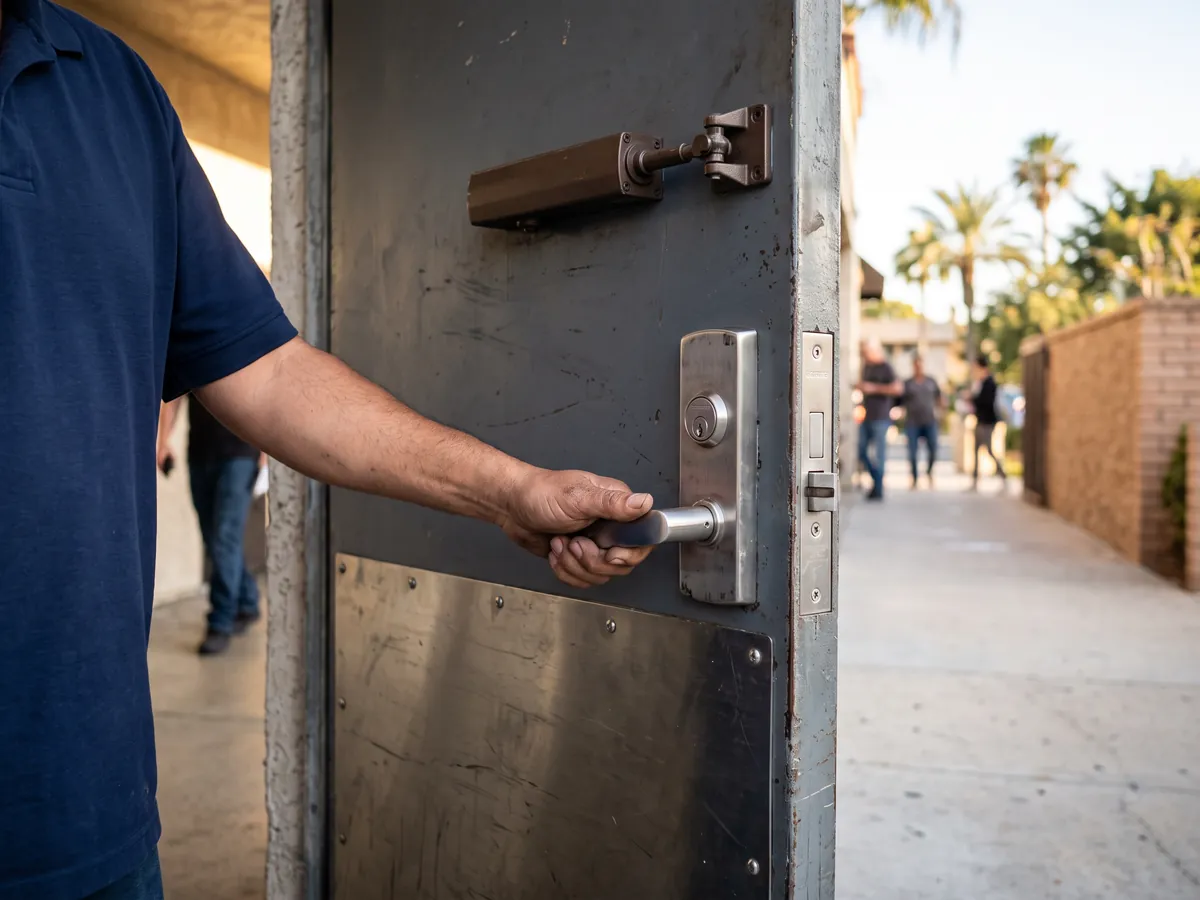
Stanton, Orange County
Exit Device Installation in Stanton
Short answer: What decides an exit device installation is the door, not the device. Steel, wood or aluminum, a single leaf or a pair, a fire label or none, key entry from outside or exit-only: each answer changes the hardware and the prep. In Stanton, call (951) 903-3193 with those answers or a few photos and we'll tell you what fits.
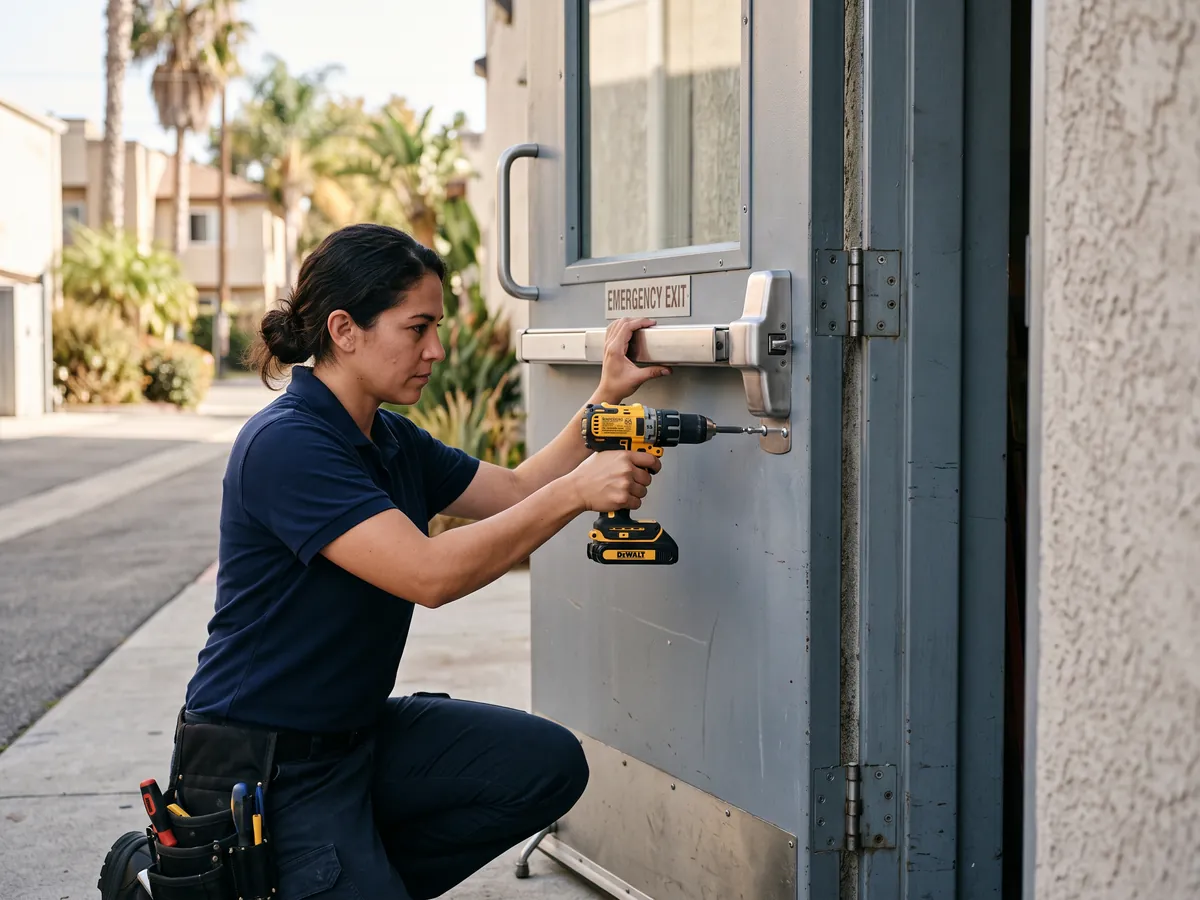
Every so often a shop owner in Stanton chains the back door after a break-in scare. It feels secure, and it's one of the first things a fire inspector writes up, because the same chain that slows a burglar also traps your crew if there's smoke. A properly installed exit device fixes both problems: the door opens with one push from inside and, with the latch fully engaged, resists entry from outside. Julian's Locksmith installs exit devices on steel, wood and aluminum doors, and can add outside trim, a keyed cylinder or a door contact where the layout calls for it. Call (951) 903-3193 to talk it through.
How this works in Stanton
An exit device is a system of parts that only works when the door around it cooperates. On the inside face sits the case, which holds the latch mechanism, and the push pad or crossbar you press to retract it. A rim device carries a latch that grabs a strike on the frame. A vertical rod device runs rods up and down to catch the header and the floor. A mortise device drops a lockbody into a pocket cut in the door's edge. The device is held to the door with through-bolts or sleeve bolts that pass from one face to the other, which is why the door's internal reinforcement matters so much. Outside you may find nothing at all, or a pull, a thumbpiece or a lever with a cylinder. The closer, hinges and strike complete the system. If the closer lets the door drift, the hinges have sagged or the strike sits a quarter inch off, the best device in the catalog will still fail. In Stanton we inspect every one of those parts before installing anything, because they decide whether the new hardware works for years or sticks within a month.
What we can do on-site
- Function and trim selection. A delivery door that staff open from the lot at dawn needs different trim than a stairwell exit that should never admit anyone. We match the function to the job the door really does, then confirm the lever, pull or plate style meets the accessibility needs of the space.
- Door preparation for steel, wood and aluminum. Old preps are the hidden work in retrofits. A door that held a lever lockset has holes in the wrong places, and one that held another exit device has a different pattern. We use filler plates, cover plates and fresh templates so the finished door looks planned rather than patched.
- Replacing a worn device with a different series. Switching from a discontinued or worn device to a new brand is common. We match the door's existing prep where possible, using adapter or filler plates, and mount the new case so the old holes don't show. Sometimes a current model from the same maker is a simple swap.
- Electrified options and access-control tie-ins. If you want a card reader or keypad to release the outside trim, or the alarm panel to know when the door opens, the exit device can carry the electronics: electric trim, a request-to-exit switch or electric latch retraction. We install the device; low-voltage wiring and power may involve your access-control contractor.
- Final adjustment, testing and documentation. The last step is a short walkthrough of living with the new hardware. We show you where to look when the door sticks, who should hold the dogging key and what a monthly test looks like. A short talk now often saves a repair call months from now.
What's different about Stanton
Warehouses and tilt-up industrial buildings in Stanton usually have steel man doors beside roll-up docks, with forklifts and pallet jacks passing close to the frame. Those doors take abuse, so we favor Grade 1 devices, heavy-gauge strikes and a closer sized for a door that gets shoved open by a loaded cart. Our survey includes checking the frame for impact damage, because a device screwed into a bent frame never latches cleanly, however good the hardware is.
Apartment complexes in Stanton have stairwell, laundry, trash-room and roof-access doors, each with its own exit hardware and its own wear. Property managers usually want one series across the property, with a shared maintenance key and a parts list they can hand to any technician. We phase the work building by building, check each door for a fire label before touching it and keep a record of what went where.
Older neighborhoods in Stanton are full of converted houses and small buildings turned into offices, clinics and child-care centers. Those doors are often thin wood with plaster-and-lath walls around them, and nothing about them was designed for panic hardware. We check the door thickness and blocking first, then choose a device that fits or tell you plainly what the opening needs, whether that is reinforcement, a new door or a different approach to egress.
Situations this covers
- A community center near Stanton Family Resource Center replaces a pair of aging double doors. The board asks whether the old rods can be reused on the new leaves. We explain that reuse usually costs more labor than it saves, install new devices on both leaves and add a coordinator so the pair latches in the right order, with the active leaf closing last.
- An example from a small precision machine shop in Stanton: the only rear door is a steel leaf with a surface bolt added after a break-in. The owner wants the crew to leave quickly and a delivery driver to enter with a key. We install an exit device with a key-retractable outside lever, remove the bolt, and rekey the cylinder to the shop's existing keys.
- Picture a rental event hall near Stanton Library with a side patio door that still has a thumbturn deadbolt. The owner wants guests to walk out freely but not wander in without paying. We fit an exit-only device with a fixed pull plate outside, add a door position switch so the alarm panel notices when it opens, and show the manager how to check the latch before each event.
- A property manager in Stanton oversees six apartment buildings whose stairwell doors each carry a different brand of exit device, and parts for two of the brands are hard to find. Over several visits we replace them with a single series keyed to one maintenance key, checking each door for a fire label as we go. The manager ends up with one parts list instead of six.
From your call to the finished job
- Walk the openings. We visit the property, look at every door in scope and measure the details that decide the hardware: handing, thickness, width, frame type, rating label, existing preps and floor condition. Photos go into your job file so everyone works from the same facts, including your contractor and inspector.
- Choose the hardware and approve the quote. With measurements in hand we recommend a device, trim and cylinder, and explain the alternatives in plain language. You get a quote for parts and labor before any work begins, and nothing is ordered until you approve it. If a door needs repair first, that appears as its own line.
- Stage the parts and plan the day. Before ordering, we confirm the device length against the door width, the trim hand and the rod lengths against door height. A device ordered an inch too long, or with the wrong hand, costs you a second trip and often a day, and a rushed inspection date makes that hurt more.
- Prepare the door and frame. We mark the template, drill and cut the door, install reinforcement or sleeves where the door needs them, and prep the frame for the strike. Cut edges get touched up so bare metal doesn't start rusting, and the template is checked twice before the first hole is drilled.
- Mount, align and connect. The device goes on with its through-bolts, the latch and strike are aligned, rods are cut to length and the trim is attached. We set the strike so the door latches without slamming and the pad travels freely, then check that nothing rubs or drags along the frame.
- Test, document and hand over. We test the device the way an inspector would: pad pressure, latch engagement, mounting height, pad length, trim operation and any alarm. Then we walk the finished door with you, show you how the hardware should feel when it's working properly and answer questions.
How we quote the job
- How many doors, and how alike they are. One exit device on one door costs more per door than ten devices on matching doors, because the survey, setup, travel and cleanup get shared across the group. Tell us the count and whether the doors are identical, and we quote on that basis. Even a rough tally from a walkthrough helps us price fairly.
- Lead time and special orders. If an inspection date is on the calendar, tell us. Choosing in-stock hardware to make that date sometimes beats waiting for a preferred finish. Cost follows the choice you make, and we'll lay out both versions so you can decide between speed and an exact match with the neighboring doors.
- Electrified hardware and other trades. Electric trim, request-to-exit switches and electric latch retraction add parts, testing and often a power supply and a wire run through the frame. When access control or a fire-alarm panel is involved, other trades may bill separately for their part, and the whole schedule depends on their availability too.
Every job gets a clear quote before any work starts. Call (951) 903-3193 with the details and we'll tell you what to expect for your situation in Stanton.
What to do before we arrive
- Send us the hardware schedule as soon as plans are approved. Rated and electrified devices can take weeks to arrive, and an early order lets us hold your installation slot instead of squeezing the work into the week before an inspection. Early planning is the cheapest protection against a rushed, mismatched order.
- Check which way the door swings. Doors serving larger rooms are generally expected to swing in the direction of exit travel, and hardware alone can't fix a door that swings the wrong way. If yours swings in, raise it with your plan checker before ordering anything, because the answer may change the whole scope.
- If an architect or hardware consultant prepared a hardware schedule, send us the page for your doors. When what arrived on site differs from the schedule, fixing it before installation day costs far less than discovering the mismatch with the door already cut. We'll compare the two lines before anyone drills.
- Decide the cylinder question early. If the outside trim takes a key, tell us which keyway or master key system the building uses and who should hold keys. It is much simpler to order the right cylinder once than to rekey the door after it's installed, and it keeps your key records clean.
Mistakes to avoid
- Forcing a new case onto the old prep with washers, shims or oversized screws. A case that doesn't seat flat twists, binds the pad and wears out early. Proper filler plates and a fresh template take a little longer on installation day and last for years longer than a quick workaround.
- Laying new flooring after the device is set. A thicker floor raises the finished surface, and the door may then drag, a bottom rod may miss its strike or the latch may no longer line up. Finish the floor first, or plan an adjustment visit once the new surface is in.
- Cutting a labeled fire door yourself. A hole saw in a rated door can void its label, and labeled doors permit only limited field changes. Have the label checked first, and choose a device whose template matches the existing prep so that the door remains the assembly the inspector expects to see.
Getting to Stanton
Stanton is about 55 miles from our San Bernardino base, roughly 60 minutes in light traffic via I-215 South through Colton and Grand Terrace to SR-91 West in Riverside, SR-91 West through Corona and Santa Ana Canyon to SR-57 South. When you call, you get an arrival estimate based on where the technician is and the traffic at that moment.
Most trips into Stanton use Chapman Avenue for at least part of the drive, and the technician keeps an eye on live traffic along the way so the arrival estimate you heard on the phone stays honest.
About Stanton: Beach Boulevard, State Route 39, is the city's main north-south artery, and no freeway runs through Stanton; Beach Boulevard connects south to the Garden Grove Freeway.
| Neighborhoods | Stanton Central Park area off Western Avenue, Date Street, Briarwood Street and Premier Park, Civic Center area along Katella Avenue, Santa Paula Street and the Family Resource Center, Hollenbeck Park area off Cerritos Avenue |
|---|---|
| ZIP codes | 90680 |
| Main routes | Beach Boulevard, Katella Avenue, Western Avenue, Knott Avenue |
| From our San Bernardino base | about 55 miles via I-215 South through Colton and Grand Terrace to SR-91 West in Riverside, SR-91 West through Corona and Santa Ana Canyon to SR-57 South, then SR-22 West (Garden Grove Freeway) to Beach Boulevard (SR-39) north into Stanton; alternate is SR-91 West to the Beach Boulevard exit in Buena Park and south on Beach, or I-10 West to SR-57 South when the 91 is jammed |
Lock or door hardware trouble in Stanton?
Call (951) 903-3193 with the address and what the door or lock is doing. We'll quote the repair before any work starts.
Frequently asked questions
How long does installing one exit device take?
A standard rim device on a prepared steel door is often a single visit. Time grows with fire ratings, aluminum storefronts, pairs, electrified hardware and doors that need repair first. We give you an honest estimate when we survey the door, and we say so if parts have to be ordered. Larger projects with many doors are planned in phases around your schedule.
Can you install an exit device on a wood door?
Yes, if the door is solid enough. Wood doors need careful boring and bolt sleeves so the through-bolts don't crush the core, and the latch edge should have solid blocking. We check thickness and condition during the survey. Thin hollow-core interior doors usually are not suitable for panic hardware and may need to be replaced before any device goes on.
What's the difference between Grade 1 and Grade 2?
Grades come from the hardware industry's testing standard for exit devices. Grade 1 is built and tested for the heaviest use, such as schools, hospitals and busy retail. Grade 2 suits lighter duty. Your specification may call for one or the other, and we'll tell you which fits your door's traffic so you aren't paying for more than you need.
What information do you need to give me a quote?
We need the door count, the material (steel, wood or aluminum), the width and thickness, whether it is a single door or a pair, any fire label, and whether you want exit-only or key-entry trim. Photos of the door, the frame and the hinge edge help a great deal. If you have a hardware schedule or an inspector's note, send that along too.
Can you install electrified exit devices?
We install the device and test the mechanical side. Electrified versions with electric trim, switches or latch retraction also need power and wiring, which may involve your access-control or electrical contractor. We coordinate on who does what, so there are no gaps when you reach the final test, and we tell you early if a low-voltage contractor is needed.
Will you install a device I bought myself?
Often yes, if it's the right model and complete. Before agreeing we look at the box and the door, since devices bought without measurements are the usual cause of problems. We can't promise a device bought elsewhere will fit your door, so sending us the model number and photos first is the safest route and costs you nothing.
How far is Stanton from your base?
Stanton is about 55 miles from our San Bernardino base, roughly 60 minutes in light traffic. Arrival time depends on traffic and on the job the technician is finishing, so we give you an estimate on the phone before you commit.
Related services in Stanton
Exit Device Installation in nearby cities
- Exit Device Installation in Garden GroveOrange County
- Exit Device Installation in CypressOrange County
- Exit Device Installation in WestminsterOrange County
- Exit Device Installation in Buena ParkOrange County
- Exit Device Installation in Los AlamitosOrange County
- Exit Device Installation in La PalmaOrange County
- Exit Device Installation in Hawaiian GardensLos Angeles County
- Exit Device Installation in AnaheimOrange County