
Rosemead, Los Angeles County
Door Latch Repair in Rosemead: Find the Real Problem
Short answer: A latch that won't catch, won't retract or sticks halfway is usually a worn or dirty latch bolt, a misaligned strike plate, or a door that has dropped on its hinges. Julian's Locksmith repairs latches in Rosemead: we clean, adjust or swap the latch assembly, then test the door repeatedly. Call (951) 903-3193 and describe what the knob feels like.
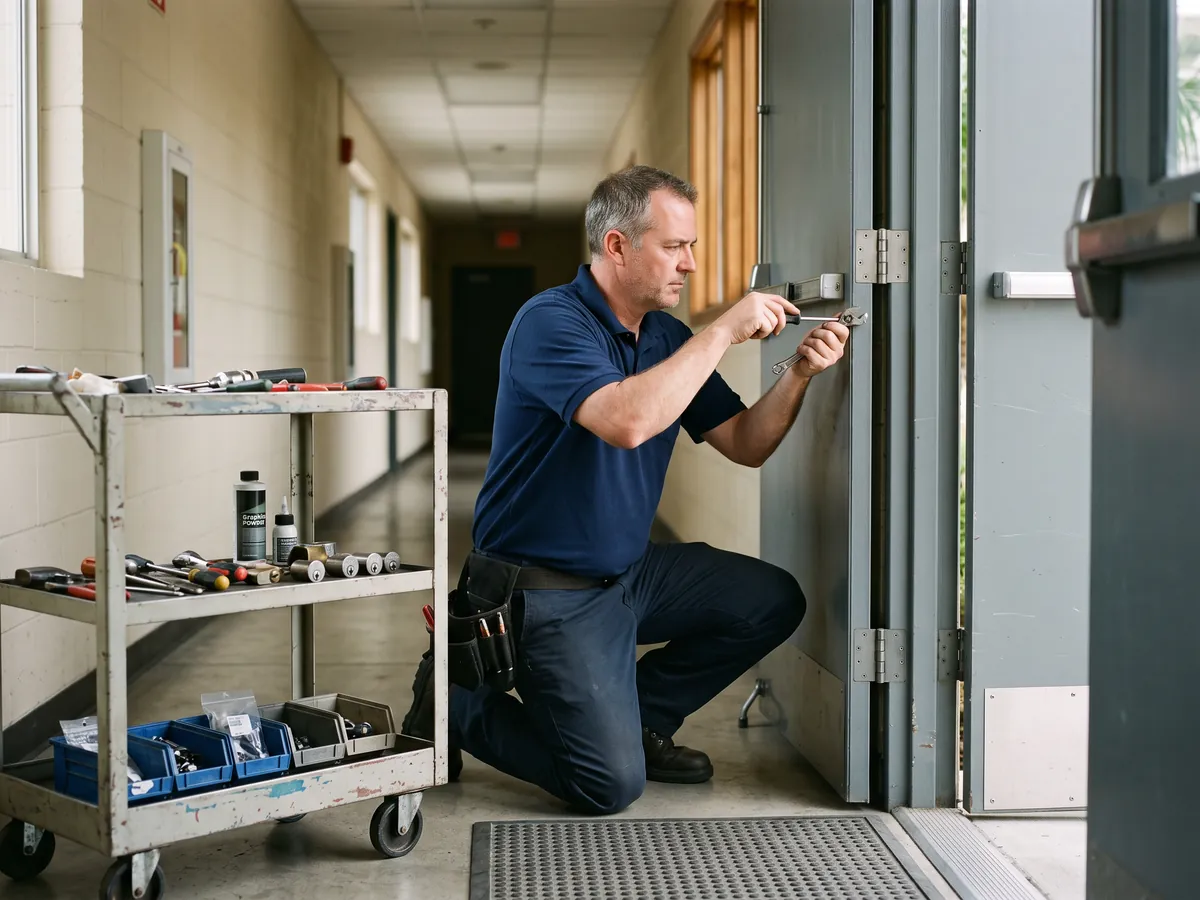
Renters and property managers in Rosemead call about latches more than you might expect. A tenant can ask the landlord in writing for the repair; a manager can send us with a work order and we treat a bedroom door as seriously as a front door. Entry doors matter most, because California Civil Code section 1941.3 expects working deadbolts on the main swinging entry doors of rentals, and a front door that won't latch properly makes the deadbolt hard to use. We confirm who authorized the work, fix the part that failed, and tell you plainly what's a repair and what's a replacement.
Latch Repair in Rosemead: what to expect
Before changing any hardware, we ask the door a few questions. Does it close if you lean on it, or only if you push? Does the tongue move freely when you turn the handle with the door open? Does it line up with the strike when you close the door slowly? Chalk or lipstick on the tongue shows where it lands, and a mark above or below the opening tells you which way the door has dropped. Uneven gaps along the top and sides reveal sagging hinges. A loose top hinge is one of the most common reasons a latch seems to fail in Rosemead, and tightening it with longer screws into the stud takes minutes. If the tongue moves freely and lands in the opening but the door still bounces open, the strike pocket may be too shallow or the weatherstripping too stiff. These checks cost nothing and keep you from buying a latch you don't need.
Work included on a typical visit
- Knobs and levers that turn without retracting the latch. Free-spinning handles are common on lever sets that were slammed or hung on, and on cheaper knobs with zinc internals. The fix depends on what snapped: a retractor, a spindle or the latch tail. We carry the common ones. If the set is discontinued, we'll suggest a close match.
- Bedroom, bathroom and closet privacy latches. Closet and laundry-room doors use plain passage latches with no lock, and they fail the same ways: tired spring, loose spindle, stripped screws. These are quick fixes, and worth doing before the knob gives out entirely and traps someone in a closet or a pantry.
- Pocket, French and patio door latches. French doors usually have an active leaf with the latch and an inactive leaf held by flush bolts or surface bolts. When the pair won't hold, either a bolt has bent or a door has sagged. We straighten or replace the bolts, adjust the hinges and make the active latch land in a firm, aligned strike.
- Screen, security and garage-entry door latches. Laundry rooms, utility closets and side-yard doors share a pattern: opened constantly, rarely maintained. A latch on a swollen exterior door may hang up in damp months and rattle in dry ones. We tune the latch, ease the door edge if needed and seal bare wood to slow future movement.
- Freeing a door that a failed latch has jammed shut. If someone is inside a room and can't get out, treat it as urgent: if there's any danger, call 911. Otherwise call us and keep talking to the person. We open interior doors by working the latch from the hall side or removing the handle, which leaves the door and frame as they were.
Local factors in Rosemead
Condo and townhome front doors often face shared corridors or HOA-controlled facades, so the exterior door, its frame and the look of its hardware may be the association's business, while interior doors are yours. Before swapping an exterior latch, check the rules on finish and brand. We can fit a matching latch inside your existing handle to avoid visible changes. Fire-rated unit doors need careful handling, and we won't drill or alter them without checking the label.
Older houses in Rosemead have doors that have been painted a dozen times and hung on hinges that have moved with the house. Latches there fail from paint layers in the strike, tongues filed to fit, and original knobs whose parts are no longer made. We try cleaning and realigning first, since original hardware is part of the home's character, and we replace latches inside old knobs where we can. Old mortise latches get their own care, and we'll tell you honestly when a part is simply gone.
Apartment doors open and close more than most, and units pass through many hands. Latches wear, strikes get painted over between tenants, and slammed doors knock hinges loose. If you rent in Rosemead, report a failing latch to your landlord in writing; for the main entry door, California Civil Code section 1941.3 covers working deadbolts. Property managers can send us with a work order, and we repair latches across several units in one visit when that saves everyone time.
Example situations
- Home sellers hit this one: an inspection report in Rosemead flags four doors that don't latch, and escrow closes soon. A locksmith can often handle every interior door in one visit by realigning strikes, swapping two dead latches and tightening hinges. We'd test the entry doors with extra care. Escrow dates are your clock, so call early; we're open every day.
- Picture a pocket door in a 1990s condo near Garvey Park and the Splash Zone. The hook latch has pulled out of the door edge, and now the bedroom door slides open whenever someone walks past. We'd cut a clean new mortise, fit a replacement hook latch and check the hanger and track. If the pull has torn the edge badly, we'd say so and suggest a carpenter.
- An example of the free-spinning knob: an older Kwikset on a hall closet in Rosemead. The knob turns, nothing moves, and the door has stayed shut for a week because nobody could get in. We'd open it by working the tongue from the edge, take the knob apart and find the retractor tab snapped. A matching latch goes in, and the same knob goes back on.
- Suppose an elderly resident of a 55-plus community in Rosemead is stuck in a bedroom because the lever handle came off in her hand. Her daughter calls from out of town. We'd take the daughter's authorization by phone, verify the resident at the door, work the latch open from the hall and repair the spindle and latch before leaving, so the door can't trap her again.
From your call to the finished job
- Tell us what the door is doing. A few details save time: how old the door is, whether it was painted recently, whether the problem is worse in the afternoon, and whether anyone has already taken the knob apart. If you have the old latch or loose screws, keep them. Give us the Rosemead address and tell us who will meet us at the door.
- Confirm who we're working for. Before opening the toolbox, we verify that you live in, own or manage the home. A lease, a utility bill, a driver's license showing the address or an authorization from the property manager all work. Interior door repairs are low risk, but we keep the same standard on every visit.
- Test the door open and closed. We also test the extras: whether a deadlatch plunger depresses, whether a privacy button releases, whether the handle returns by itself. A latch that works flawlessly with the door open can fail once the door's weight or the weatherstrip pushes back, so the closed-door test counts as much as the bench check.
- Quote the repair and the alternative. You'll hear what we found and usually two options: clean and adjust, or replace the latch. We give you the price for each before starting. A twenty-year-old knob that is rough in other ways may deserve a new lockset, and we'll say so, but you decide.
- Repair, adjust or replace the latch. The repair itself is usually short. Cleaning and lubricating a latch takes only a few minutes, and a replacement goes quickly when parts match. Door-edge damage and odd sizes add time. We carry common latches and finishes, so most doors in Rosemead can be completed during the same visit.
- Test everything and hand off. We operate the latch repeatedly, close the door gently and firmly, and test every lock function: key, button, thumbturn. Everything has to work from both sides. Then we show you what changed and leave tips on keeping the latch smooth.
How we quote the job
- Tune-up versus new latch. Some latches only need attention and others need replacing, and the diagnosis is where that gets decided. Knowing the cause up front means you don't pay for a latch when a hinge screw was the problem, or the other way around.
- Lock brand, backset and finish. Matching your lockset keeps the handle tight and the keys working. Finish adds a small factor too, since a polished brass latch edge has to match a polished brass knob. If appearance is a concern, we'll show you the replacement part before it goes in.
- Entry-door security work. If the deadlatch plunger or the strike has to be rebuilt to protect the door properly, that means additional hardware and time. A reinforced strike or a thin steel wrap around the door edge goes beyond a simple repair, and we add it only when you want it.
Every job gets a clear quote before any work starts. Call (951) 903-3193 with the details and we'll tell you what to expect for your situation in Rosemead.
Practical tips before you call
- When one latch fails from age, others of the same age and brand are close behind. Replace the worst one now and make a list of the stiff ones. Doing three together saves the setup and travel of three separate visits.
- Pocket door hooks and edge pulls sit on tiny screws in soft wood. If you hear the hook click but the door still slides open, the hold has stripped. Stop pulling on it, because the next hard tug can rip the whole pull out of the door edge.
- Save every screw, the old latch and any faceplate you remove, and bag them with a note saying which door they came from. A matching sample lets us order the exact replacement and avoids the fit problems that come with guesswork.
- Pay attention to when a door sticks. If it catches fine in the morning and binds after a hot afternoon, wood movement is involved, and the cure is alignment rather than a new latch. Telling your locksmith the pattern changes what we bring and what we try first.
Common errors that cost time and money
- Forcing a stuck door with a screwdriver, a pry bar or a shoulder. You can split the jamb, crack the strike plate and bend the latch, and the door still won't open. Working the tongue gently, or calling a locksmith, costs less than carpentry.
- Filing the latch tongue or the strike opening until the door closes. It hides the alignment problem, weakens the part and often leaves the door rattling. Find out why the two don't meet, whether that's a hinge, a swollen edge or a shallow pocket, and fix that instead.
- Replacing the whole lockset when only the latch failed. A complete new set means new keys, a different finish and sometimes mismatched backsets, all for a part that sits in a hole in the door edge. Ask for a diagnosis first and decide afterward.
Service in Rosemead
Rosemead is about 55 miles from our San Bernardino base, roughly 58 minutes in light traffic via I-215 South to I-10 West. When you call, you get an arrival estimate based on where the technician is and the traffic at that moment.
Our path into Rosemead depends on where the previous job wrapped up. Sometimes that's a straight run via Del Mar Avenue; other times it's surface streets the whole way. Either way, you get a heads-up call when the technician is close.
About Rosemead: The original 1771 site of Mission San Gabriel, known as La Misión Vieja, lies near Whittier Narrows on the border between Rosemead and Montebello.
| Neighborhoods | Garvey Avenue corridor, Mission Drive and Rosemead Park area, San Gabriel Boulevard and Don Bosco Tech area, Garvey Park area, Rosemead Place area on Rosemead Boulevard, Rio Hondo Avenue and Temple City Boulevard east side |
|---|---|
| ZIP codes | 91770 |
| Main routes | I-10, SR-60, Rosemead Boulevard, Valley Boulevard |
| From our San Bernardino base | about 55 miles via I-215 South to I-10 West (San Bernardino Freeway) across the Pomona Valley, West Covina and El Monte, exiting at Rosemead Boulevard, Walnut Grove Avenue or San Gabriel Boulevard; alternate is SR-210/I-210 West to I-605 South, then I-10 West into Rosemead |
Lock or door hardware trouble in Rosemead?
Call (951) 903-3193 with the address and what the door or lock is doing. We'll quote the repair before any work starts.
Frequently asked questions
Can you repair a latch on a fire-rated or garage-entry door?
Yes, with care. The door from an attached garage, or a fire-rated unit door in a condo, carries requirements, usually that it close and latch on its own. We repair latches, strikes and hinges but don't drill extra holes or remove closers without checking. If a part would change the rating, we'll say so and look at compliant options.
Why does my door latch fine in the morning and stick in the afternoon?
Wood swells and shrinks with temperature and humidity, and a house shifts slightly as the day warms. A door that's snug in its frame can start to bind by late afternoon, especially on sun-facing walls, and a loose hinge makes it worse. The fix is alignment: tighten hinges, adjust the strike, sometimes ease the door edge. A new latch rarely helps.
Could a thief slip my latch open with a card?
A plain spring latch can often be pushed back from the gap, which is why locked doors rely on deadbolts. Entry-door latches include a deadlatching plunger meant to stop this once the door is closed and properly aligned. We check that on every entry door, but the deadbolt is the lock you should rely on. A reinforced strike with long screws helps too.
The knob turns but the latch doesn't move. What broke?
Usually one of three small parts: the retractor tab on the latch, the spindle that connects the two handles, or a loose set screw holding a lever to the spindle. Test both sides. If only one side fails, suspect the spindle or set screw. We take the handle off, find the failed part and replace it, often without replacing the whole set.
How do I know which replacement latch fits my door?
Measure the backset, the distance from the door's edge to the center of the large hole in the face: usually 2-3/8 or 2-3/4 inches. Check the faceplate shape, round or square, and note the knob brand. Adjustable latches cover both backsets. A photo of the latch removed from the door edge, beside a ruler, tells us nearly everything.
What does latch repair include?
Latch repair covers anything that stops the spring-loaded tongue in your door's edge from working: cleaning and lubricating a sticking bolt, replacing a weak or broken latch, fixing a knob or lever that spins without moving it, and realigning the strike so the tongue lands. We start by diagnosing whether the latch, strike, handle or door is at fault, then quote. Call (951) 903-3193 for a visit in Rosemead.
How far is Rosemead from your base?
Rosemead is about 55 miles from our San Bernardino base, roughly 58 minutes in light traffic. Arrival time depends on traffic and on the job the technician is finishing, so we give you an estimate on the phone before you commit.
Related services in Rosemead
- Door Hardware Repair in Rosemead
- Residential Lock Repair in Rosemead
- Door Lock Repair in Rosemead
- Deadbolt Repair in Rosemead
- Jammed Door Lock in Rosemead
- Loose Door Lock in Rosemead
- Lock Not Turning in Rosemead
- Mortise Lock Repair in Rosemead
- Gate Latch Repair in Rosemead
- Commercial Door Won't Latch in Rosemead
Latch Repair in nearby cities
- Latch Repair in South San GabrielLos Angeles County
- Latch Repair in San GabrielLos Angeles County
- Latch Repair in South El MonteLos Angeles County
- Latch Repair in Temple CityLos Angeles County
- Latch Repair in El MonteLos Angeles County
- Latch Repair in East San GabrielLos Angeles County
- Latch Repair in North El MonteLos Angeles County
- Latch Repair in ArcadiaLos Angeles County
