
Riverside, Riverside County
Rekey Your Business Locks in Riverside and Retire the Old Keys
Short answer: Ask three things before booking a commercial lock rekey: how many cylinders are involved, what key system they should end up on and whether you want copy-resistant keys. Julian's Locksmith, license LCO7891, answers those during a short walk-through in Riverside and quotes in writing. We work every day, 6:30 a.m. to 11:30 p.m. We are closed between 11:30 p.m. and 6:30 a.m.
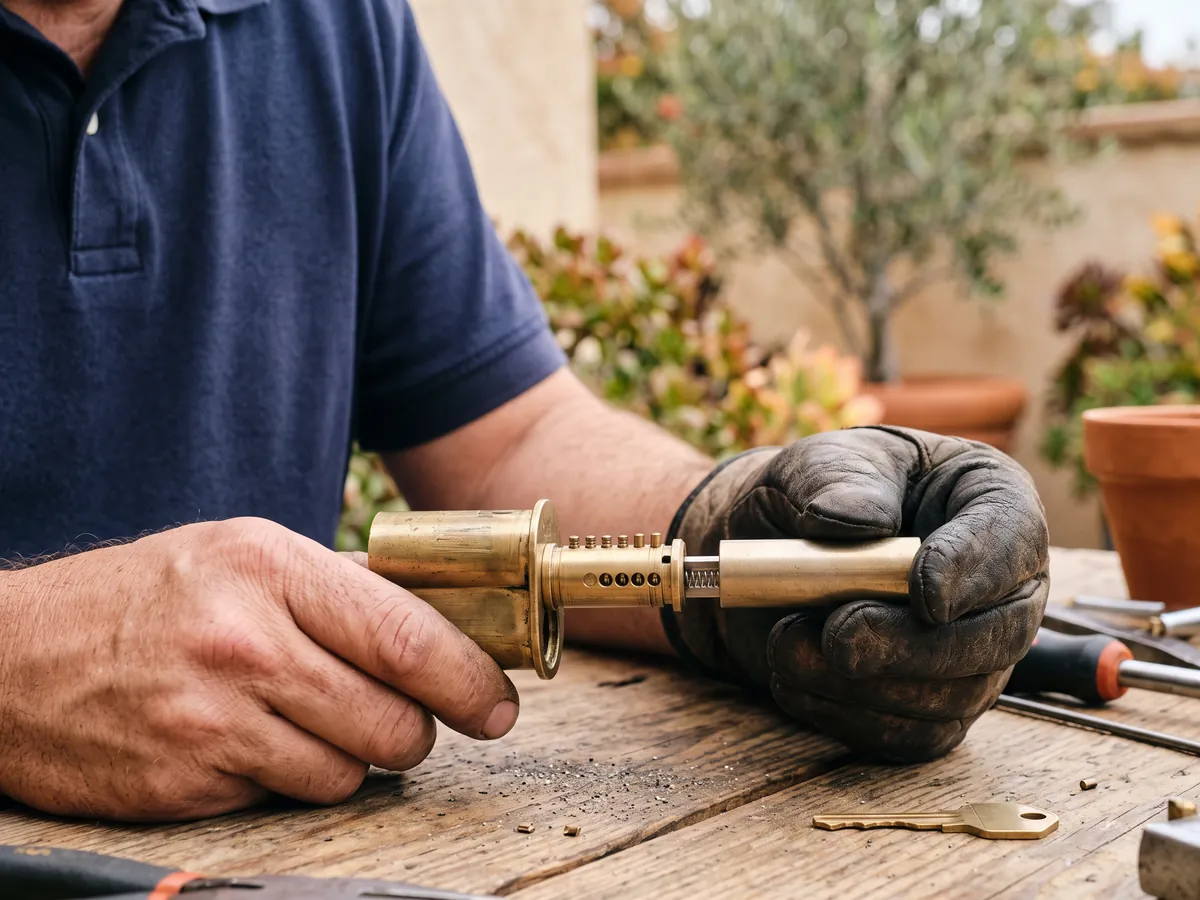
Open a drawer at almost any older business in Riverside and you'll find the key problem: a Schlage here, a Yale there, a padlock of unknown origin and a former owner's ring that opens three of the five doors. A commercial lock rekey is a chance to fix more than secrecy. We can bring a mixed set of cylinders onto one key, or two, so everyone carries a lighter ring and fewer keys can go missing. First we identify what you have; then we show you which cylinders can be re-pinned and which should be replaced. Call Julian's Locksmith at (951) 903-3193 to set up a walk-through.
What to know first in Riverside
A rekey only matters if the new keys stay under control. That starts with the keyway. A standard keyway can be copied at nearly any hardware store, so the number of copies can grow without you ever knowing. Restricted keyways, such as patented profiles, require authorization to duplicate, so copies pass through you. Next comes the structure: which doors share a key, which have their own, and whether a master or manager's key sits above them. Last is the record: a short list of who holds which key, coded rather than labeled with the door's name. Before we leave, we test every door with the new key and with an old key to show that the old one fails. We hand you the keys, a short key chart and our notes on which doors we touched. Ask us about a signed key log for employees; it's a small habit that makes the next change cheaper.
How we can help in Riverside
- Recoring interchangeable-core locks. Interchangeable-core locks let us pull a figure-eight core with a control key and drop in a new one pinned to the new key. It's usually the fastest way to change many doors, because the core is swapped without taking the lock apart. We carry cores and pin them in the van.
- Rekeying under a landlord's building standard. Suite doors in office and industrial parks can sit on a master key you don't control. When the landlord's master is the problem, your options are to ask the landlord to re-master, to add a second, tenant-controlled lock where the lease allows, or to leave the suite door alone and secure the interior doors instead.
- Forgotten openings that stay on the old key. Roll-up doors, yard gates and fenced storage areas depend on padlocks and cylinder locks that rarely get attention. Some can be re-pinned; many cheap padlocks can't. We replace those with rekeyable or higher-grade versions and bring them onto your key system.
- Alike, different and master: planning which doors share a key. Each extra level adds keys and complexity, so we start with the smallest system that does the job. Many small businesses do well with three keys: staff, management and owner. If you outgrow that, we can build a full master system later.
- Proof that the old keys are dead. A rekey's value is a failed key, so we prove it. At each rekeyed door we try an old key and show it won't turn the plug, then try the new key and cycle the lock. If you have old keys on hand, give us one per door and we'll use them for the test.
How Riverside shapes the job
Campus-area businesses such as cafes, print shops and tutoring centers in Riverside have staff who turn over each term, and keys that follow them out the door. Rekeying every term is usually unnecessary; the better habit is assigning keys by role, logging them and rekeying only when a log gap or a lost key calls for it. Restricted blanks make that log stick.
Older commercial buildings in Riverside often have mortise locks, transom windows and suite doors that predate the current tenants. Mortise cylinders are straightforward to re-pin, and the lock cases can often stay. Check with the landlord about the building standard and any shared stairwell or elevator-lobby doors, since a rekey of your suite should not disturb your neighbors' access. Ask whether the building keeps a lock schedule on file.
Converted houses used as offices, salons or small shops in older Riverside neighborhoods often mix residential locks with commercial needs. A knob and a deadbolt from the 1960s can be rekeyed, but they may not meet commercial egress rules or hold up to staff use. We rekey what's sound and recommend commercial-grade levers or exit hardware where the occupancy and the code call for it.
Situations this covers
- A franchise owner finishes a build-out in a shopping center and receives a ring of contractor keys along with the permanent set. Before opening, we pin the entry, stockroom and office to a final set of keys, collect the contractor's keys against a sign-off and hand the owner a one-page chart showing which key opens what.
- A community nonprofit has a dozen volunteers carrying keys to a fellowship hall, a kitchen and a storage shed, and nobody knows who still holds what. We rekey all three, split the doors into two key levels so kitchen volunteers don't automatically get the office, and recommend restricted blanks so copies can't be made casually.
- Consider a tire shop near La Sierra Avenue whose office door was pried open over a holiday weekend. The thief didn't get far, but the shop's spare keys were in the desk. We replace the damaged cylinder, rekey the other doors, add a reinforced strike on the office door and give the owner a short list of what else to check.
- Imagine a tenant in an industrial park whose suite door uses the landlord's building-standard cylinders. The tenant wants new keys after a partner left. The lease allows rekeying with a copy to the property manager. We re-pin the suite and loading-dock doors, make the extra key for the manager and record the change on the work order.
Step by step with Julian's Locksmith
- List every opening. Walk the space with a notepad or your phone camera. Note each door's location, whether it has a deadbolt, a lever or an exit device, and what kind of key it takes. Send us the photos. Even a rough list lets us bring the right pinning kits and spare cylinders.
- Identify the cylinders on site. While we're there, we test door operation: closer sweep, latch retraction, strike alignment and whether the door locks as intended. A rekey exposes problems that habit had hidden. We report what we find and leave the repair decision to you.
- Decide rekey, recore or replace, door by door. If a lock is a poor candidate for rekeying, we show you why: a loose plug, a missing part, a keyway with no available blanks. Sometimes replacing a cylinder costs about the same as rebuilding it, and we say so honestly, so you aren't paying for labor that isn't worth it.
- Choose the key system and quantities. Tell us who actually needs each key. A short role list works: owner, manager, staff, vendor. We pin to match, so the cleaning crew's key doesn't open the office. Once the plan is on one page, we cut the keys by code and mark them with codes rather than door names.
- Re-pin, cut and test. Replacement cylinders are installed to match the existing cams, tailpieces and door prep. We check the throw of the bolt, the retraction of the latch and the smooth action of the plug. Hardware that needs adjusting, such as a loose trim plate or a sagging strike, gets noted or fixed.
- Prove the old keys are dead and close out. At each rekeyed door we try an old key to show it no longer turns the plug. We then hand over the new keys, a short key chart and notes on which doors were touched. The work order records who approved the job and when.
How we quote the job
- Key quantity and key type. Cutting by code from a record is faster than copying from a worn key, and it gives cleaner results. If we're building a small system, we cut keys on site and test them in the rebuilt cylinders, which adds a little time but prevents a drawer full of keys that stick.
- Structure of the key system. A single key for everything is the simplest and cheapest, but it creates one point of failure. Separating staff, management and owner doors costs a little more in pin work and gives you much better control. Most small businesses land on two or three levels.
- Scheduling, access and travel. Doing the work during business hours is simpler to schedule, but it interrupts customers. Doing it before opening or after closing may cost a bit more yet keeps doors working when it matters. We help you pick, and we never leave an entrance unsecured while we work.
Every job gets a clear quote before any work starts. Call (951) 903-3193 with the details and we'll tell you what to expect for your situation in Riverside.
Common errors that cost time and money
- Letting departing staff say they returned all keys without checking. People forget copies, lend keys to relatives or keep a spare in a car. A rekey ends that uncertainty, but only if you actually test the old keys afterward. Ask for every key back in one sitting and write down each name.
- Buying whatever cylinders are cheapest each time one fails. Over a few years a business ends up with five brands, four keyways and a ring of keys no one can sort. Standardize your next replacements to the current system. Keep a short list of approved models for your openings so a maintenance person can reorder the right part.
- Ignoring the lease and the landlord's master. Rekeying a suite door without telling the manager can breach the lease and block emergency access. A short email first avoids that. If the landlord controls the cylinder, ask them to change it.
Practical tips before you call
- Issue keys by door access, not by person. A manager's key and a staff key shouldn't be the same just because it's convenient. Two or three levels fit most small businesses, and labeling them with codes keeps a lost key from advertising what it opens.
- Look for double-cylinder deadbolts, chains, hasps or padlocks on exit doors. They block escape, and a fire inspector will flag them. Mention them during the visit. We can swap them for hardware that opens without a key from inside while keeping the outside secure.
- Ask whether the new keys will be restricted before you order extras. A standard key can be copied at nearly any hardware store, which can quietly undo the rekey. A restricted key costs more but keeps duplication under your authorization.
- Photograph your key chart and keep a copy off site. A chart that lives only in the office drawer disappears with the office. Store a copy with your accountant or in a private cloud folder, tag keys with codes and keep the decoder separate.
Reaching Riverside
Riverside is about 22 miles from our San Bernardino base, roughly 28 minutes in light traffic via I-215 South through Colton and Grand Terrace to SR-91 South. When you call, you get an arrival estimate based on where the technician is and the traffic at that moment.
Most trips into Riverside use Van Buren Boulevard for at least part of the drive, and the technician keeps an eye on live traffic along the way so the arrival estimate you heard on the phone stays honest.
About Riverside: The Riverside Auto Center opened in 1965 on former citrus groves along Indiana Avenue and Adams Street, just east of the 91 Freeway.
| Neighborhoods | Mission Grove, Arlanza, Wood Streets, Casa Blanca, Orangecrest, University |
|---|---|
| ZIP codes | 92501, 92503, 92504, 92505, 92506, 92507, 92508 |
| Main routes | SR-91, SR-60, I-215, Magnolia Avenue |
| From our San Bernardino base | about 22 miles via I-215 South through Colton and Grand Terrace to SR-91 South (Riverside Freeway) into downtown and Magnolia Center; I-215 South to Alessandro Boulevard or Van Buren Boulevard for Mission Grove and Orangecrest |
Business lock or door work in Riverside?
Call (951) 903-3193 with the address, the doors or hardware involved and when the site is open. We'll quote the job before any work starts and book a time within our hours that suits your schedule.
Frequently asked questions
Can you change a lock to a restricted keyway without replacing it?
No. A rekey changes the pins, not the shape of the keyway, so it can't convert a standard lock into a restricted one. Moving to a restricted keyway means new cylinders. Some interchangeable-core systems can accept a restricted core, which makes upgrades easier. We explain what applies to your locks and what the system adds.
How do I decide between rekeying and replacing commercial locks?
Rekey when the lock is sound, commercial grade and compliant. Replace when it's worn, residential grade on a heavy-use door, damaged or out of code, or when you want a restricted keyway, which a rekey can't provide. Julian's Locksmith examines each door, shows you the wear and writes up both options so you can compare them.
Can all commercial locks be rekeyed?
Most can, but not all. Standard mortise, rim, key-in-lever and interchangeable-core cylinders are usually rekeyable. Worn or damaged cylinders, locks with discontinued keyways and some inexpensive padlocks and cam locks aren't worth rebuilding or can't be. We test each lock first, tell you which to rekey and which to replace, and price both paths.
What's the difference between rekeying and recoring?
Rekeying changes the pins inside a cylinder you keep. Recoring applies to interchangeable-core locks: we pull the figure-eight core with a control key and install a core already pinned to the new key. Recoring is often faster across many doors, but it needs a working control key and the right core platform. We tell you which fits your locks.
Does a rekey change my keypad code, alarm code or safe combination?
No. A rekey affects only the mechanical cylinders we re-pin. Keypad codes, alarm codes, card or fob credentials and safe combinations are separate. We can often change a keypad lock's code or a safe's combination at the same visit when the lock allows it, and we'll tell you which items belong to your alarm or access vendor.
Can you rekey commercial locks if I don't have a working key?
Often yes. With the lock open or accessible, we can take the cylinder apart and re-pin it without the old key. If a door is locked and no key works, we need to gain entry first, after confirming you're authorized to approve it. Bring proof that you own or lease the space, and photo ID.
How far is Riverside from your base?
Riverside is about 22 miles from our San Bernardino base, roughly 28 minutes in light traffic. Arrival time depends on traffic and on the job the technician is finishing, so we give you an estimate on the phone before you commit.
Related services in Riverside
- Lock Rekey in Riverside
- Commercial Rekey in Riverside
- Business Lock Rekey in Riverside
- Commercial Lock Replacement in Riverside
- Restricted Keyway in Riverside
- Key Control System in Riverside
- Master Key Rekey in Riverside
- Commercial Locksmith in Riverside
- Tenant Turnover Rekey in Riverside
- Duplicate-Protected Keys in Riverside
Commercial Lock Rekey in nearby cities
- Commercial Lock Rekey in RubidouxRiverside County
- Commercial Lock Rekey in PedleyRiverside County
- Commercial Lock Rekey in Jurupa ValleyRiverside County
- Commercial Lock Rekey in Glen AvonRiverside County
- Commercial Lock Rekey in Mira LomaRiverside County
- Commercial Lock Rekey in Grand TerraceSan Bernardino County
- Commercial Lock Rekey in Home GardensRiverside County
- Commercial Lock Rekey in BloomingtonSan Bernardino County
