
Redlands, San Bernardino County
Commercial Rekey Projects in Redlands, Planned Door by Door
Short answer: Before you book a commercial rekey, have three things ready: an approximate count of doors and padlocks, any keying chart or bitting list a previous locksmith left, and proof that you own or manage the property, or a signed authorization from the owner. With those in hand, Julian's Locksmith can quote a Redlands job accurately and arrive with the right keyways and parts.
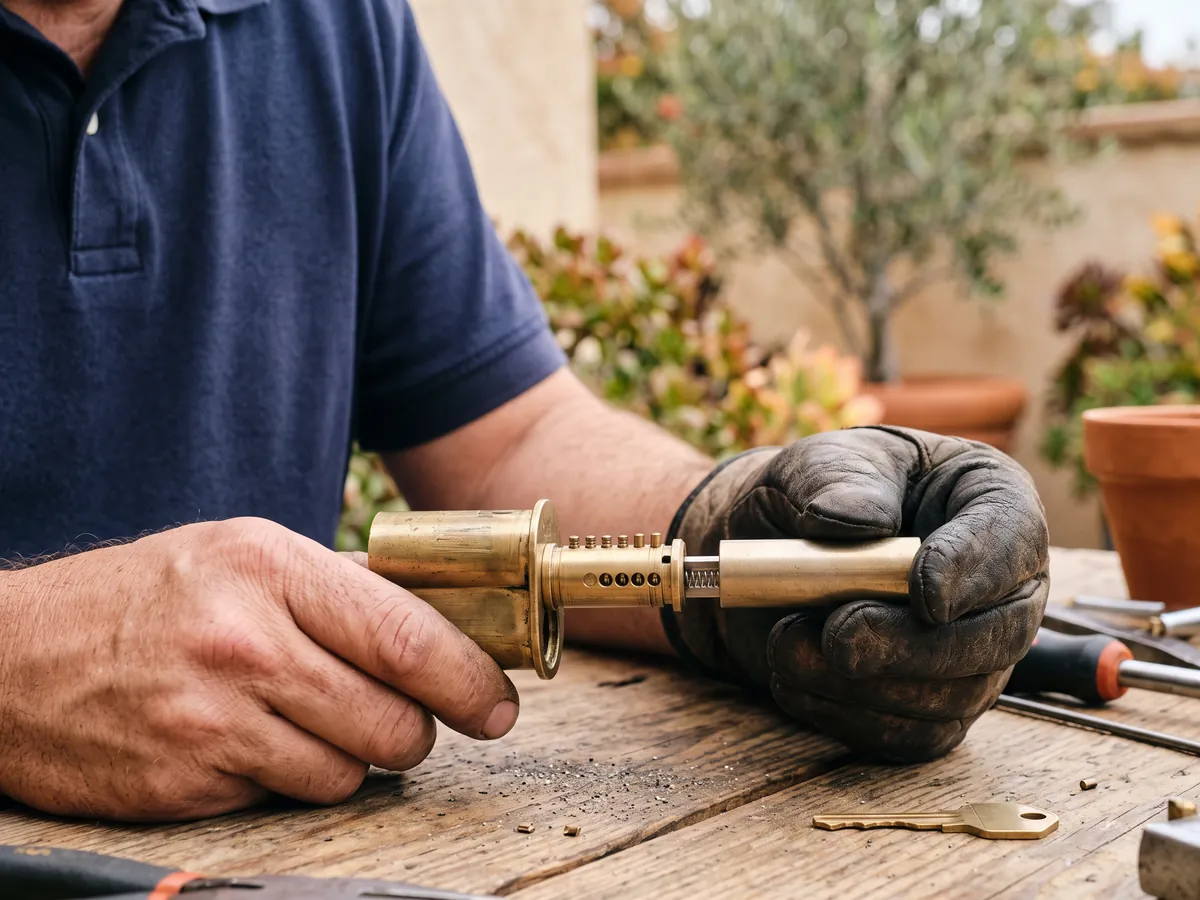
If you're closing out a tenant improvement or a new commercial build in Redlands, the construction keys are still floating around: the general contractor, the electrician, the drywall crew and the flooring sub may all have one. Before the owner or the incoming tenant takes possession, those keys need to stop working. A commercial rekey at turnover does exactly that, whether it means swapping temporary construction cores for permanent ones or re-pinning cylinders that shipped keyed to the builder's system. Julian's Locksmith can set up the permanent keying, cut the owner's keys, and leave a keying schedule the facilities team can actually use. Bring the project's hardware schedule if you have it.
Commercial Rekey in Redlands: what to expect
A good commercial rekey starts with a door inventory, not a pinning tray. For each opening we note the hardware type, brand, keyway, cylinder style and current function. Is the door on the master? Does it need its own change key? Is it a common area that several tenants share? That list becomes the keying schedule, which decides how many distinct keys the building ends up with and who holds each one. Getting this right on paper matters more than it seems. If a suite rekey cuts the tenant off from the shared restroom or the trash enclosure, someone will be calling the next morning. If a mechanical room ends up on a tenant's change key, you've handed out access to equipment you meant to protect. Julian's Locksmith walks the property with you or your maintenance lead, flags doors whose hardware is failing or doesn't fit the plan, and quotes from the finished list. On a small office, the inventory takes a few minutes. On a multi-building center, it may be the longest step of the whole commercial rekey.
How we can help in Redlands
- Mortise cylinder rekeying. Office suites and older commercial buildings in Redlands often run on mortise locks from Sargent, Corbin Russwin, Schlage L or Best. We back out the set screw, unthread the cylinder, re-pin the plug and reinstall it with the correct cam and cylinder length, so the lock function and trim stay exactly as they were.
- Storefront and Adams Rite cylinders. Aluminum storefront doors usually lock with an Adams Rite deadbolt or deadlatch operated by a mortise cylinder with an Adams Rite cam. We rekey the outside cylinder and, on double-cylinder setups, the inside cylinder too, then check that the hook bolt throws fully into the frame keeper.
- Interchangeable core rekeys. IC buildings are rekeyed one core at a time. That makes them ideal for suites that turn over often, because a single core can be swapped while neighboring doors stay untouched. We can also pin a few spare cores in advance, so your next tenant change becomes a short stop instead of a full project.
- Office furniture, cabinet and mailbox locks. Desk pedestals, lateral files and storage cabinets often use cam locks or removable-core furniture locks. In offices that store records or petty cash, those cores deserve the same attention as the doors. We can rekey or replace them during the commercial rekey and key them alike, individually, or under a master.
- Phased rekeys and keying records. Large properties rarely get rekeyed in one shot. We break the work into phases, building by building or floor by floor, and finish each phase with every door locked and tested. Between phases, the keying chart shows which doors are already on the new system, so staff know which key to carry where.
Local factors in Redlands
Near campuses, many small commercial buildings are leased to businesses with high staff turnover, and student-housing operators run offices, maintenance rooms and package rooms on mechanical keys. A commercial rekey at the end of each academic year, or whenever a key goes unreturned, keeps those doors under control. In Redlands we can schedule around move-in and move-out weeks, when maintenance teams are stretched thin.
Inland summers bake metal doors and the cylinders inside them. In Redlands, south- and west-facing commercial doors often show dried-out cylinders, gummy lubricant and storefront locks that stick in the afternoon. During a commercial rekey we clean each plug, use a dry lubricant that won't collect dust, and check that heat-swollen doors still let deadbolts and hook bolts throw fully into their strikes.
Plenty of building managers and owners drive in from elsewhere in San Bernardino County, so timing a commercial rekey around when a key holder can be on site matters. We start at 6:30 a.m. every day, which lets us finish a suite before tenants arrive, and we can work into the evening for buildings that clear out late. Tell us when your contact will be there, and we'll plan the visit around that window.
Situations this covers
- Picture a strip center where the landlord gets a storefront back after a restaurant tenant closes. The front is a narrow-stile aluminum door with an Adams Rite deadbolt; the back is a steel door with a panic bar and rim cylinder. A typical commercial rekey here covers both cylinders plus the grease-enclosure padlock, and we'd note whether the storefront hook bolt is worn before the next tenant moves in.
- Imagine a car dealership service department where a key to the parts room went missing during a busy month. The showroom and sales offices aren't affected. We'd rekey only the service-side cylinders, cut a limited number of new keys for the service manager and parts lead, and suggest restricted blanks so nobody can copy them at a hardware counter.
- A typical portfolio call: a management firm handles several small commercial buildings in San Bernardino County, each rekeyed at different times by different vendors. No two use the same keyway, and the records disagree with the doors. We'd suggest moving each building onto a standard keyway at its next turnover and documenting every property the same way, so a maintenance tech isn't carrying a pound of keys.
- For example, a property manager oversees a two-story office building off Alabama Street where a law firm just vacated a second-floor suite. The firm returned four keys, but the lease ran seven years. We'd rekey the suite entry and its three interior doors to a new change key, keep them on the building master, and confirm the old keys still fail at the shared restroom corridor, which stays on its own common key.
Step by step with Julian's Locksmith
- Scope call. Call (951) 903-3193 and describe the property: building type, rough door count, whether it's master keyed, and why you're rekeying. Mention any padlocks, roll-up doors or cabinets you want included. Those details tell us whether to schedule a site walk first or quote from your description.
- Authorization and site walk. Larger properties get a written door list during the walk: location, hardware type, cylinder type, keyway and the key each opening should take afterward. That list becomes the keying schedule. Smaller jobs, such as a single suite, can usually be scoped and rekeyed in the same visit.
- Keying plan and quote. The quote breaks out cylinder rekeys, cores, padlocks, keys and any replacement hardware, so you can trim or add items. If the property needs restricted blanks or a keying chart drawn up from scratch, that shows as its own line. Nothing gets added on rekey day without your sign-off.
- Scheduling around occupants. Occupied buildings need notice. We'll suggest giving tenants a short heads-up with the date, the doors affected and how they'll receive new keys. When a suite can't spare its entrance during business hours, we rekey it first thing in the morning or after close.
- Rekeying and testing each opening. On site, each cylinder is removed, re-pinned to its assigned bitting and reinstalled, or its core is swapped. We test the new key with the door open, then again with the door closed against the strike, and confirm the old key fails. Master keys and change keys are each tried on the doors they should operate.
- Keys, records and handoff. Before we leave, you can walk the property with your new keys if you want to. Afterward, keep the keying record somewhere secure and update it whenever keys are issued or returned. That record is what makes the next commercial rekey quick and accurate instead of starting over.
What affects the cost
- Interchangeable cores versus fixed cylinders. Fixed cylinders take more labor per door: removal, disassembly, pinning, reassembly and reinstallation. On a small property the difference hardly matters. On a building that turns tenants over often, that extra labor repeats at every turnover, which is when an IC conversion starts to deserve a serious look.
- Master keying and keying charts. Each added level raises the price: a grand master over several buildings, masters per building, sub-masters per tenant, change keys per door. More levels mean more calculation and more pins per chamber. We'll suggest the fewest levels that still give each group the access it actually needs.
- Keyway and key security. Some owners change the keyway at the same time as the rekey, moving from an open keyway to a restricted one. That means new cylinders or cores instead of re-pinning, so the cost goes up, but every future copy has to be requested through an authorized source with a record kept.
Every job gets a clear quote before any work starts. Call (951) 903-3193 with the details and we'll tell you what to expect for your situation in Redlands.
What to do before we arrive
- Ask for Do Not Duplicate stamping if you like, but don't treat it as protection, since plenty of key counters ignore it. Real duplication control comes from restricted or patented keyways whose blanks are sold only through authorized channels, paired with a signed record of who requested each copy.
- If your property uses interchangeable cores, keep a few spare cores pinned to the current keying and store them with the control key. When a tenant leaves or a key disappears in Redlands, a pre-pinned core turns an urgent rekey into a short swap at the door.
- Before calling for a commercial rekey, walk the property with a notepad and list every keyed thing: doors, panic bar trims, storefront locks, roll-up padlocks, gates, cabinets, mailbox compartments. Most owners undercount by a few. A complete list makes the quote accurate and keeps forgotten locks from undermining the new key plan.
- When a building is sold, ask the seller for every key, the keying chart and any control keys at closing, then rekey anyway. The chart speeds the work and lets you keep a well-designed hierarchy, but no seller can account for every copy made over the years.
Common errors that cost time and money
- Ignoring hardware condition while the locks are apart. A rekey is the cheapest moment to catch a cracked cylinder, a stripped set screw or a worn storefront hook bolt. Skipping that inspection means paying for a second trip when the part fails a few months later.
- Changing the master key without a chart. Guesswork leaves some cylinders opening with keys that shouldn't work, or refusing keys that should. Master keyed systems have to be calculated, recorded and pinned to the chart every time, even when only a handful of doors are involved.
- Rekeying the suite but forgetting the shared doors. The outgoing tenant's key no longer opens their old space, but it still opens the back corridor, the roof hatch or the trash enclosure because those were on the same key. Always check what else the old key operates before settling the scope.
Getting to Redlands
Redlands is about 19 miles from our San Bernardino base, roughly 25 minutes in light traffic via Belmont Ave and Palm Ave to I-215 South. When you call, you get an arrival estimate based on where the technician is and the traffic at that moment.
Our path into Redlands depends on where the previous job wrapped up. Sometimes that's a straight run via Colton Avenue; other times it's surface streets the whole way. Either way, you get a heads-up call when the technician is close.
About Redlands: The Redlands Bowl, built in 1930 in Smiley Park, hosts what is regarded as the oldest continuously free outdoor concert series in the United States.
| Neighborhoods | Barton Road corridor near the Asistencia, Lugonia, Ford Park area, Citrus Plaza area, Smiley Park Historic District, Santa Fe Depot District |
|---|---|
| ZIP codes | 92373, 92374 |
| Main routes | I-10, SR-210, SR-38, Redlands Boulevard |
| From our San Bernardino base | about 19 miles via Belmont Ave and Palm Ave to I-215 South, then I-10 East to the Orange Street (SR-38) exit for downtown; SR-210 East through Highland to the San Bernardino Avenue exit for north and east Redlands |
Planning a rekey in Redlands?
Call (951) 903-3193 and tell us how many doors you want on the new key and the brand of the locks if you know it. We'll quote the rekey before any work starts.
Frequently asked questions
Can you rekey interchangeable cores?
Yes. We work with small format cores of the type used by Best, Falcon, Arrow and others, and with large format cores from manufacturers such as Schlage, Sargent and Medeco, subject to keyway availability. If you have the control key, we pin new cores and swap them at each door. If the control key is missing, we'll discuss removal options and whether a new control bitting is needed.
Can you rekey a building that has no keying records?
Yes, though it takes more time at the start. We decode representative cylinders and, where needed, take a few apart to learn the existing bittings and any master pinning. From there we either rebuild the existing system on paper or design a fresh one. Either way, you finish the commercial rekey with documentation the property didn't have before.
Are you licensed for commercial locksmith work?
Yes. Julian's Locksmith holds California locksmith company license LCO7891, issued by the Bureau of Security and Investigative Services, and you can verify it at search.dca.ca.gov before booking. Because we're a mobile service, the rekey happens at your property, with cylinders pinned in the van or at the door, across the Inland Empire and the surrounding valleys.
What does a commercial rekey include?
A commercial rekey changes the internal combination of your property's lock cylinders so existing keys no longer work, then supplies new keys. On a typical Redlands building that covers mortise cylinders, rim cylinders on panic bars, storefront cylinders, key-in-lever locks, and often padlocks and cabinet locks. Doors, levers, exit devices and closers stay in place. You end up with new keys and a record of which key opens each door.
What happens if a master key is lost?
A lost master usually means every cylinder that master operates needs attention, because whoever finds it can open all of those doors. Sometimes we can rekey to a new master while keeping change keys the same, which avoids recutting every tenant's key. Other times the whole system needs new bittings. We'll review your chart and explain the options before quoting.
Do you need proof I'm allowed to rekey the building?
Yes. Before any commercial rekey we verify ID and your connection to the property: a deed, a property management agreement, a lease that grants lock rights, or a signed authorization from the owner. California's Locksmith Act and BSIS oversight make verification part of doing the job properly, and it protects you from someone else ordering work on your building.
How far is Redlands from your base?
Redlands is about 19 miles from our San Bernardino base, roughly 25 minutes in light traffic. Arrival time depends on traffic and on the job the technician is finishing, so we give you an estimate on the phone before you commit.
Related services in Redlands
- Lock Rekey in Redlands
- Commercial Lock Rekey in Redlands
- Master Key System in Redlands
- Master Key Rekey in Redlands
- Commercial Locksmith in Redlands
- Restricted Key System in Redlands
- Key Control System in Redlands
- Commercial Lock Replacement in Redlands
- Business Lock Rekey in Redlands
- Storefront Lock Repair in Redlands
Commercial Rekey in nearby cities
- Commercial Rekey in MentoneSan Bernardino County
- Commercial Rekey in Loma LindaSan Bernardino County
- Commercial Rekey in HighlandSan Bernardino County
- Commercial Rekey in San BernardinoSan Bernardino County
- Commercial Rekey in ColtonSan Bernardino County
- Commercial Rekey in Grand TerraceSan Bernardino County
- Commercial Rekey in YucaipaSan Bernardino County
- Commercial Rekey in Moreno ValleyRiverside County
