
Orange, Orange County
Orange Storefront Door Repair: Fix the Door, Not Just the Lock
Short answer: Repair or replace? Most sagging, dragging or drafty storefront doors in Orange can be repaired by renewing pivots, hinges or sweeps, because the door slab is rarely what failed. Replacement makes sense when a stile is bent, a corner joint has opened or the glass is cracked. We quote the repair first, say honestly when a glazier is the better call, and start only after you approve.
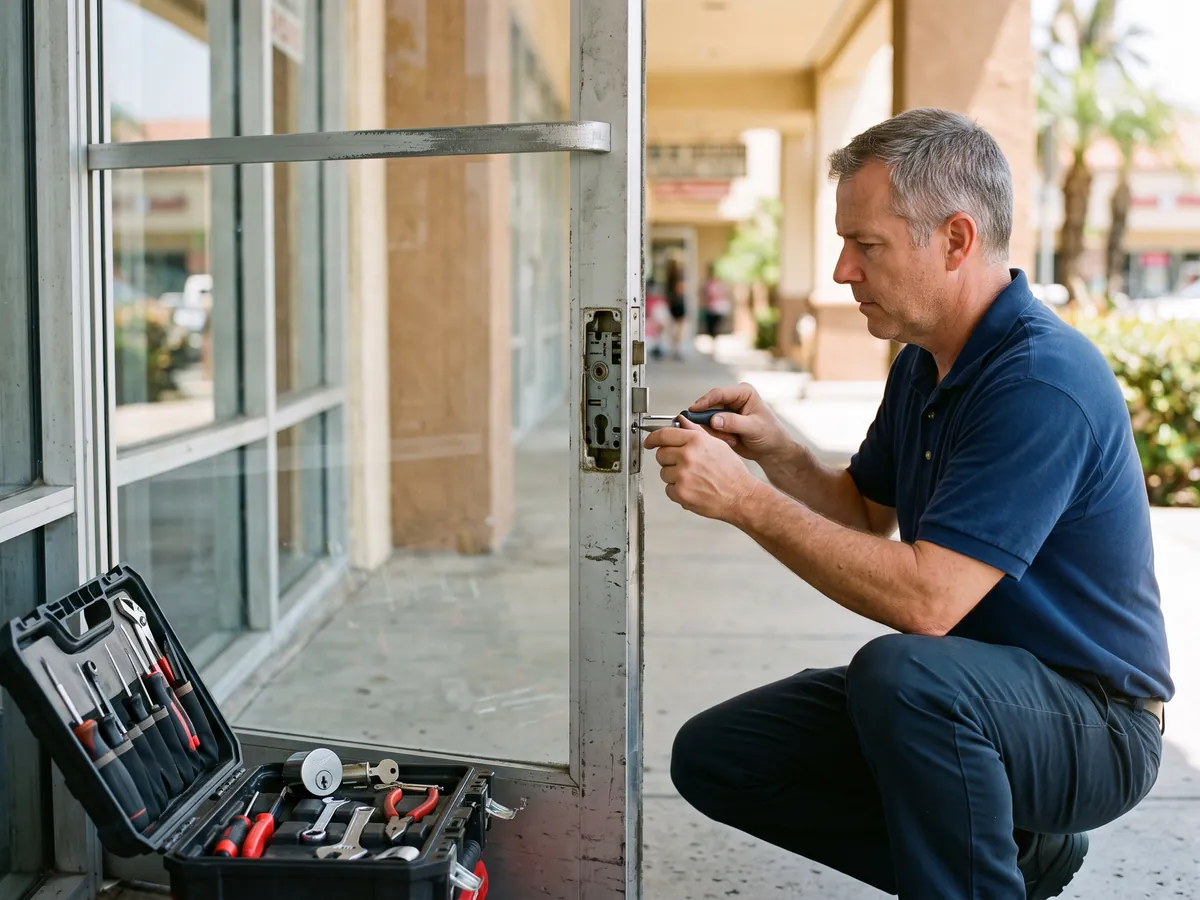
Who fixes a storefront door depends on which part failed, and plenty of owners lose a day calling the wrong trade. Cracked glass, open frame corners, door leaf replacement and caulking belong to a glazier or door contractor. Pivots, hinges, strikes, latches, locks, pulls and the way the door meets its frame are hardware, and that is our side. Storefront door repair in Orange often needs a little of each, so we tell you what to expect before anyone is scheduled. Julian's Locksmith holds California locksmith license LCO7891 and drives to your location, so most hardware repairs are finished in a single visit. Describe the problem at (951) 903-3193, and we'll tell you which side of the line it falls on.
Storefront Door Repair in Orange: what to expect
A storefront door that drags is usually a door that leaks, too. Gaps let in dust, heat and cold air, and in the Inland Empire they let in smaller visitors as well. A mouse can squeeze through an opening about as wide as a pencil, and insects need far less. Health inspectors notice daylight under a restaurant door, customers feel the draft, and your air conditioning pays for it every afternoon. Storefront door repair in Orange therefore includes the envelope: replacing cracked vinyl sweeps, hardened pile weatherstripping and threshold seals that have flattened or lifted. We pay attention to height, because accessibility standards cap how tall a threshold may rise, so a taller seal is not always the answer. Sometimes the right fix is adjusting the door's height so an ordinary sweep meets the floor. Wind-driven grit also wears the pivots we just serviced, so we tell you what to sweep away, and what never to hose down at all.
How we can help in Orange
- Hinge repair and continuous hinge replacement. On a geared continuous hinge, grit and heat can make the door feel stiff or noisy. We clean it, check every fastener along its length, and replace the hinge if the teeth have worn. The door should swing with the same effort at any point in its arc.
- Re-hanging and squaring a dropped door. Squaring a door means working top to bottom: pivots first, then clearance at the threshold, then the lock side. The order matters, because adjusting the strike before the pivots only chases a moving target. We re-test the lock after each step.
- Weatherstripping, sweeps and thresholds. Seals do more than save air conditioning. A good sweep wipes grit off the bottom rail and keeps wind from whistling and rattling the door. We pick the profile for your floor and threshold, install it square, and check it doesn't catch during the swing.
- Repair after impact or forced entry. Break-ins leave a rush of decisions. We start by making the door close and lock properly, even as a temporary measure, then separate what we can fix from what needs a glazier, and give you a short list to pass to your insurer or landlord.
- Scheduled door checks for multiple suites. A routine look at an entrance costs far less than an emergency repair. For businesses with a few doors, we do a periodic walk-through, test movement and wear, and note when parts are due for replacement so the work can be planned.
How Orange shapes the job
On a shopping corridor near Chapman Avenue, a whole row of storefronts often shares the same age, the same door system and the same wear. When one suite's door starts to drop, its neighbors usually follow. Storefront door repair here works well as a scheduled walk down the frontage: pivots, sweeps and closers checked door by door, with the landlord's hardware standards noted so replacement parts match.
Shops and cafes near campus take a daily pounding from backpacks, bike handlebars and crowds arriving between classes. Doors get propped open, slammed and pulled from both leaves at once. Pivots wear quickly under that kind of use. A repair visit timed before the semester starts, rather than after the first week of lines at the door, keeps things working smoothly.
Coffee counters, dry cleaners and convenience stores open before dawn, and a door that fails at opening time costs a whole morning of sales. Our day starts at 6:30 a.m., so call the evening before if a door has been acting up. A scheduled early visit is far easier on a commuter-heavy business than a lockup that can't wait.
Common situations
- A property manager with six suites off Lincoln Avenue keeps a running list of door complaints: two sagging, one with a missing sweep, one pull handle that spins. Instead of six emergency calls, she books one scheduled visit. We work through the list door by door, fix what can be fixed from the van, and leave a note on which suites need parts or a glazier.
- A new tenant signs a lease on a former tutoring center and finds the entrance door heavy and noisy. Nobody has serviced the pivots in years, and the closer is leaking oil onto the threshold. Before opening day, we service the pivots and tell the tenant the closer should be replaced. Since the landlord owns the frame, we also note anything that needs his approval.
- A salon on the sunny side of a strip center notices a hot draft along the bottom of its door every afternoon, plus a gritty sound as it opens. Heat has hardened the pile weatherstripping on the lock stile and warped the sweep. We replace both, clean the threshold, and lubricate the pivots, which together cut the draft and the noise. The owner never needed a new door.
- A nail salon's glass door scrapes the tile near the lock-side corner. Staff have learned to lift the handle while turning the key, and the closer seems to be fighting the door. A typical visit in Orange ends with a new bottom pivot bushing, an adjusted strike and a door that swings on its own weight again. The owner had assumed she needed a new lock and was ready to order one online.
Step by step with Julian's Locksmith
- Describe the symptom and send photos. Start with the symptom and when it began, whether after a bump, a storm or a slow change. Photos of the gap along the top edge and the bottom rail tell us a lot. We use them to decide what to load on the van before we head out.
- Confirm authority to work on the door. We verify ID and your connection to the business or property before starting, the same way we do for lockouts. For tenants, a lease excerpt or a message from the property manager is usually enough. It protects you as much as the building.
- Read the reveals and the door's travel. We start with the door closed, checking the gap at the head, jambs and bottom. Then we lift the handle to feel for play and swing the door through its full arc. Rub marks on the jamb and threshold show exactly where it is touching.
- Isolate the part that failed first. We take the lock out of the equation by working the bolt with the door open, then remove load from the pivots to see how far the door settles. That tells us whether a part is worn out or simply needs adjusting.
- Quote, then repair. You get a clear quote for each option before any work starts, usually adjustment, repair or replacement. We then do the work you approve, with parts that match the door's finish and style wherever they are available.
- Test everything and hand over notes. Before we leave, we open and close the door several times from both sides, confirm it latches and locks firmly, and look for any remaining drag. You get a note listing the parts used and anything worth monitoring.
How we quote the job
- Traffic, wind and weather exposure. A door used all day needs attention more often than one that sees a few customers. Heavy use, wind exposure and dusty sites wear parts faster, which affects both the price of a repair and how often to schedule checks.
- Coordination with other trades. Some repairs involve more than one contractor. When a glazier or alarm company has to be involved, scheduling becomes part of the job. We'll tell you what to ask them and in what order the work should happen so nothing is done twice.
- Timing and urgency. A scheduled repair during regular hours generally costs less than a rushed call late in the evening. If the door still locks and isn't a safety problem, booking earlier in the week gives us time to bring the right parts.
Every job gets a clear quote before any work starts. Call (951) 903-3193 with the details and we'll tell you what to expect for your situation in Orange.
What to do before we arrive
- Call as soon as a door starts acting up, even when it isn't urgent. We work every day until 11:30 p.m., so you can pick a quiet slot between customers. A sticking latch or a door that rubs the frame tends to get worse with use, so reporting it early gives us room to fix it before a busy weekend.
- Look for light under the door from outside after dark, with the interior lights on. A visible strip of light or a felt draft means the sweep or threshold seal needs replacing. It is a small fix that also keeps out dust and unwelcome small animals.
- Use the right fasteners. If a hinge or pull loosens, don't reach for longer screws. In thin aluminum they strip the hole faster. Ask for rivet nuts or the correct fasteners, which hold far longer and can be tightened repeatedly.
- Don't hang heavy things from the pull handle. Shopping bags, signs and seasonal decorations add pulling force to the hinge side every time the door opens. A door that carries extra weight on its handle will drop sooner than one that only has to swing.
Common errors that cost time and money
- Cranking the closer to force a sagging door shut. Turning the valves faster only slams the door harder against its stop, loads the hinge anchors and cracks seals. Correct the hang first, then set the closer to a speed that latches the door without a bang.
- Skipping the paperwork on a leased door. Changing hardware, cutting into the frame or swapping a door can breach a lease or interfere with a landlord's warranty on the entrance system. A short email to the property manager before work starts protects you from paying twice.
- Chaining or padlocking a damaged door while people are inside. It feels like a quick way to secure the shop, but an exit door must open from the inside without a key. If the door can't latch, call for help and keep the exit usable until it is repaired.
Getting to Orange
Orange is about 52 miles from our San Bernardino base, roughly 60 minutes in light traffic via I-215 South through Colton and Grand Terrace to SR-91 West. When you call, you get an arrival estimate based on where the technician is and the traffic at that moment.
Homes and businesses just off Main Street are routine stops for us. Give the suite or unit number and any gate instructions, and say whether the van can park out front or should pull into a side lot.
About Orange: Orange was incorporated on April 6, 1888, and is the only city in Orange County planned around a central plaza, which earned it the nickname Plaza City.
| Neighborhoods | Orange Park Acres, Fairhills Eichler tract, Olive Heights, North El Modena, Fairhaven Eichler tract, El Modena |
|---|---|
| ZIP codes | 92865, 92866, 92867, 92868, 92869 |
| Main routes | I-5, SR-22, SR-55, SR-57 |
| From our San Bernardino base | about 52 miles via I-215 South through Colton and Grand Terrace to SR-91 West (Riverside Freeway) through Riverside, Corona and the Santa Ana Canyon, then SR-55 South (Costa Mesa Freeway) to the Chapman Avenue exit; west on Chapman Avenue for Old Towne and the Plaza, east on Chapman Avenue for El Modena, Santiago Canyon College and Orange Park Acres; alternate via I-10 West to SR-57 South and the Chapman Avenue exit for The City district, The Outlets at Orange and UCI Medical Center when the 91 is jammed |
Lock or door hardware trouble in Orange?
Call (951) 903-3193 with the address and what the door or lock is doing. We'll quote the repair before any work starts.
Frequently asked questions
Do you replace door sweeps and weatherstripping?
Yes. Cracked vinyl sweeps, worn pile weatherstripping and flattened threshold seals are routine work for us, and they often explain drafts, dust and pests at the entrance. We match the profile to your door, install it so it doesn't drag, and keep the clearance at the bottom within accessibility requirements.
Who is responsible for storefront door repair, the tenant or the landlord?
It depends on your lease. Many leases make the tenant responsible for door hardware and the landlord responsible for the frame and glass, but others differ. Check your lease or ask your property manager before ordering work, and we'll document what we found so the conversation is easier. We can't give legal advice, but we can give you a clear written description.
What does storefront door repair include?
Storefront door repair covers the hardware that hangs, closes and secures a glass-and-aluminum entrance: pivots, hinges, strikes, latches, locks, pulls, sweeps and weatherstripping, plus basic closer adjustment. We also realign doors that have dropped or been knocked out of square. Glass replacement, frame welding and door leaf manufacture belong to a glazier, and we'll tell you if your door needs one.
How can I tell whether the lock or the door is the problem?
Open the door and turn the key. If the bolt slides smoothly in and out, the lock is working and the door is probably the culprit. If the key turns only when you lift the handle, or the bolt misses its hole when the door is closed, the door has dropped. Fixing the hang usually restores the lock without replacing it.
Do you repair cracked glass or replace storefront door glass?
No. Glass repair and replacement belong to a glazier, and tempered glass can't be repaired once it is damaged. We can secure the hardware, make the door safe to close and give the glazier a clear description of what we saw. If the hardware is also worn, doing both repairs in the same week often saves time.
Can a sagging storefront door be fixed without replacing it?
In most cases, yes. A sag is usually caused by worn pivots, loose hinge anchors or a shifted frame, and all of those can be repaired or adjusted without buying a new door. Replacement only becomes necessary when a stile is bent, a corner joint has opened or the glass is cracked. We'll show you what we find and quote the repair first.
How far is Orange from your base?
Orange is about 52 miles from our San Bernardino base, roughly 60 minutes in light traffic. Arrival time depends on traffic and on the job the technician is finishing, so we give you an estimate on the phone before you commit.
Related services in Orange
- Storefront Lock Repair in Orange
- Storefront Door Lock Replacement in Orange
- Aluminum Storefront Door Repair in Orange
- Glass Door Lock Repair in Orange
- Storefront Door Closer Repair in Orange
- Commercial Door Repair in Orange
- Commercial Door Won't Close in Orange
- Commercial Door Won't Latch in Orange
- Locksmith for Retail Store in Orange
- Storefront Locksmith in Orange
Storefront Door Repair in nearby cities
- Storefront Door Repair in Villa ParkOrange County
- Storefront Door Repair in TustinOrange County
- Storefront Door Repair in Santa AnaOrange County
- Storefront Door Repair in AnaheimOrange County
- Storefront Door Repair in PlacentiaOrange County
- Storefront Door Repair in Yorba LindaOrange County
- Storefront Door Repair in FullertonOrange County
- Storefront Door Repair in Garden GroveOrange County
