
Orange, Orange County
Duplicate-Protected Keys in Orange
Short answer: Should you switch to duplicate-protected keys? If employees, tenants, contractors or relatives hold keys you can't account for, probably yes. They won't stop picking or forced entry, but they do stop casual copying. In Orange, Julian's Locksmith can look at your doors, recommend which ones justify protected cylinders and explain who will be able to authorize copies afterward.
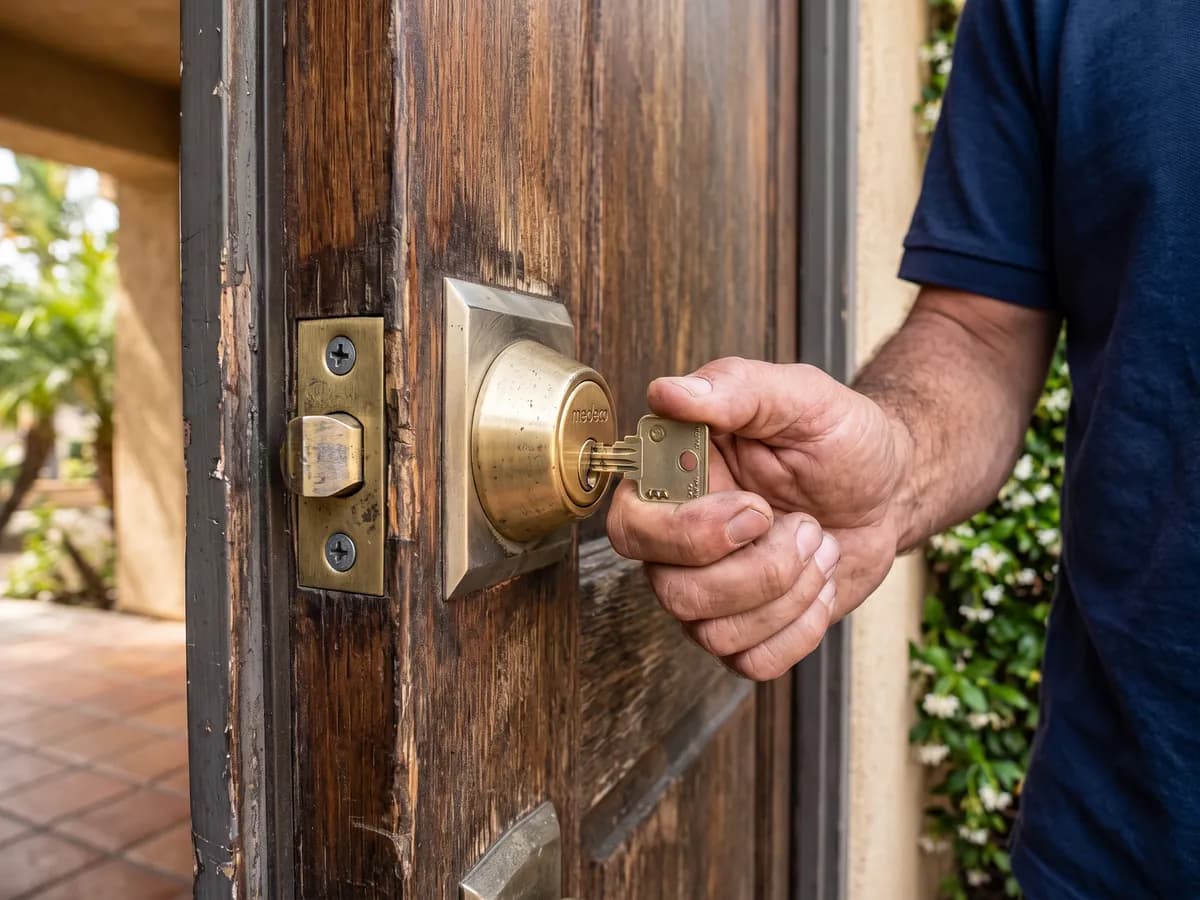
Most homeowners in Orange don't need duplicate-protected keys, and we'll tell you that if it's true. But if you have a pool house, a home office with sensitive files, a wine room or household staff who come and go, there's a reasonable case. Protected keys let you decide exactly who may copy a key and turn every extra copy into a deliberate event rather than a casual convenience. We'll explain what a protected system involves and where it makes sense on a house. If it turns out you don't, we'll say so and save you the cost of a system you wouldn't use.
How this works in Orange
Switching to duplicate-protected keys is really switching your key habits. The hardware part is straightforward: protected cylinders go in the doors that matter, often keyed alike within a group, with sub-masters if you need them. The habit part is where systems succeed or fail. You decide who is an authorized signer, where the authorization card lives, how new keys are requested and how returned keys are logged. For a family, that might be two names on a card. For a business, it might be an owner and an office manager, with a written sign-out sheet. We help with the first part and give you a one-page procedure for the second. Then, because the old cylinders and their unaccounted-for copies are gone, you start from a known number: every key in circulation is one that someone cut on purpose. Skipping that second half is the most common reason a protected system quietly stops protecting anything within a few years.
How we can help in Orange
- Authorized spares for existing protected keys. Spares for a protected key come with a short verification step. We confirm who you are, confirm that you're allowed to authorize copies, and match the key to the lock before cutting anything. Skipping that step is exactly what protected keys are designed to prevent, so we don't skip it, even when the key looks ordinary.
- Identifying your key system. Not every key marked Do Not Duplicate is actually protected; some are ordinary keys with a stamp. Others look plain but carry a restricted profile. We sort that out first, because it decides whether a copy needs a code machine, a factory order or nothing special.
- Cutting protected keys by code. Code cutting means the key is made from numbers, not from tracing a sample. For systems that allow it, we decode the key or retrieve the code from the owner's records, cut each position and angle to spec, and verify the key in your cylinder. When a system forbids local cutting, we say so.
- Key numbering, logs and issue records. Every key in a protected system should have a number you can trace. We can mark keys with control numbers, not cut codes, and set up a simple log showing who holds what. When someone leaves, you know exactly what to collect.
- Master and sub-master layouts with protected keys. A sub-master arrangement lets a department head open the doors in that department without opening the whole building. Pairing it with protected keys means each level can only be copied through the authorized channel. We design the levels with you before ordering anything.
What's different about Orange
Families in Orange share keys with teenagers, babysitters, grandparents, neighbors and house-sitters, and each of those keys can turn into a copy. Duplicate-protected keys let the household decide which two adults can approve more, and number the keys handed to others. When a babysitter moves on or a teenager loses a key, you know exactly which one it was and what to replace.
Barns and tack rooms in Orange are visited by trainers, boarders, farriers, veterinarians and hired help, and the keys to feed rooms and saddle storage tend to multiply. Duplicate-protected keys on those doors, issued by number to the people who need them, give the property owner a clear picture of who has access. A boarder who leaves hands back a key you can account for.
Clinics and offices near hospitals in Orange secure medication closets, records rooms and equipment storage, and they have staff who come and go on rotating schedules. Duplicate-protected keys for those specific doors give the practice manager a way to know exactly who holds each key and to approve every copy. A short signer list and a numbered key log fit into daily operations without much effort.
Example situations
- A homeowner texts a photo of his house key to a house-sitter, then realizes a picture is all some people need to cut a copy. We swap his cylinders for a protected line whose keys are much harder to reproduce from an image, issue the sitter a numbered key, and note the date to collect it.
- A small warehouse owner keeps tools and inventory behind a roll-up door padlock, and a dozen drivers have copies. We replace it with a protected-key padlock, issue keys by name, keep the authorization with the owner and recommend a monthly check that every key is accounted for before the next shift schedule goes out. Each driver signs for a key.
- A property manager can't find the authorization card for a patented system installed long before she took the job. We confirm the owner's authority with ID and the deed, trace the original supplier through the lock's markings, and order two spare keys through the proper channel. The wait is several days, and she appreciates hearing that at the start.
- For example, a small landlord near Irvine Regional Park and the Orange County Zoo inherits a four-unit building with a ring of unlabeled keys and no idea how many copies tenants made over the years. We replace the unit-door cylinders with a protected line, issue numbered keys to the current tenants, and put the owner and one manager on a two-name authorization list.
Step by step with Julian's Locksmith
- Identify the key and the system. Sometimes the lock tells us more than the key. We check the cylinder face and series markings, then compare them with the key to confirm they belong to the same system and see what rules apply.
- Verify identity and authority. Tenants and employees can hold keys but often can't authorize copies. We explain that early and, when needed, involve the owner or manager so the request goes through the right person without wasting your time.
- Choose how the key will be made. Now we decide the route: cut on site by code, ordered from the manufacturer or handled by an authorized dealer. We explain the pros and cons, including timing, so you can choose with accurate expectations.
- Quote, order and cut. You get a quote before we begin, covering the keys, any ordering and the visit itself. Once you approve, we cut or order the keys and keep you updated on timing from there. Nothing is ordered without your approval.
- Test every key in every cylinder. A new protected key must turn smoothly in the lock it was made for. We test each key several times, from both sides where applicable, and check that it doesn't bind, stick or need wiggling.
- Record, mark and explain the rules. We record each key issued, stamp control numbers where appropriate and give you a short sheet showing who may authorize copies. You leave knowing how to request more and what to do if one goes missing.
How we quote the job
- Type of protection. A patent-protected line with factory key control costs more than a restricted-blank system, which costs more than a standard key with a stamp. The more control built into the key, the more the key and the setup involve. We show you where your system falls.
- Cylinder conversion for existing locks. Not every door needs conversion. We recommend starting with exterior doors and rooms holding valuables or records, then expanding as your plan develops. Converting in stages spreads the cost without leaving key doors exposed. We lay out a staged plan and an all-at-once plan so you can compare them side by side.
- Timing and scheduling. Waiting time affects planning more than price, but it still matters. If you need a key by a certain day, tell us when you call. We'll say honestly whether it's realistic and, if not, what stopgap will keep you moving.
Every job gets a clear quote before any work starts. Call (951) 903-3193 with the details and we'll tell you what to expect for your situation in Orange.
Practical tips before you call
- For cleaners, contractors and dog walkers, set an end date. Give a numbered key or a temporary code, record it, and collect the key when the work finishes. Open-ended access is how unknown copies pile up. Collecting the key on the last day also avoids a lingering question months later.
- Ask how a spare is obtained before you buy a protected system. Some allow fast local cutting; others route every key through the factory. Knowing the answer in advance prevents surprises when you suddenly need a key on a deadline.
- Look at your keys. If the blade has milling on the flat sides, small dimples or odd angled cuts, you probably hold a protected profile. Note the brand and any series numbers on the bow, because those details tell us how to get a legitimate copy.
- Order a spare early and store it somewhere secure. A protected key can't be replaced at the corner kiosk, so having one backup in a safe place turns a lost key from a delay into a minor inconvenience. A spare in a fireproof box or with a trusted relative beats a rush order.
Mistakes to avoid
- Writing the cut code on a sticky note, tag or phone note next to the key. Anyone who reads it can have a copy made. Record control numbers, not codes, and keep the code information where only authorized people can reach it.
- Assuming any locksmith can simply order your key. Protected systems usually require proof that you're an authorized person. Showing up without ID, the card or proof of ownership leads to delays, and we won't skip the check. Bringing ID and the key or card in advance makes the request routine.
- Protecting the front door and forgetting the rest. A side door, garage entry or storage room still on an old common key leaves the original problem in place. Plan the whole property, even if you install in stages. Staging is fine, but write the full list down first.
Reaching Orange
Orange is about 52 miles from our San Bernardino base, roughly 60 minutes in light traffic via I-215 South through Colton and Grand Terrace to SR-91 West. When you call, you get an arrival estimate based on where the technician is and the traffic at that moment.
If you're close to Glassell Street, tell us which exit or cross street you're nearest. It trims the last mile and keeps the van from circling a block that looks right on the map but isn't.
About Orange: The Old Towne Orange Historic District covers about one square mile around Plaza Park, was added to the National Register of Historic Places on July 11, 1997, and is described as the largest such district in California.
| Neighborhoods | Chapman University area, Fairhaven Eichler tract, Fairmeadow Eichler tract, Orange Park Acres, North El Modena, Fairhills Eichler tract |
|---|---|
| ZIP codes | 92865, 92866, 92867, 92868, 92869 |
| Main routes | I-5, SR-22, SR-55, SR-57 |
| From our San Bernardino base | about 52 miles via I-215 South through Colton and Grand Terrace to SR-91 West (Riverside Freeway) through Riverside, Corona and the Santa Ana Canyon, then SR-55 South (Costa Mesa Freeway) to the Chapman Avenue exit; west on Chapman Avenue for Old Towne and the Plaza, east on Chapman Avenue for El Modena, Santiago Canyon College and Orange Park Acres; alternate via I-10 West to SR-57 South and the Chapman Avenue exit for The City district, The Outlets at Orange and UCI Medical Center when the 91 is jammed |
Business lock or door work in Orange?
Call (951) 903-3193 with the address, the doors or hardware involved and when the site is open. We'll quote the job before any work starts and book a time within our hours that suits your schedule.
Frequently asked questions
Can you copy Medeco, Schlage Primus, Mul-T-Lock or ASSA keys?
It depends on the system. For some lines we can cut or code-cut keys once authority is confirmed; for others the key must come from the manufacturer or an authorized dealer. We'll identify the key, explain the route, and say plainly if a particular system is out of our reach. We won't promise a copy we can't deliver.
Why won't the hardware store copy my key?
Usually for one of three reasons. The key may carry a Do Not Duplicate stamp that the shop honors, the blade profile may be one the store's machine can't trace, or the blank may simply not be sold over the counter. If you're in Orange and got turned down, send us a photo of both sides of the key and we'll tell you what you're holding.
Can protected keys still be picked or bumped?
Duplicate protection controls copying; it isn't the same as pick or bump resistance. Many protected lines use cylinders with real attack resistance, but that is a separate feature, and some cheaper restricted-blank systems have little. If picking and bumping worry you too, ask about the cylinder's design as well as its key control. We can compare both on your doors.
When can you come to Orange to help with protected keys?
We work every day from 6:30 a.m. to 11:30 p.m., weekends included. We're closed between 11:30 p.m. and 6:30 a.m. Call (951) 903-3193 with the brand on the key, where you are and what you need, and we'll give an honest ETA and explain whether the job is one visit or needs ordering. Our license is LCO7891.
What is the difference between a restricted keyway and duplicate-protected keys?
A restricted keyway is the key's profile: a shape whose blanks are limited to authorized sellers. Duplicate-protected keys describe the whole result, including the profile, any patent or registration, and the controlled process for getting copies. A restricted keyway is one ingredient. A fully protected key system also controls who can order, record and receive keys.
I lost the authorization card. What now?
Don't panic. Start by telling us the brand on the key or lock. We'll look for the original dealer, order records or a manufacturer lookup. You may be asked to prove ownership with ID and documents, and sometimes to sign a letter. If the trail can't be traced, replacing the cylinder and issuing a new key set is usually the safest path.
How far is Orange from your base?
Orange is about 52 miles from our San Bernardino base, roughly 60 minutes in light traffic. Arrival time depends on traffic and on the job the technician is finishing, so we give you an estimate on the phone before you commit.
Related services in Orange
- High Security Locks in Orange
- Restricted Keyway in Orange
- Restricted Key System in Orange
- High Security Key Duplication in Orange
- Restricted Key Duplication in Orange
- Key Control System in Orange
- Employee Key Control System in Orange
- Bump-Resistant Locks in Orange
- Pick-Resistant Locks in Orange
- Master Key System in Orange
Duplicate-Protected Keys in nearby cities
- Duplicate-Protected Keys in Villa ParkOrange County
- Duplicate-Protected Keys in TustinOrange County
- Duplicate-Protected Keys in Santa AnaOrange County
- Duplicate-Protected Keys in AnaheimOrange County
- Duplicate-Protected Keys in PlacentiaOrange County
- Duplicate-Protected Keys in Yorba LindaOrange County
- Duplicate-Protected Keys in FullertonOrange County
- Duplicate-Protected Keys in Garden GroveOrange County