
Orange, Orange County
Orange Business Lock Rekey Without Closing for the Day
Short answer: A business lock rekey in Orange changes the pins inside your existing locks so keys held by former employees, a previous owner or whoever found your lost key ring stop working. Doors, handles and panic bars stay as they are. Julian's Locksmith comes to your shop, office or warehouse, verifies you're authorized, quotes before starting and cuts new keys on site. Call (951) 903-3193.
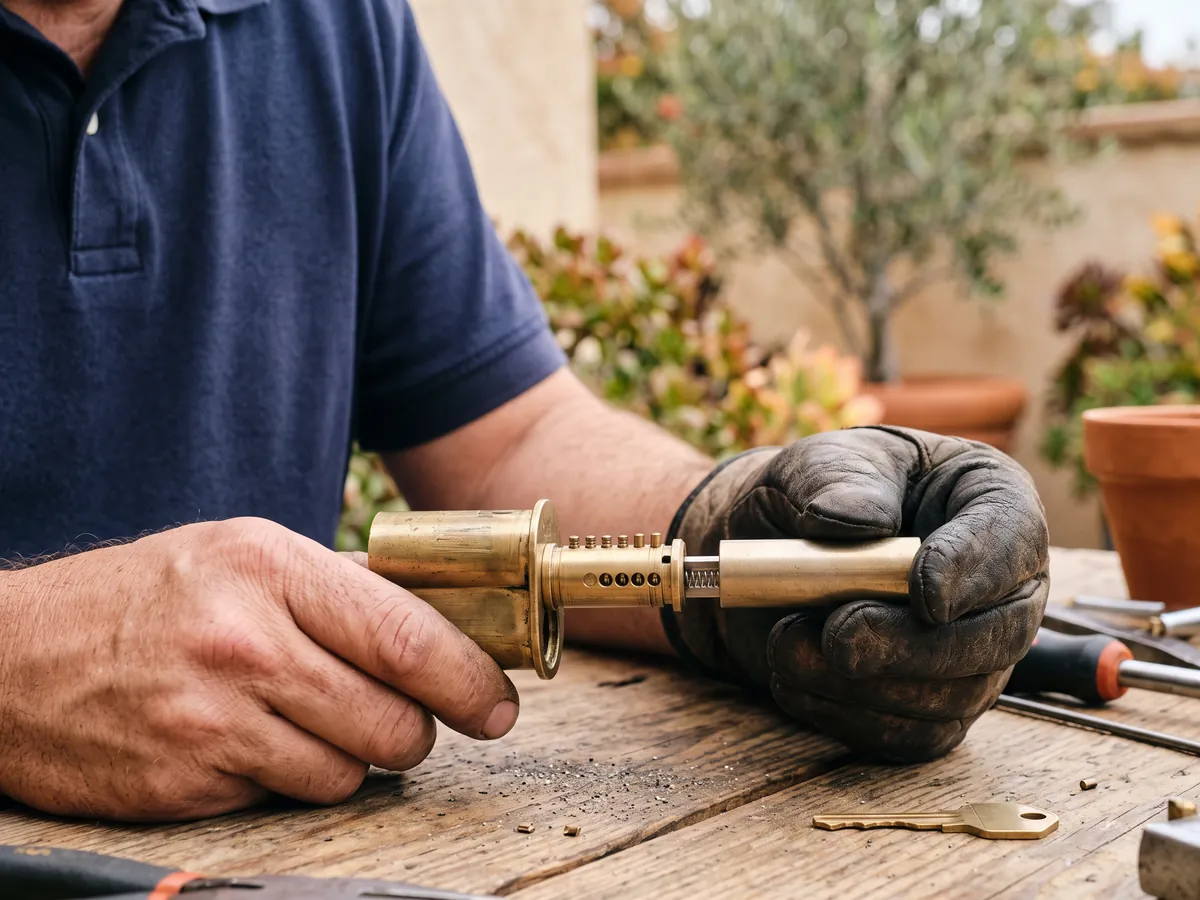
Most business owners don't think about their keys until someone leaves on bad terms. A shift lead who quit without notice, a manager who was let go, a seasonal hire who never came back for a final paycheck: any of them might still have a key to your front door. A business lock rekey in Orange makes those keys useless without replacing the locks your business already paid for. Julian's Locksmith comes to your location, confirms you're the owner or an authorized manager, and re-pins each cylinder to a new key. You approve the price before we start, and new keys are cut in our van while you watch. Call (951) 903-3193 to schedule.
What to know first in Orange
The right scope for a business lock rekey starts with one question: what could the missing key open? If a cashier had a front-door key only, rekeying the front entrance and anything keyed the same is the job. If a manager carried a ring with the office, safe room, back door and gate padlock, all of those are in play. Owners are often surprised to learn that several doors share a key without anyone planning it that way. During the visit we test the old key in every lock on the property, so you find out exactly what it operated rather than guessing. From there, you decide what to include. Don't forget the things a rekey doesn't touch: alarm codes, keypad codes, garage or gate remotes, and logins to any access control or camera app. Changing those on the same day as the locks closes every door the departing person could have used, not just the mechanical ones. It takes a few extra minutes and saves a second scare later.
What we can do on-site
- Rekey after buying a business. If the purchase includes staff who are staying on, a rekey isn't a statement about them. It simply resets keys that were issued under the previous owner. You can then hand out new keys under your own rules, with numbers and a log, which is a good habit to set from the first week.
- Lost or stolen business keys. If your business keys are lost or stolen, especially with anything that identifies the business, rekey the locks they opened. We rekey the affected doors, padlocks and cabinets, cut replacement keys for everyone who still needs access, and confirm the lost key no longer works anywhere.
- Rekey and repair after a break-in. If burglars got in with a key rather than force, that's a strong sign a key is circulating that shouldn't be. Rekeying every lock that key could open is the priority. We'll also look at the door, frame and strike, since a weak strike or a loose cylinder often invites a second attempt.
- Separate keys for staff and management. Separating keys by role means the next time a cashier leaves without returning a key, you may only need to rekey the entrance. The office, safe room and back storage stay secure because that key never opened them. It's one of the most cost-effective changes a small business can make.
- Padlocks, gates, cabinets and lockers. Businesses with display cases, such as jewelry, phone or vape shops, depend on cam locks that a single lost key can compromise. During a business lock rekey we can change those cams too, sort out which staff need case keys, and keep those keys separate from the door keys.
What's different about Orange
Owners who travel into Orange from across the region often rely on early openers and late closers, which puts keys in more hands. A business lock rekey is easy to schedule around that. We start at 6:30 a.m. every day, so an owner can meet us before opening, and we're done before the evening drive home. Give openers numbered keys and keep a spare set at home.
Neighborhood businesses in Orange, such as daycares, tutoring centers, salons and small professional suites, often share a center with families coming and going all day. A business lock rekey is common after a staff change, especially where children or sensitive records are involved. Interior doors for supplies, records and cash deserve their own keys, separate from the one that opens the front.
Shops along Main Street and in nearby strip centers tend to share one pattern: a glass storefront with a single aluminum door, a back door off a service alley and a rotating cast of part-time staff. A business lock rekey in Orange usually covers those two doors, the stockroom and any display case locks. Landlord rules in multi-tenant centers matter, so check your lease first and ask whether center management keeps a key.
Common situations
- A dental office in Orange lets a front-desk employee go. The patient records room and the supply closet turn out to share a key with the front entrance, which nobody realized. We rekey all three onto separate keys so the front-desk key opens only the front. The practice manager keeps the records room key, and the dentist carries an owner-level key.
- A franchise sandwich shop's owner wants a rekey after a store manager transfers out. The franchise agreement says the franchisor keeps a key to the building, so she checks first. With written approval in hand, we rekey the front and back doors, leave a key for corporate, and give the new manager a numbered key stamped with no store name.
- A family restaurant near Santiago Oaks Regional Park loses its closing manager midweek. His ring opens the alley door, the office, the dry-storage room and a padlock on the cage around the walk-in's condenser. After the dinner rush winds down, we rekey all four, give the owner a top-level key and two numbered staff keys, and try each one before we leave the lot.
- A tenant takes over a vacant suite in a strip center off Katella Avenue. The shop before them sold nail services, and the property manager admits the old tenant's keys were never collected. With written approval from management, we rekey the storefront and back door, cut a copy for the landlord as the lease requires, and mark which neighboring doors the new keys cannot reach.
Step by step with Julian's Locksmith
- Tell us what happened and which doors are involved. Start with a call or text. Tell us the trigger, such as an employee leaving, a lost ring or a new lease, then list the doors: front, back, office, stockroom, padlocks and cabinets. A rough count is plenty. We'll ask about the lock types and give you an honest idea of timing.
- Show who you are and that you can authorize the work. Before work begins, we need photo ID and something tying you to the business: a business license, a fictitious business name filing, a lease or ownership papers. A manager can authorize the job with the owner's written permission. We check this on every business call.
- Survey the doors and test the old keys. On arrival we walk the premises with you, door by door. We try the old key in every lock, including ones you didn't expect, and note brand, cylinder type and condition. That test shows exactly what the missing key could open, so the scope rests on facts, not guesses.
- Decide key levels, key count and who holds what. Ask yourself who truly needs each key. The opener, the closer and the manager are obvious. Vendors, cleaners and part-timers are the usual debate. Some owners give them a keypad code or let a keyholder open for them, and we'll help you weigh the options.
- Rekey in sequence while you stay open. We rekey one lock at a time, so your business never sits with an unsecured door. The front stays usable while we work on the back, and we test each lock from both sides before moving on. Most small jobs fit between your opening and closing routines.
- Hand over keys, record them and reset the extras. A rekey doesn't touch alarm codes, keypad codes, remote fobs or logins to camera and POS systems. We'll remind you to change those the same day, and when an item needs a low-voltage contractor, such as an alarm panel or card reader, we say so honestly.
How we quote the job
- How many doors, padlocks and cabinets are on the list. Cabinets and padlocks count too. A cam lock on a file drawer is quick, but twelve of them add up. If one key opened many small locks, tell us early so the quote covers the whole ring and not just the doors.
- The kind of locks on your doors. Condition matters as much as type. A well-kept cylinder re-pins in no time, while a gritty or damaged one needs cleaning, new springs or outright replacement. We judge each one by feel and by taking it apart, since wear is rarely visible from outside. After a break-in, expect a few locks to need replacing instead of rekeying.
- Same-visit extras like safes, closers and codes. When something needs a low-voltage contractor, such as card readers or camera systems, we'll say so plainly. We handle mechanical locks, keypad locks and many electric strikes, but a full access control build can mean another trade on site. Splitting the work this way keeps our quote limited to what we actually do.
Every job gets a clear quote before any work starts. Call (951) 903-3193 with the details and we'll tell you what to expect for your situation in Orange.
Practical tips before you call
- Photograph each door and lock before the visit, and keep the pictures with your key list. Photos record brands, finishes and any damage, which helps with insurance paperwork and future quotes. They also let you spot later if someone swapped a lock without telling you.
- Count your keys twice a year. Lay out every key you issued beside your written list. If the numbers don't match, a key is missing, and a rekey on your own timeline beats one forced by a surprise. A short audit turns key control into a habit instead of a crisis.
- Stamp keys with numbers, such as K-07, and keep the matching list in a drawer you lock. Never write the business name, address or door names on a key or tag. A found ring labeled with a store name tells a thief exactly where to go, while a numbered key means nothing to a stranger.
- Treat every unreturned key as a copy in circulation. A returned key proves nothing about duplicates made last year. When a key position turns over, such as a manager, an opener or anyone who handled cash, decide in advance that the locks get rekeyed, so you aren't making an awkward judgment call about a person.
Common errors that cost time and money
- Waiting for a quiet moment that never arrives. Owners put off a rekey because it feels like an overreaction, and the missing key stays in circulation for months. Next to replacing stolen inventory or cash, rekeying a few cylinders is a small decision. Schedule it when the doubt begins.
- Trusting a returned key. Handing a key back doesn't prove no copy exists, since a duplicate takes moments at a hardware counter. If the person ever held keys to your cash, stock or records, treat them as compromised and rekey instead of hoping.
- Rekeying only the front door. Keys rarely fit a single lock, and many businesses key the back door, office and padlocks alike without realizing it. Test the missing key in every lock before deciding the scope, or you could leave behind a key that still opens the cash room.
Service in Orange
Orange is about 52 miles from our San Bernardino base, roughly 60 minutes in light traffic via I-215 South through Colton and Grand Terrace to SR-91 West. When you call, you get an arrival estimate based on where the technician is and the traffic at that moment.
Traffic matters more than mileage. We check conditions on Glassell Street and its connecting routes before quoting you a time, and we don't pretend a long drive through heavy congestion is a short one.
About Orange: The Old Towne Orange Historic District covers about one square mile around Plaza Park, was added to the National Register of Historic Places on July 11, 1997, and is described as the largest such district in California.
| Neighborhoods | Orange Park Acres, El Modena, Fairhaven Eichler tract, Fairmeadow Eichler tract, Chapman University area, Old Towne Orange |
|---|---|
| ZIP codes | 92865, 92866, 92867, 92868, 92869 |
| Main routes | I-5, SR-22, SR-55, SR-57 |
| From our San Bernardino base | about 52 miles via I-215 South through Colton and Grand Terrace to SR-91 West (Riverside Freeway) through Riverside, Corona and the Santa Ana Canyon, then SR-55 South (Costa Mesa Freeway) to the Chapman Avenue exit; west on Chapman Avenue for Old Towne and the Plaza, east on Chapman Avenue for El Modena, Santiago Canyon College and Orange Park Acres; alternate via I-10 West to SR-57 South and the Chapman Avenue exit for The City district, The Outlets at Orange and UCI Medical Center when the 91 is jammed |
Planning a rekey in Orange?
Call (951) 903-3193 and tell us how many doors you want on the new key and the brand of the locks if you know it. We'll quote the rekey before any work starts.
Frequently asked questions
Can a manager or employee authorize the rekey?
A manager can authorize it when the owner gives written permission and the manager shows ID. We won't rekey a business at the request of a former employee, or when two owners disagree about who controls the space. If you're a tenant, we may also want to confirm your lease allows lock changes before we start.
Is rekeying enough after a break-in?
Only if the locks weren't damaged and the burglars didn't use a key. After forced entry, cylinders, strikes or frames are often bent, so we inspect first. If a key was used or taken, we rekey. Either way, talk to the police before repairs, since they may want photos, and tell us what you saw.
How often should a business rekey its locks?
There's no calendar rule. Rekey when a key you can't account for leaves your control, such as an employee departure, a lost ring, a break-in or a change of ownership. Some businesses also rekey every year or two for tidiness and use the same visit to audit their key list. Either approach beats waiting for a crisis.
How much does it cost to rekey a business?
Price depends mainly on how many cylinders you're rekeying, the lock types, how many keys and key levels you want, and the timing of the visit. We quote the whole job before starting, and no work begins until you approve it. Call (951) 903-3193 with your door count and lock types for a quote you can plan around.
Can you work before we open or after we close?
Within our hours, yes. We work every day from 6:30 a.m. until 11:30 p.m. Weekends are included. An early visit before you open, or an evening visit after the last customer leaves, often suits shops and restaurants best. Call ahead and tell us your closing routine so we can reserve the right time.
Do I need my landlord's permission to rekey?
If you lease, probably. Many commercial leases require landlord consent for lock changes, a key for management, or both. Read the lease or ask your property manager, and keep their answer in writing. We won't rekey leased space without confirming you're allowed to, and we coordinate with building master keys when they exist.
How far is Orange from your base?
Orange is about 52 miles from our San Bernardino base, roughly 60 minutes in light traffic. Arrival time depends on traffic and on the job the technician is finishing, so we give you an estimate on the phone before you commit.
Related services in Orange
Business Lock Rekey in nearby cities
- Business Lock Rekey in Villa ParkOrange County
- Business Lock Rekey in TustinOrange County
- Business Lock Rekey in Santa AnaOrange County
- Business Lock Rekey in AnaheimOrange County
- Business Lock Rekey in PlacentiaOrange County
- Business Lock Rekey in Yorba LindaOrange County
- Business Lock Rekey in FullertonOrange County
- Business Lock Rekey in Garden GroveOrange County
