
Ontario, San Bernardino County
Storefront Door Lock Replacement in Ontario: Match It, Key It, Secure It
Short answer: If your storefront lock fails while you're open, secure the shop in a way that keeps the exit usable, then call Julian's Locksmith at (951) 903-3193. We replace locks across Ontario every day, 6:30 a.m. to 11:30 p.m. We're closed overnight. We quote before starting and install only after you approve.
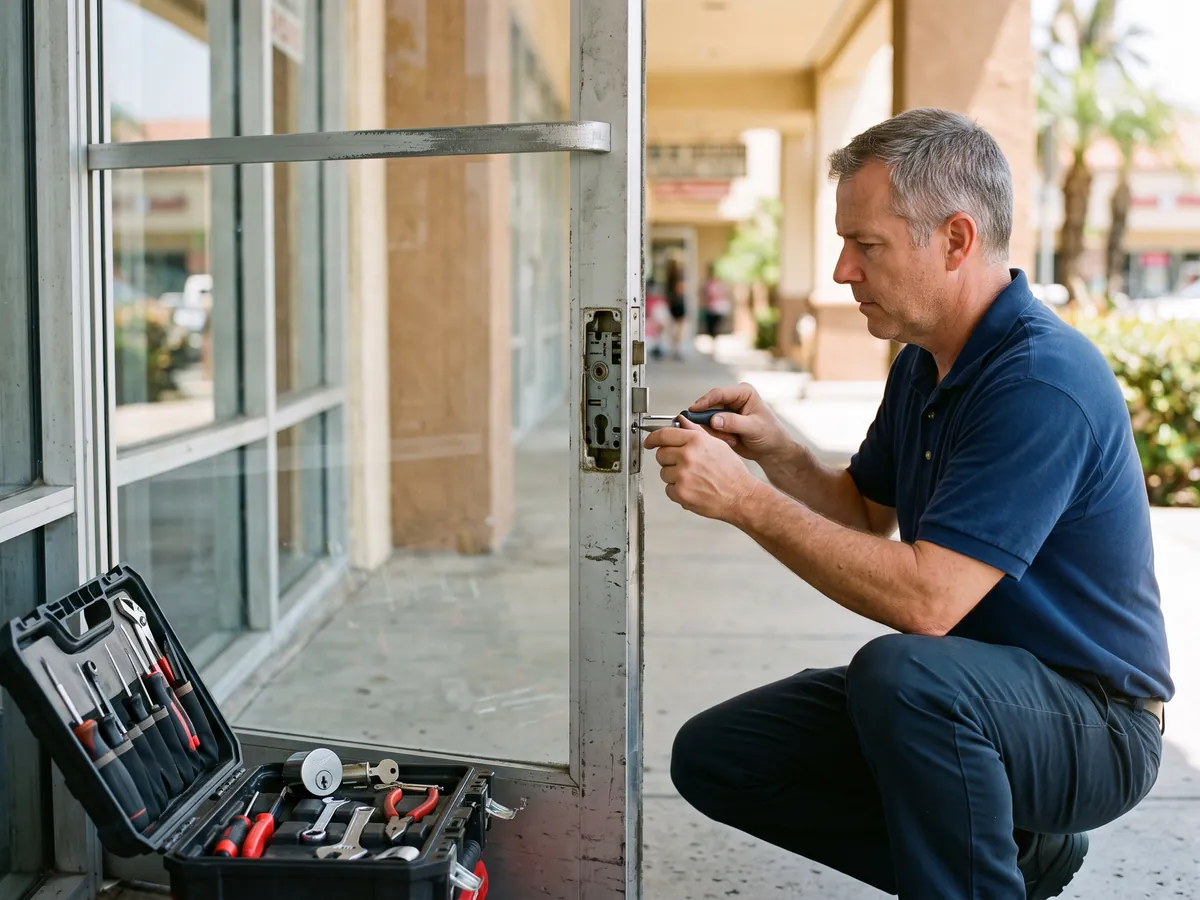
New lease, new locks is a good rule for any shop. When you take over a space in Ontario, you can't know how many keys the previous tenant, the landlord, contractors and cleaners still hold. Storefront door lock replacement at move-in resets that. Julian's Locksmith can install and key a new lock on the front door, rekey or replace the rear door to match, and give you a short list of what was done for your records. Because the lock is part of the building, read your lease or ask your property manager first, since some landlords require approval, a master key or the original hardware back at move-out. Call (951) 903-3193.
Storefront Door Lock Replacement in Ontario: what to expect
Matching is where most storefront replacements succeed or fail. The new lock must share the original's backset, the distance from the edge of the stile to the center of the cylinder hole. The faceplate has to suit the stile edge and the mortise opening so the case slides in without cutting aluminum. The cylinder needs the right length for your stile and the right cam for the new case. Handing matters on locks that aren't reversible, and the finish should match the door, usually clear anodized, dark bronze or black. Common catalog finish codes include 628 for clear anodized and 313 for dark bronze. When you ask us about storefront door lock replacement in Ontario, we aim for a drop-in match. If the original is obsolete, we look for an adapter faceplate or a modest re-prep of the pocket and explain the trade-off before cutting anything. A good match means the lock goes in the way the door was designed to take it.
What we can do on-site
- Hookbolt deadlock replacement. When a deadlock's hookbolt is bent, its springs are tired or the case has been forced, we replace it with a unit that has the same backset, faceplate and finish. The new lock throws the bolt fully into the strike and holds the door shut against a pry bar.
- Mortise cylinder replacement. A broken key, spun cylinder or worn pins often calls for only a new mortise cylinder, not a whole lock. We match the thread, length and cam, key the new cylinder fresh, and leave the existing case in place when it tests sound.
- Paddle handles and trim replacement. If a lever or pull has loosened its mounting or cracked, replacement is safer than another round of tightening. We fit trim that works without tight gripping, so the door stays easy for every customer and employee to use. Accessibility rules favor lever and paddle designs for good reason.
- High-security cylinder and lock upgrades. Medeco, Mul-T-Lock and ASSA cylinders resist picking, bumping and unauthorized copying. We fit them with the correct storefront cam and a protective guard, and explain how restricted keys are ordered so only authorized people can add copies later. You decide who may authorize extra keys.
- Replacing a lock that has failed shut. A failure at closing time is stressful. We first make the shop secure, then replace the lock with a matching unit. If the matching part isn't on the van, we use a temporary security measure and finish the swap on a return visit.
How Ontario shapes the job
Sun-baked storefront doors can warp slightly, harden grease and bake the plastic parts inside electrified hardware. Where summer heat is intense, as it is around Ontario, replacement locks should have solid metal internals, dry lubricant and a finish that won't blister. If you choose an electrified lock, we select components rated for outdoor heat and explain how to protect the power supply.
Gift shops, restaurants and lobbies with long hours rely on locks that survive heavy use and let managers hand out access without chaos. We replace storefront locks with durable hardware, key them in tiers for opening crews, managers and owners, and consider electrified options for staff entrances, so there are fewer physical keys to track, collect and replace. That keeps closing crews accountable.
Office entrances in business parks are often attached to warehouses full of valuable stock, and nighttime break-ins target them. Storefront door lock replacement for these doors tends to emphasize a hookbolt deadlock, cylinder guards, restricted keys and a well-anchored strike. We also help with keying so managers, drivers, cleaners and visiting vendors each receive only the access they truly need.
Example situations
- A convenience store replaced its lock twice and still had trouble. The real fault was a sagging door that made the hookbolt miss its strike. We repaired the pivot first, then fitted a new lock, which worked straight away. Fixing the door before replacing the lock avoids paying for the same job twice, which is why we always check how the door hangs.
- A restaurant manager's key snaps in the front-door cylinder at opening time, with the bolt thrown. After checking his authorization, we extract the broken piece and test the case, finding a damaged cam. Rather than leave a weak lock on a busy entrance, he approves a new cylinder and cam, and we key it to match the kitchen door. The doors open for lunch service.
- A salon's double doors lock at the center, but the inactive leaf's bolts are worn, so a pry bar could spread the pair. We replace the active leaf's lock, renew the flush bolts and align the leaves so the meeting stiles line up. Both leaves now hold together when the door is locked, and the astragal closes the gap that used to invite a tool.
- Overnight, someone tried to twist the cylinder out of a tire shop's front door with pliers. The cylinder is loose and scratched and the cam is chewed up. This is a typical case for replacement, with a beveled guard, a hardened set screw and a check that the strike is anchored firmly. Photos taken before we start help with the insurance report.
Step by step with Julian's Locksmith
- Identify the lock and the failure. Tell us what the lock does and send photos of the faceplate on the door's edge, the cylinder face and the paddles. Those usually name the maker and model, which lets us bring a matching lock instead of guessing at the door.
- Verify who can authorize the work. We confirm your identity and your authority over the door with photo ID plus a lease, business license or note from the owner. If the landlord controls exterior locks, we help you get approval before swapping anything.
- Choose the replacement and any upgrades. With the old lock in hand, we confirm backset, faceplate, cam, cylinder length, handing and finish. Then you decide how far to go on security and keying, and we quote the choice before we order or install anything.
- Remove the old lock and prepare the pocket. A tidy pocket makes a lasting repair. After removing the lock, we clear debris, check how the screws bite into the stile and confirm nothing inside the door is bent. We tell you if the stile itself needs a glazier's attention.
- Fit, key and align the new lock. The new case is seated and fastened, the cam set on the cylinder, and the cylinder threaded to the right depth with its set screw locked. We then align the strike so the bolt enters smoothly and holds the door tight.
- Test every function and hand over keys. We cycle the lock with the door open, then closed, then with the paddle or thumbturn, and give the door a firm pry test. You receive the keys and notes on the hardware installed. Any issues with the door itself are explained before we leave.
How we quote the job
- Matching and part availability. Finish and handing affect availability too. Dark bronze or black parts, or a lock that comes in only one hand, may need ordering. If a part is on order, we make the door secure in the meantime and schedule the return visit.
- Security level and keyway. Standard cylinders cost the least. High-security cylinders with restricted keys cost noticeably more, but they control who can copy keys and resist picking and bumping. We help you judge honestly whether your location and your staff turnover justify the upgrade.
- Number of cylinders and keying plan. Whether new locks are keyed alike, keyed to an existing key, or placed under a master system changes the work involved considerably. Tell us who needs access to which door and we'll price the whole arrangement before ordering any parts.
Every job gets a clear quote before any work starts. Call (951) 903-3193 with the details and we'll tell you what to expect for your situation in Ontario.
Advice before you book
- Photograph the faceplate on the edge of the door and the face of the cylinder, with the door open, before you call. The stamped brand and model speed up matching, and the photos also show finish and handing. Keep them with your lease and alarm records so anyone covering for you can find them.
- Choose a quiet time within our hours. Mid-morning on a weekday is easier than the lunch rush, and calling as soon as you notice the problem leaves room for a return visit if a part has to be ordered. We work every day until 11:30 p.m., so a visit after your store closes is also an option if you'd rather keep the work away from customers.
- Replace the strike along with the lock when it shows wear. A worn or bent strike chews a fresh hookbolt and hides alignment problems. The strike is a small part, and fitting a new one with the new lock gives the whole system a fresh start.
- Test the finished work like a customer and like a burglar. Pull the door shut and listen for the bolt, push hard on the lock side, and try the paddle from outside. If anything feels loose or inconsistent, mention it before the technician leaves.
Common errors that cost time and money
- Leaving the old strike and loose screws in place. A fresh lock meeting a worn strike or stripped anchors loses much of its benefit and wears quickly. Replace the strike when it shows wear, and re-anchor it in the jamb with the right fasteners.
- Buying a residential deadbolt for an aluminum storefront door. A standard cylindrical deadbolt needs a round bore that a narrow stile can't accommodate, and forcing one in weakens the metal around the lock. Storefront doors use mortise cases built for the stile, so match the lock to the door rather than the door to the lock.
- Replacing the lock when the door is the real problem. If the door sags or the strike has moved, a new hookbolt will bind exactly like the old one. Test the old lock with the door open, check how the door hangs, and fix the alignment before you pay for new hardware.
Service in Ontario
Ontario is about 25 miles from our San Bernardino base, roughly 33 minutes in light traffic via I-215 North to the I-15 junction at Devore. When you call, you get an arrival estimate based on where the technician is and the traffic at that moment.
Commercial jobs on busy stretches like Euclid Avenue sometimes need a parking plan, especially for storefront doors or roll-up gates. Let us know about loading zones, red curbs or parking structures before we arrive.
About Ontario: A mule-drawn passenger tramway ran up and down the Euclid Avenue median from 1887 until 1895, when electric cars replaced the mules.
| Neighborhoods | Euclid Avenue historic corridor, North Ontario near Chaffey High School, Creekside, New Haven, West Ontario along Mountain Avenue, Edenglen |
|---|---|
| ZIP codes | 91761, 91762, 91764 |
| Main routes | I-10, SR-60, I-15, Euclid Avenue |
| From our San Bernardino base | about 25 miles via I-215 North to the I-15 junction at Devore, then I-15 (Ontario Freeway) South to I-10 West and Holt Boulevard for downtown and the airport; stay on I-15 South to Ontario Ranch Road or SR-60 for Ontario Ranch. SR-210 West to I-15 South is the usual alternate. |
Lock or door hardware trouble in Ontario?
Call (951) 903-3193 with the address and what the door or lock is doing. We'll quote the repair before any work starts.
Frequently asked questions
Can I lock my front door with a key from the inside?
Maybe, but only under specific conditions. Exit doors generally have to open without a key from the inside while people are in the building. Some occupancies allow key-operated locking on main entrance doors during closed hours, with signage. Rules vary, so check with your fire authority before converting; we install what the authority approves.
What happens to my old lock and keys?
We can hand the old lock back to you or dispose of it, as you prefer. If we replaced the cylinder, the old keys no longer work, and we confirm that before leaving. Keep the damaged parts if you're filing an insurance claim, since they show your insurer exactly what failed.
How much does storefront door lock replacement cost?
We don't quote a figure without knowing the lock, because the range is wide. A cylinder swap costs less than a full case, and high-security or electrified hardware costs more. Cost depends on parts, matching, keying, door condition and timing. We give a firm quote before we start and do only what you approve.
Is it better to replace the lock or the whole door?
In most cases the lock. The door is a sturdy assembly, and a new lock restores security at a fraction of the cost of a new leaf. Door replacement makes sense only if the stile is bent, the corner joints have opened or the glass is cracked. We tell you which situation you have after inspecting the door.
Can I keep using my existing keys with a new lock?
Often yes. We can key a new cylinder to match your current key, so staff keep what they already carry. If you're replacing because keys are lost or unaccounted for, though, that defeats the purpose and new keys are better. We ask why you're replacing the lock and recommend keying that suits the reason.
Can I get a keypad or card reader instead of a key?
Often, yes. Electrified latches and electric strikes exist for narrow-stile doors, but they need power and low-voltage wiring, which may involve an electrician or access control contractor. We assess the door and frame, tell you what is possible for your particular entrance and keep a mechanical key override where the design allows.
How far is Ontario from your base?
Ontario is about 25 miles from our San Bernardino base, roughly 33 minutes in light traffic. Arrival time depends on traffic and on the job the technician is finishing, so we give you an estimate on the phone before you commit.
Related services in Ontario
- Storefront Lock Repair in Ontario
- Storefront Door Repair in Ontario
- Aluminum Storefront Door Repair in Ontario
- Narrow Stile Lock Repair in Ontario
- Glass Door Lock Repair in Ontario
- Commercial Lock Replacement in Ontario
- Business Lock Replacement in Ontario
- Commercial Lock Rekey in Ontario
- High Security Lock Replacement in Ontario
- Storefront Lockout in Ontario
Storefront Door Lock Replacement in nearby cities
- Storefront Door Lock Replacement in MontclairSan Bernardino County
- Storefront Door Lock Replacement in ChinoSan Bernardino County
- Storefront Door Lock Replacement in UplandSan Bernardino County
- Storefront Door Lock Replacement in Rancho CucamongaSan Bernardino County
- Storefront Door Lock Replacement in ClaremontLos Angeles County
- Storefront Door Lock Replacement in EastvaleRiverside County
- Storefront Door Lock Replacement in PomonaLos Angeles County
- Storefront Door Lock Replacement in EtiwandaSan Bernardino County
