
March Air Reserve Base, Riverside County
Emergency Locksmith Help in March Air Reserve Base for Homes, Cars and Businesses
Short answer: Price and timing depend on what's locked, where it is, and what has to happen after the door opens. Entry is quicker than making a car key from scratch or replacing a kicked-in deadbolt. Tell the emergency locksmith exactly what happened, have photo ID and proof you live there or own the vehicle, and you'll hear a firm quote for your March Air Reserve Base address before work begins.
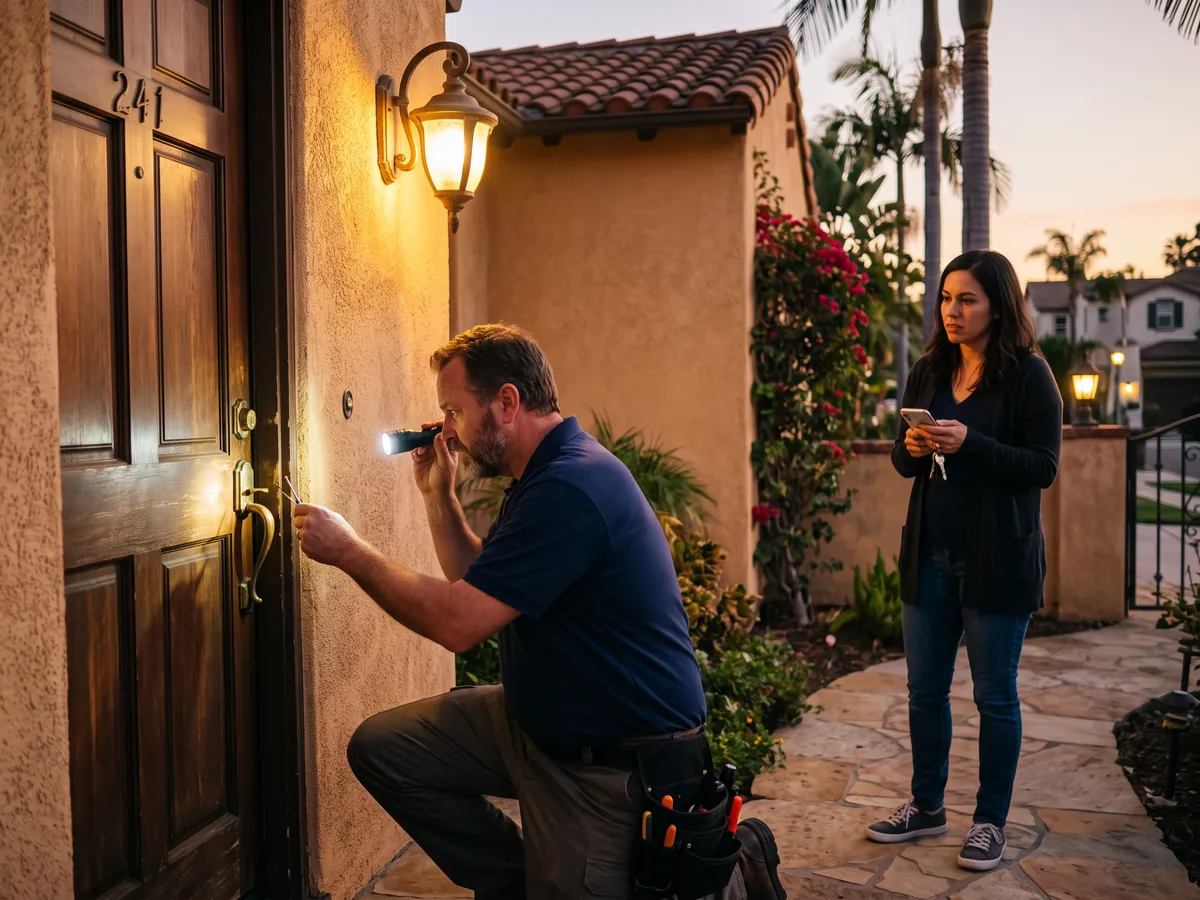
When a business can't open, can't lock, or has just been broken into, every hour costs something: payroll standing around, deliveries turned away, a storefront sitting exposed overnight. Julian's Locksmith works as an emergency locksmith for March Air Reserve Base shops, offices, restaurants and warehouses, and we know commercial hardware well: aluminum storefront deadlatches, mortise cylinders, panic bars, door closers and the padlocks on roll-up doors. Our day starts at 6:30 a.m., early enough to open a door before most first shifts. Owners and authorized managers can call (951) 903-3193, describe the door, and get a quote before the van leaves.
Emergency calls near March Air Reserve Base fall into two worlds: the ring of homes, lots and offices outside the fence, and the controlled ground inside it. We work the first. If you're shut out of a house in Orangecrest, stuck with a dead fob on the Metrolink platform at Meridian Parkway, or looking at a forced dock door in a Meridian Business Park building, that's an emergency locksmith call we can reach. A problem inside the gates is different, because the base decides who comes aboard and we won't try to talk past a checkpoint. Triage comes first. A child or pet shut in a hot car goes to 911 before anyone dials a locksmith, and on this flat, open land the sun heats a parked car fast. A damaged door gets secured before it gets upgraded. Once the immediate risk is handled, we sort out the lockout, the key or the hardware. Call (951) 903-3193 and expect an honest ETA based on where the van is and what I-215 is doing. Expect us to verify ID and ownership before we open a home, business or vehicle.
How this works in March Air Reserve Base
Not every lock problem is an emergency, and sorting them quickly saves money and stress. We think of urgent calls in three tiers. The first is life safety: a child, a pet or a vulnerable adult in danger inside a locked car or home, or a medical crisis behind a locked door. That tier belongs to 911, full stop. The second is security exposure: a door that won't lock after a break-in, keys stolen along with your address, a storefront that can't be secured at closing, an ex-partner who still holds a key. Those need an emergency locksmith the same day, because every hour the gap stays open is risk. The third is disruption: you're locked out, a key broke, the car won't start with its key, a keypad went dark. Nobody is in danger, but you can't get on with your day. In March Air Reserve Base, Julian's Locksmith handles the second and third tiers, and we'll help you work out which one you're in when you call. Sometimes the honest answer is that a sticky lock can wait for a scheduled visit, and we'll say that too.
How we can help in March Air Reserve Base
- Securing a door after a break-in. Pry damage on storefronts and sliders needs a different fix. A bent narrow-stile door may get a hookbolt adjustment or an added surface-mounted lock until a door shop replaces it, and a slider with a broken latch can take an auxiliary keyed lock or security bar. Shattered glass goes to a glazier or board-up crew.
- Broken and stuck key extraction. Keys that break in an ignition, a padlock or a file cabinet need a lighter touch, because wafer locks damage more easily than pin tumblers. We extract the fragment, check whether the break came from a worn key or a binding cylinder, and fix the cause. A worn key that broke once tends to break its copy too.
- Lost-key emergency rekeying. A business with a missing master key faces more exposure than a homeowner with a lost house key, since one master may open dozens of doors. We start with exterior doors and rooms holding cash, records, inventory or medication, then plan the rest of the system so the key chart stays accurate.
- Doors that won't lock or latch. Electrified doors fail in their own ways. A fail-secure electric strike that loses power stays locked from outside, while a fail-safe magnetic lock releases and leaves the door open to anyone. We can secure the opening mechanically and diagnose the lock side; panel, wiring and programming work may involve a low-voltage contractor.
- Urgent safety lock changes. California tenants with a protective order or qualifying police report can ask the landlord in writing to change the locks, and the landlord has 24 hours to do it. If the landlord doesn't act in time, the law lets the tenant have the locks changed. We can do that work and give you a receipt for the landlord.
Local factors in March Air Reserve Base
Inland heat turns ordinary lockouts into safety problems. A car interior parked in direct summer sun becomes dangerous quickly, keypad batteries fade sooner, and metal doors swell until deadbolts bind in their strikes. In March Air Reserve Base, if anyone is trapped in a hot car, call 911 immediately. For other lockouts, wait in shade or air conditioning and tell us if heat exposure is a concern.
Warehouses and distribution centers near March Air Reserve Base run early shifts, and a locked man door or seized dock padlock can idle a whole crew. We start at 6:30 a.m., cut and replace seized padlocks, rekey after a supervisor's keys go missing, and repair heavy-duty mortise locks and exit devices. Have the authorized contact available, and tell us the building and door or dock number when you call.
Commuters in March Air Reserve Base tend to hit lock trouble at the very start of the day: a car key that won't turn in the driveway before dawn, a fob locked in the car at a park-and-ride, a front deadbolt that won't throw on the way out. Our 6:30 a.m. start isn't early enough for every shift, so keep a spare car key at home and a plan for the earliest mornings.
Common situations
Picture a Thursday night after a long day on the flight line. A reservist pulls into a rental off Trautwein Road in Orangecrest and finds the garage side door ajar, the strike plate torn out of the jamb. Police take the report and leave, but the door won't stay shut. A typical visit would brace the frame with a steel reinforcer, fit a new Grade 2 deadbolt and drive 3-inch screws through the strike into the stud, so the house is locked before midnight. A carpenter can repair the frame in daylight.
- Imagine a tenant who has just received a protective order against a former partner who still has a key. The tenant gives the landlord a written request with the order attached, but a full day passes with no response. California law allows the tenant to have the locks changed at that point. We'd rekey or replace the cylinders, hand over the new keys, and provide a receipt the tenant can share with the landlord.
- A boutique owner in a shopping strip near Moreno Valley/March Field Metrolink Station goes to lock up at closing, and the key turns but the hookbolt in the aluminum door never swings out. The cylinder cam has stripped. Leaving an unlocked storefront overnight isn't an option. A typical fix is pulling the mortise cylinder, replacing the cam or the whole cylinder from van stock, and cycling the bolt several times before anyone heads home.
- Say a family returns from a weekend away to find the side door by the garage kicked in. The strike plate hangs by one screw and the jamb is split along the bolt line. Police have taken the report. We'd install a heavy-gauge strike with 3-inch screws, check whether the deadbolt bent, rekey if any keys went missing, and recommend a carpenter for the jamb, so the house can be locked that same night.
Step by step with Julian's Locksmith
- Check for danger first. If an intruder might still be inside after a break-in, step away and call the police, not a locksmith. Let officers clear the property and take their report. Once they leave, the emergency locksmith can secure the damaged door, and the report number will help with any insurance claim.
- Call and describe the problem. For vehicles, give us the year, make and model, whether it has push-button start, and where the keys are. For buildings, mention the lock brand if you can see it, and whether the door has a deadbolt, a lever, a storefront hookbolt, or a keypad.
- Hear the quote and an honest ETA. Before we dispatch, you hear what the job is likely to involve, a quote for that work, and a realistic arrival estimate. If the situation turns out different on site, we requote before continuing. You never pay for extra work you didn't approve first.
- Prepare while you wait. Wait somewhere safe and visible, such as a lit porch, a store entrance or a neighbor's living room. Keep your phone charged and answer unfamiliar numbers, since the technician may call for a gate code or directions while pulling in.
- Verification and damage-free entry. On arrival we check ID against the address or registration, then choose the gentlest method: picking, a bypass tool, or an air wedge and reach rod for cars. Drilling is a last resort, and we ask before doing it because it means installing a new cylinder.
- Secure it before we leave. If something can't be finished on the same visit, such as a dealer-only car key or a door that needs a carpenter, we leave things as secure as possible and explain exactly what comes next, who to call, and what that step should involve.
What affects the cost
- What kind of emergency it is. Opening a locked door is the simplest emergency job: tools, skill and a short visit. Extracting a broken key adds time. Rekeying after lost keys adds parts for each cylinder. Making a car key from nothing, or replacing hardware after a break-in, adds the most. We price each piece separately, so you can see what you're paying for.
- Security level of the lock or vehicle. Electronic locks bring their own variables. A keypad deadbolt that only needs batteries is a short visit; one with a failed motor or corrupted board may need replacing. Electric strikes, maglocks and access control panels can also involve a low-voltage contractor for the wiring and programming side.
- Damage and earlier attempts. What happened before we arrived affects the job. A keyway packed with superglue, a cylinder drilled halfway, or a door pried with a screwdriver often turns entry into replacement. If someone already tried, tell us on the phone; it helps us bring the right parts the first time.
Every job gets a clear quote before any work starts. Call (951) 903-3193 with the details and we'll tell you what to expect for your situation in March Air Reserve Base.
Mistakes to avoid
- Forcing a stuck car key with pliers or a wrench. When a key won't turn, the steering lock is often binding or the wafers are worn. Extra torque snaps keys and breaks ignition cylinders, turning a free fix, rocking the wheel gently, into a real repair.
- Copying a spare and calling it done after losing keys tagged with your address, or a wallet holding your license. A copy doesn't stop the lost key from working. Rekeying the exterior locks is the step that actually closes the gap, and it's usually less work than people expect.
- Chaining or padlocking the exit doors of an occupied business after a lock fails. Fire code requires egress doors to open from the inside without a key or special knowledge whenever people are in the building. Repair or replace the failed entrance lock instead of creating a trap.
What to do before we arrive
- Plan ahead for the stretch when we're closed, which runs from 11:30 p.m. to 6:30 a.m. Know who holds a spare key, whether your auto policy includes roadside assistance, and your landlord's after-hours number. A few minutes of planning now beats an evening sitting on the curb.
- Learn your fob's emergency blade before you need it. Most smart fobs have a release slide that frees a small mechanical key, and many driver's door handles hide a keyhole under a plastic cap. Find both once in daylight in your own March Air Reserve Base driveway, where nobody is watching the clock.
- Check deadbolt alignment once a season: throw the bolt with the door open, then again with it closed. If it moves smoothly open but drags or stops short when closed, the strike is misaligned. Fixing that at a scheduled visit is far easier than finding out when the bolt won't lock at night.
- After a break-in, photograph the door, frame, lock and every bit of damage before anything gets repaired. Your insurer will want images and police may ask too. Once you have them, getting the door locking again the same day matters more than waiting for an adjuster to look.
Getting to March Air Reserve Base
March Air Reserve Base is about 25 miles from our San Bernardino base, roughly 29 minutes in light traffic via University Parkway to I-215 South through San Bernardino, Colton and Grand Terrace, along the shared 60/215 stretch through Riverside past Box Springs. When you call, you get an arrival estimate based on where the technician is and the traffic at that moment.
Our path into March Air Reserve Base depends on where the previous job wrapped up. Sometimes that's a straight run via Meridian Parkway; other times it's surface streets the whole way. Either way, you get a heads-up call when the technician is close.
About March Air Reserve Base: March Field Air Museum, beside the flight line at 22550 Van Buren Boulevard, opened in 1979 and displays an SR-71A Blackbird, a B-52D and a B-17G among more than 100 aircraft.
| Neighborhoods | Woodcrest, Mead Valley, North Perris along Harley Knox Boulevard, South Moreno Valley along Cactus Avenue and Heacock Street, March Inland Port Airport, Edgemont |
|---|---|
| ZIP codes | 92518, 92508, 92551 |
| Main routes | I-215, SR-60, Van Buren Boulevard, Cactus Avenue |
| From our San Bernardino base | about 25 miles via University Parkway to I-215 South through San Bernardino, Colton and Grand Terrace, along the shared 60/215 stretch through Riverside past Box Springs, then I-215 South to Alessandro Boulevard, Cactus Avenue or Van Buren Boulevard; continue to Harley Knox Boulevard for north Perris and Mead Valley |
We start at half past six every morning, seven days a week. Every day the phones stay on until 11:30 at night, so an after-dinner lockout is usually still within reach. Saturday is no exception, with service ending at 11:30 at night. Call early that day if the problem can't wait until Sunday morning.
Before we open a home or business, we ask for photo ID and something tying you to the address: a lease, a utility bill, mail with your name on it, or written authorization from the property manager. It adds a minute or two, and it's the same check you'd want if a stranger tried to get into your place.
Locked out in March Air Reserve Base?
Call (951) 903-3193 with the address and what's locked. You'll get an arrival estimate and a quote before anyone heads out, and when we arrive we'll ask for ID that ties you to the property. If a child or pet is shut inside a hot car or building, call 911 first.
Frequently asked questions
What should I do if I'm locked out while you're closed?
Start with whoever already has a key: a landlord, property manager, relative or neighbor. For a vehicle, roadside assistance through your auto insurer or motor club may send someone. If you're safe and the property is locked, staying with a friend and calling us when we open at 6:30 a.m. is a reasonable plan. Anything involving danger to a person goes to 911.
Will you have to drill my lock to get me in?
Rarely. Most residential and commercial locks can be picked or bypassed without damage, and cars open with an air wedge and reach tool. Drilling becomes necessary with some high-security cylinders, seized or broken locks, and certain safes. If it comes to that, we explain why, ask first, and fit a new cylinder before leaving so your March Air Reserve Base door still locks.
Do you handle smart lock and keypad emergencies?
Yes. Most come down to dead batteries, which we fix after opening the door through the key override or by powering the keypad from its emergency terminals. We also deal with jammed motors, lost codes and locks that dropped off the app. Common brands include Schlage Encode, Kwikset Halo, Yale Assure, Lockly and Ultraloq. Some failures mean a replacement.
What if my car is stuck on a freeway shoulder or in a parking garage?
On a freeway shoulder, safety comes first: stay well away from traffic and call the CHP or your roadside service, since a tow to a safe spot may be needed before anyone can work on the car. In a parking structure near Riverside National Cemetery or anywhere else, tell us the level and space number and any height limit so the technician can reach you.
Do you open safes in an emergency?
Yes, when you can show the safe is yours. Electronic safes often fail from dead batteries or a bad keypad, and some can be powered externally or opened with an override key. Mechanical safes may need manipulation, or drilling followed by repair. A safe opening can take longer than a door, so the emergency locksmith sets expectations before starting.
How do you verify I live there if my ID is locked inside?
We can often open the door first, then check your ID and proof of residence before you go in or before we leave. Phone photos of a license, lease or utility bill help a lot. If nothing ties you to the address, the owner, landlord or another resident will need to confirm. That care keeps the wrong person out of your home, too.
How far is March Air Reserve Base from your base?
March Air Reserve Base is about 25 miles from our San Bernardino base, roughly 29 minutes in light traffic. Arrival time depends on traffic and on the job the technician is finishing, so we give you an estimate on the phone before you commit.
Related services in March Air Reserve Base
- 24 Hour Locksmith in March Air Reserve Base
- Mobile Locksmith in March Air Reserve Base
- Locksmith Near Me in March Air Reserve Base
- Emergency Lockout Service in March Air Reserve Base
- Emergency Door Unlocking in March Air Reserve Base
- Emergency Locksmith Open Now in March Air Reserve Base
- Home Lockout in March Air Reserve Base
- Car Lockout in March Air Reserve Base
- Business Lockout in March Air Reserve Base
- Broken Key Stuck in Door in March Air Reserve Base
Emergency Locksmith in nearby cities
- Emergency Locksmith in Mead ValleyRiverside County
- Emergency Locksmith in Moreno ValleyRiverside County
- Emergency Locksmith in PerrisRiverside County
- Emergency Locksmith in Good HopeRiverside County
- Emergency Locksmith in RiversideRiverside County
- Emergency Locksmith in NuevoRiverside County
- Emergency Locksmith in RomolandRiverside County
- Emergency Locksmith in Grand TerraceSan Bernardino County


