
Homeland, Riverside County
Locked Out, Broken Into or Stranded in Homeland? Emergency Locksmith Help
Short answer: Price and timing depend on what's locked, where it is, and what has to happen after the door opens. Entry is quicker than making a car key from scratch or replacing a kicked-in deadbolt. Tell the emergency locksmith exactly what happened, have photo ID and proof you live there or own the vehicle, and you'll hear a firm quote for your Homeland address before work begins.
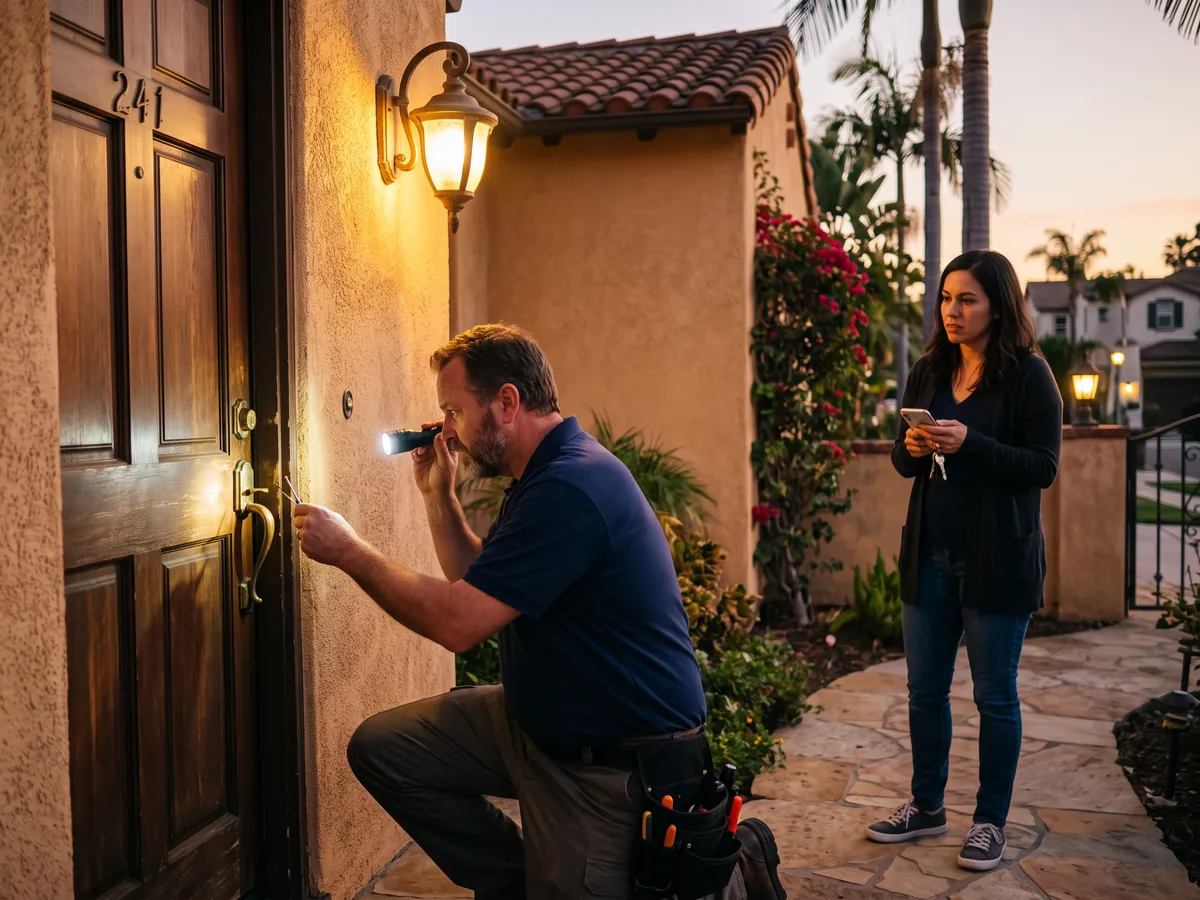
When a business can't open, can't lock, or has just been broken into, every hour costs something: payroll standing around, deliveries turned away, a storefront sitting exposed overnight. Julian's Locksmith works as an emergency locksmith for Homeland shops, offices, restaurants and warehouses, and we know commercial hardware well: aluminum storefront deadlatches, mortise cylinders, panic bars, door closers and the padlocks on roll-up doors. Our day starts at 6:30 a.m., early enough to open a door before most first shifts. Owners and authorized managers can call (951) 903-3193, describe the door, and get a quote before the van leaves.
Emergency calls from Homeland come in three kinds: a house or manufactured home that won't lock, a car that won't open or start, and a shop or storage space left standing open. Each gets sorted by what has to happen first. On a manufactured home, an out-swing door that was forced is easy to mistake for one that's merely stuck, and the hinge side tells the story. Triage comes before anything else. If a child, an older adult or a pet is shut inside a hot car or a closed house, call 911 first. Summer days here pass 100 degrees, and a parked car heats up long before a locksmith can finish a 40-mile drive from University Heights. For everything else, tell us the street, your space number and gate code if you live in a park, and what the lock is doing. We give an honest ETA instead of a promise, since I-215 through Riverside and Highway 74 set the pace. We're open every day until 11:30 p.m., weekends included.
What to know first in Homeland
Emergency entry should leave the property the way we found it. For residential pin-tumbler locks, that means picking with a tension wrench and pick, or raking a builder-grade cylinder. Lever handles can often be operated from the inside with an under-door tool, and spring latches without anti-shim plungers can sometimes be slipped. For vehicles, an inflatable air wedge opens a narrow gap at the top corner of the door so a long-reach rod can press the lock switch, or a Lishi tool picks the door cylinder while reading its cuts. Commercial doors call for mortise cylinder picking and care around aluminum stiles that bend easily. Destructive entry exists for good reasons, though. A Medeco or Mul-T-Lock cylinder, a lock seized by corrosion, or a safe with a failed lock may need drilling. When that's the case, the emergency locksmith explains why, shows you any alternative, and replaces what was drilled before leaving your Homeland property. Drilling should never be something you discover on the invoice.
How we can help in Homeland
- Vehicle lockouts, including trunks. Many push-button cars are designed not to lock with the fob inside, so when it happens anyway the fob's coin cell is a prime suspect. After opening the door we test that battery so it doesn't repeat. Where reach tools are awkward, a Lishi pick turns the door cylinder exactly as the key blade would.
- Business and storefront lockouts. Storefront lockouts usually involve an aluminum narrow-stile door with an Adams Rite deadlatch or swinging hookbolt, run by a mortise cylinder. We pick or bypass the cylinder rather than prying the stile, which bends easily and costs a lot to replace. Before any work, we confirm you're the owner or an authorized manager.
- Broken and stuck key extraction. A key that's stuck but whole is a separate problem. It usually means the plug hasn't returned to the vertical position where the key can exit, or a pin is binding on a worn blade. Yanking bends the key. An emergency locksmith frees it, lubricates the cylinder with dry graphite or PTFE, and cuts a new key if needed.
- Lost-key emergency rekeying. Lost keys turn urgent when they were attached to something with your address on it: a tagged key ring, a car registration, a wallet with your license. Rekeying swaps the pin stacks in each cylinder so the lost keys stop working, without changing the hardware on the door. Every exterior lock can usually share one new key.
- Dead smart locks, keypads and safes. Dead batteries are the usual reason a smart lock leaves you outside. Many keypad deadbolts, including keyed versions of the Schlage Encode and Kwikset Halo, have a cylinder for exactly this moment, and if the key is inside, we pick that cylinder. Some keypads hide 9-volt contacts or a USB port for emergency power.
Local factors in Homeland
Foothill homes around Homeland live with dust, wind and wildfire seasons. Santa Ana winds drive grit into exterior cylinders and slam doors hard enough to bend strikes. During an evacuation warning, a lock that won't secure or a gate that won't open feels urgent, but official orders come first; leave safely, then call an emergency locksmith to deal with the hardware once you're allowed back.
Newer tracts around Homeland usually come with builder-grade deadbolts and knobsets, keypad locks and app-controlled garage openers. Builder-grade cylinders pick open readily during a lockout, which is also why a rekey after move-in makes sense: you don't know how many construction-era keys are floating around. Emergency calls in newer homes often involve keypads with dead batteries, or a garage entry door that locked behind someone carrying groceries.
Rural properties near Homeland bring long driveways, locked ranch gates, outbuildings and workshop padlocks. Give clear directions, including gate codes and exactly which structure is locked, because addresses on large lots can be vague. Padlocks left out in the weather often seize, and we can cut and replace them. Distance from our San Bernardino base matters here, so expect an honest arrival estimate up front.
Situations this covers
Say a resident of a single-wide just off Highway 74 gets home at 9 p.m. on a Tuesday and finds the front door ajar, the latch bent outward where someone pried it. Nothing is missing, but the door won't stay shut. We would check the frame and hinge pins, replace the damaged lockset, and add a reinforced strike so the next shove meets solid framing. If the jamb is split too badly to hold screws, we'd close the door up securely for the night and leave the carpentry for daylight.
- For example, a shipping supervisor arrives at 6:30 a.m. to open a roll-up dock door, and the padlock on the hasp won't release; its shackle has seized with rust and grit. A truck is already backing in. We'd try the key with penetrating lubricant first, then cut the shackle cleanly if needed, and install a new shrouded padlock from van stock so the dock can be locked again at the end of the shift.
- Consider a Saturday night just before midnight. A renter in an apartment near Juniper Flats Road realizes the keys are inside, and we closed at 11:30 p.m. We won't pretend otherwise. The practical moves are the complex's after-hours maintenance line, a roommate or relative with a spare, or a night at a friend's place. If the situation can wait safely, calling us Sunday morning at 6:30 gets the door opened without damage.
- A boutique owner in a shopping strip near Motte Historical Museum goes to lock up at closing, and the key turns but the hookbolt in the aluminum door never swings out. The cylinder cam has stripped. Leaving an unlocked storefront overnight isn't an option. A typical fix is pulling the mortise cylinder, replacing the cam or the whole cylinder from van stock, and cycling the bolt several times before anyone heads home.
From your call to the finished job
- Check for danger first. If an intruder might still be inside after a break-in, step away and call the police, not a locksmith. Let officers clear the property and take their report. Once they leave, the emergency locksmith can secure the damaged door, and the report number will help with any insurance claim.
- Call and describe the problem. For vehicles, give us the year, make and model, whether it has push-button start, and where the keys are. For buildings, mention the lock brand if you can see it, and whether the door has a deadbolt, a lever, a storefront hookbolt, or a keypad.
- Hear the quote and an honest ETA. Our arrival estimate reflects traffic and distance from wherever the technician is right now, not a number pulled from the air. If it's too long for your situation, you're free to make other arrangements; we'd rather you know now than wait and wonder.
- Prepare while you wait. Find your photo ID plus something tying you to the address or vehicle: a lease, utility bill, registration or insurance card. A phone photo works if the paper is locked inside. Having it ready turns verification into a quick check instead of a search.
- Verification and damage-free entry. If your documents are locked inside, the emergency locksmith may open the door and then check them before you go in or before leaving. Without proof of ownership or residency, nobody gets let in; that rule protects you as much as anyone.
- Secure it before we leave. If something can't be finished on the same visit, such as a dealer-only car key or a door that needs a carpenter, we leave things as secure as possible and explain exactly what comes next, who to call, and what that step should involve.
What affects the cost
- What kind of emergency it is. The same call can grow or shrink. A home lockout might become entry plus a deadbolt repair if the bolt was binding in the first place, and a car lockout turns into key origination if the keys aren't inside after all. The emergency locksmith requotes whenever the job changes, before doing more work.
- Parts and hardware. For car keys, the blank or fob is often the largest single item. A smart fob costs more than a basic transponder key, and many vehicles accept only specific parts matched by FCC ID and part number. We'll show you the options instead of quoting the priciest one by default.
- Damage and earlier attempts. What happened before we arrived affects the job. A keyway packed with superglue, a cylinder drilled halfway, or a door pried with a screwdriver often turns entry into replacement. If someone already tried, tell us on the phone; it helps us bring the right parts the first time.
Every job gets a clear quote before any work starts. Call (951) 903-3193 with the details and we'll tell you what to expect for your situation in Homeland.
What to do before we arrive
- Mount a small combination lockbox somewhere out of sight, such as inside the side-yard gate or behind a shrub, holding one house key and a mechanical car blade. Change the code after sharing it with a contractor, dog walker or house sitter, and check the key still works every few months.
- Leave a spare house key with a trusted neighbor or relative in Homeland instead of under the doormat or inside a fake rock. Those hiding spots are the first places a burglar checks. A neighbor two doors down can end a lockout before you ever need an emergency locksmith.
- After a break-in, photograph the door, frame, lock and every bit of damage before anything gets repaired. Your insurer will want images and police may ask too. Once you have them, getting the door locking again the same day matters more than waiting for an adjuster to look.
- Learn your fob's emergency blade before you need it. Most smart fobs have a release slide that frees a small mechanical key, and many driver's door handles hide a keyhole under a plastic cap. Find both once in daylight in your own Homeland driveway, where nobody is watching the clock.
What not to do
- Chaining or padlocking the exit doors of an occupied business after a lock fails. Fire code requires egress doors to open from the inside without a key or special knowledge whenever people are in the building. Repair or replace the failed entrance lock instead of creating a trap.
- Calling a locksmith when the situation belongs to 911. A child or pet in a hot car, or someone unresponsive inside a home, needs emergency responders who can force entry on the spot. A locksmith is the right call when nobody is in danger, not when every moment counts.
- Squirting superglue or epoxy into a keyway, or jamming a screwdriver in to turn it, after a key breaks. Glue bonds the pins in place and turns a simple extraction into a cylinder replacement, and a screwdriver can shear pins or crack the plug outright.
Reaching Homeland
Homeland is about 40 miles from our San Bernardino base, roughly 45 minutes in light traffic via University Parkway to I-215 South through San Bernardino, Colton and Riverside, past March Air Reserve Base and Perris to Exit 15. When you call, you get an arrival estimate based on where the technician is and the traffic at that moment.
Rush hour on I-215 can stretch a drive considerably. We'd rather give you a realistic arrival window than an optimistic one, and we'll call you if a closure or a crash changes the plan.
About Homeland: Homeland lies along the southern edge of the Lakeview Mountains, a range of about 30 square miles formed mainly of Cretaceous tonalite from the Lakeview Mountains Pluton.
| Neighborhoods | Juniper Flats Road area, Romoland, Highland Palms, Leon Road, Highway 74 corridor, Homeland Avenue |
|---|---|
| ZIP codes | 92548, 92545 |
| Main routes | SR-74, I-215, SR-79, Juniper Flats Road |
| From our San Bernardino base | about 40 miles via University Parkway to I-215 South through San Bernardino, Colton and Riverside, past March Air Reserve Base and Perris to Exit 15 (SR-74 East toward Hemet) in Menifee, then about five miles east on Highway 74 through Romoland into Homeland |
Here are our real hours: 6:30 a.m. to 11:30 p.m., every day of the week, weekends included. We aren't a 24/7 locksmith and won't pretend to be. If you're locked out while we're closed, your auto club or your property manager's emergency line may get you in sooner, and we're glad to book you for the moment we reopen.
Car keys are made only for the registered owner or someone the owner has authorized. Have your driver's license plus the registration or title ready, and we match the name and VIN before cutting or programming anything. If the paperwork is inside the locked car, we open it first and check before going further.
Locked out in Homeland?
Call (951) 903-3193 with the address and what's locked. You'll get an arrival estimate and a quote before anyone heads out, and when we arrive we'll ask for ID that ties you to the property. If a child or pet is shut inside a hot car or building, call 911 first.
Frequently asked questions
Can you make a car key if I've lost every key?
Usually, yes. With proof of ownership, we decode the lock or obtain the key code, cut a new blade on the van's machine, and program the transponder or smart key through the OBD-II port right where the car is parked. Some makes and newer models require dealer programming, and we'll tell you on the phone if yours is one of them.
My key broke off in the lock. What should I do?
Leave the stub alone, keep the piece that came out, and don't add glue or oil. Use another door if you can. We extract the fragment with thin hooks or by removing the cylinder, figure out why it broke (usually a worn key or a binding cylinder), and cut a fresh key from the pieces or by code.
Can a store manager authorize an emergency business lockout?
Yes, if you have the authority. We ask for ID and confirmation that you can approve work at that location, such as a call to the owner, a letter on file, or your name on the lease or business license. Employees without that authority can't approve entry or lock changes, which protects the business from former staff and impostors.
What counts as an emergency locksmith call?
Anything that leaves you unable to get in, unable to lock up, or unable to drive: house, apartment, car and business lockouts, keys broken in a lock, doors damaged in a break-in, lost keys tied to your address, dead keypad locks and failed storefront hardware. If someone's safety is at risk, call 911 first. For everything else in Homeland, call (951) 903-3193.
What should I do if I'm locked out while you're closed?
Start with whoever already has a key: a landlord, property manager, relative or neighbor. For a vehicle, roadside assistance through your auto insurer or motor club may send someone. If you're safe and the property is locked, staying with a friend and calling us when we open at 6:30 a.m. is a reasonable plan. Anything involving danger to a person goes to 911.
Is Julian's Locksmith licensed in California?
Yes. Julian's Locksmith holds California locksmith company license LCO7891, issued by the Bureau of Security and Investigative Services, which administers the state's Locksmith Act. You can confirm it at search.dca.ca.gov. Asking any locksmith for a license number before work starts is one of the simplest ways to tell a local company from a call center reselling jobs.
How far is Homeland from your base?
Homeland is about 40 miles from our San Bernardino base, roughly 45 minutes in light traffic. Arrival time depends on traffic and on the job the technician is finishing, so we give you an estimate on the phone before you commit.
Related services in Homeland
- 24 Hour Locksmith in Homeland
- Mobile Locksmith in Homeland
- Locksmith Near Me in Homeland
- Emergency Lockout Service in Homeland
- Emergency Door Unlocking in Homeland
- Emergency Locksmith Open Now in Homeland
- Home Lockout in Homeland
- Car Lockout in Homeland
- Business Lockout in Homeland
- Broken Key Stuck in Door in Homeland
Emergency Locksmith in nearby cities
- Emergency Locksmith in WinchesterRiverside County
- Emergency Locksmith in RomolandRiverside County
- Emergency Locksmith in NuevoRiverside County
- Emergency Locksmith in MenifeeRiverside County
- Emergency Locksmith in PerrisRiverside County
- Emergency Locksmith in Quail ValleyRiverside County
- Emergency Locksmith in Canyon LakeRiverside County
- Emergency Locksmith in Good HopeRiverside County


