
Good Hope, Riverside County
Emergency Locksmith Open Now in Good Hope
Short answer: If anyone is in danger, a child or pet is trapped, or someone may be hurt behind a locked door, call 911 first. For a lock emergency where everyone is safe, such as a forced door, a snapped key or a lockout, call Julian's Locksmith at (951) 903-3193. We sort calls by safety first, then by how exposed your property is, and tell you honestly where you stand.
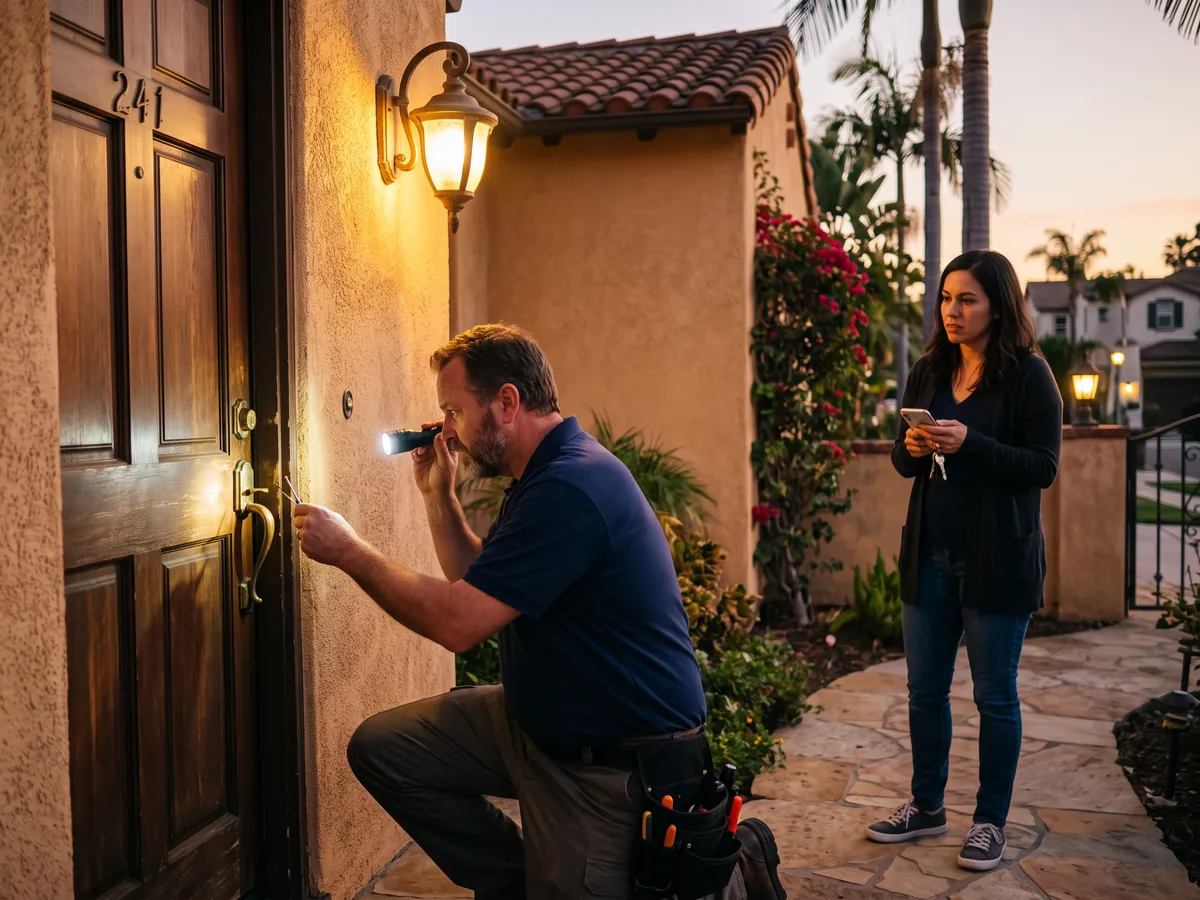
When you call an emergency locksmith open now, four answers move a van faster than any amount of panic: where exactly you are, what you need to get into or secure, what happened, and whether anyone or anything is at risk. Have those ready when you call (951) 903-3193 from Good Hope, along with a number that will pick up if you step away. Cell coverage drops in garages, stairwells and canyon roads, so say so if it might. Then relax your shoulders a little. We'll quote the job, give an honest ETA and tell you whether you can do anything useful while you wait.
What to expect in Good Hope
Emergencies are exactly when someone might try to talk a locksmith into opening a door that is not theirs, so verification doesn't relax when the clock is running. We ask for photo ID and something that ties you to the place: a lease, a utility bill, mail, a vehicle registration, or an ID showing the address. If your wallet is inside, we can often work from a phone photo, a call to your landlord or property manager, or a confirmation from a co-owner. We won't open a home, business or car on a story alone. California's Locksmith Act, administered by the Bureau of Security and Investigative Services, is the law behind that rule, and you can look up our license, LCO7891, at search.dca.ca.gov while you wait for us to arrive. Anyone who offers to skip the ID step would open your door for a stranger just as readily, so treat a locksmith who insists on checking as the one doing the job properly.
What we can do on-site
- Lockouts where waiting is the problem. Some lockouts can't wait for a spare key across town: a pot left on the burner, a toddler napping inside with a sitter unreachable, medication on the kitchen counter. If you smell smoke or hear a child in distress, call 911 first. For everything short of that, we come to Good Hope and open the door without damage.
- Doors that won't latch, lock or close. Heat and seasonal movement push doors out of square, and a bolt that slid freely in winter binds in August. We re-bore or reset the strike so that the bolt throws cleanly, and we check hinges while we're there, since sag at the top hinge is a common hidden cause. The goal is a door that locks with a light turn, not a shove.
- Keys stolen, lost with an address, or in the wrong hands. A stolen bag with your keys and an ID card is an emergency even if nothing at home has been touched yet. The thief knows the address and holds a key. We re-pin or replace the cylinders on every exterior door, usually in one visit, so the old keys become useless that same evening.
- Business doors that can't stay open overnight. A storefront with a failed lock is an overnight liability. Cash, inventory and equipment sit behind glass, and an unlocked door invites the next problem. We handle aluminum storefront locks, hookbolts, panic hardware and rolling-gate locks, and we get a door secured or temporarily reinforced before you leave the building.
- The follow-up visit once the emergency is over. Emergency work is quick by design, so we often suggest a short second visit in daylight. That's when a temporary lock becomes permanent hardware, a mismatched key set gets cleaned up and any rough edges from the night before are finished properly. You choose whether to book it; the urgent part is already behind you.
What's different about Good Hope
Yards and warehouses meet emergencies at shift change: a padlock that won't release at 6:45 a.m., a roll-up door lock sheared overnight, a sliding gate latch bent by a truck. We start at 6:30 a.m. every day, which fits early dock schedules. Bring a manager's authorization and tell us whether the gate uses a keypad, a chain or a cylinder. Guard shacks usually need to know we're coming, so call ahead.
Canyon roads and foothill homes bring patchy cell coverage and limited access. Share a landmark and a backup number, and walk to a spot with signal before you dial. Wildfire season adds another wrinkle: after an evacuation you may return to a door forced by responders, or a smart lock that lost power. In red-flag wind, we'll help you pick the safest place to wait and give a realistic arrival estimate.
Family emergencies are usually small and loud: a teenager locked out after practice, a toddler who pushed a bathroom privacy lock, a garage entry door that won't latch. If a young child is stuck behind a locked door or inside a car, call 911. Otherwise we come to your street in Enchanted Hills, verify ID and open the lock without damage, then suggest a spare-key plan so the next lockout is a call to a neighbor.
Example situations
- Say it's 11:10 p.m. on a Saturday and a tenant realizes a former roommate never returned a house key. We close at 11:30 p.m. and reopen at 6:30 a.m., so we'd tell her straight away whether the drive fits. If it doesn't, she'd wedge the door shut that night, and we'd rekey the locks first thing Sunday morning.
- Consider a shop owner who finds the glass storefront door's hookbolt jammed half-extended at closing time. He can't lock it and can't leave it. We'd arrive with Adams Rite parts and a spare cylinder, free the bolt, test the deadlatch and confirm the door locks from outside. Cash and stock stay secure, and nobody sleeps in the store.
- A typical late call: it's 10:50 on a Wednesday night, a homeowner in Good Hope is back from dinner and finds the garage entry door kicked in, the jamb split along the strike plate. Police take the report first. We'd then ask for photos, arrive before our 11:30 p.m. close if the drive allows, fit a reinforced strike and a fresh deadbolt, and leave the door holding for the night.
- Imagine a parent in a gated community off Santa Rosa Mine Road who steps onto the porch to take out recycling and hears the door click behind her. The baby is asleep upstairs and the monitor is glowing through the window. We'd tell her to call 911 if the child wakes in distress, then come as quickly as the roads allow, with ID and proof of address ready.
How the visit works
- Answer the four questions. The call opens with short questions on purpose. Where are you standing? What does the lock or vehicle look like? Did anything get forced? Is someone inside? A minute of clear answers tells us which tools, parts and key blanks to load, and whether this sounds like an emergency or a job we can book for a calmer hour.
- Decide whether to go, wait or refer. Once we know the situation, we make one of three calls. If it's urgent and within our hours, we go. If it's something that can wait until morning, we offer the first opening. If it's not a lock problem, such as a medical or fire emergency, we say so and point you to 911 or another service immediately.
- Hear the quote and the ETA. Before the van leaves, you hear a price for the job as you've described it and an arrival estimate based on where we are and current traffic. It is an honest estimate, not a promise we'd have to break. If something changes on site, we requote before doing any extra work.
- Stay safe and reachable while we drive. Wait somewhere lit, visible and comfortable: inside an open store, a lobby, or a neighbor's porch if they offer. Keep your phone charged and answer unknown numbers, since the call may be us confirming your gate or exact spot. Don't wait beside a busy road or in dry brush on a windy day.
- Verify, then open or repair with the least damage. We work slowly, because speed that scratches a door or bends a frame isn't a good trade. If a lock has to be destroyed, we explain why first and quote the replacement. For forced doors, we assess the frame at this stage and decide what can be fixed tonight and what needs a carpenter.
- Secure it, test it and plan the follow-up. Before we leave, we test every lock we touched with the door open and closed. The bolt should throw freely, the latch should catch and every key we cut should work. If the repair is temporary, we tell you exactly what it is and what the permanent version would involve.
What affects the cost
- What failed and what it takes to fix. Entry-only and entry-plus-repair are different jobs on the same call. If we open a door and the cylinder is also worn out, the repair is optional work we explain and price separately. You approve each piece before it starts, so the quote you agreed to on the phone doesn't quietly grow while the door is open.
- The hour you call within our schedule. Ask whether the job can wait. A spare key, a sticky lock or a rekey that isn't urgent is usually cheaper to book for the next open morning than to rush at the end of a long evening. We'll say plainly if you're better off waiting, because a rush price shouldn't be spent on a problem that can keep.
- Paperwork for police, insurers and landlords. Check your deductible before you file anything. A lock and strike repair is often smaller than a typical homeowner's or renter's deductible, so your insurer may not pay on it, but a larger loss from the same break-in might. We can't advise on your policy, but we can give you clean documentation either way.
Every job gets a clear quote before any work starts. Call (951) 903-3193 with the details and we'll tell you what to expect for your situation in Good Hope.
Common errors that cost time and money
- Cleaning up or replacing the lock before documenting anything. Fresh photos and the original damaged hardware help with police reports, insurance claims and landlord disputes. Take pictures first, keep the broken parts in a bag, and then let us repair the opening.
- Paying a rush price for something that can keep. A spare key, a sticky lock or a rekey on a routine move rarely needs an urgent visit. Book the next opening, save the cost of a late-evening call and keep emergency slots open for people with a door that won't close.
- Securing only the damaged door. If your keys were stolen or someone had a copy, the other exterior locks are just as exposed. A forced back door gets fixed, then the thief walks in through the front with the stolen key. Cover every exterior entry in the same visit.
Practical tips before you call
- Businesses should keep a laminated card in the manager's wallet: who can authorize locksmith work, the lease or license on file, the after-hours contacts and a photo of each door's lock. When a storefront fails at closing, being able to prove authority in thirty seconds changes the whole evening.
- Have your alarm code, gate code and the names of any pets ready before we arrive. A technician who opens a door into a screaming alarm or a worried dog loses time. If an alarm monitoring company will phone you, tell them a licensed locksmith is on the way so the call doesn't escalate.
- Call from somewhere with a solid signal, give us a callback number and keep the phone charged. If you walk into a dead zone, text the address. In canyons, garages and stairwells, move before you dial. Answer unknown numbers for the next half hour, since it may be us confirming your gate or spot.
- Write a household key list: who has which key, when it was copied and where the spares are. During an emergency it saves minutes, and afterward it tells you exactly which locks need rekeying. Include contractors, cleaners, dog walkers and exes, because a key that left your hand years ago is still a key.
Getting to Good Hope
Good Hope is about 38 miles from our San Bernardino base, roughly 45 minutes in light traffic via Palm Ave to I-215 South through Colton, Riverside and Moreno Valley, past March Air Reserve Base to the Perris exits. When you call, you get an arrival estimate based on where the technician is and the traffic at that moment.
Commercial jobs on busy stretches like Cowie Avenue sometimes need a parking plan, especially for storefront doors or roll-up gates. Let us know about loading zones, red curbs or parking structures before we arrive.
About Good Hope: The CDP covers about 11.2 square miles of land at an elevation near 1,624 feet, and nearly all addresses use the Perris name with the 92570 ZIP code.
| Neighborhoods | Meadowbrook, Spring Street and Mountain Avenue, Marshall Road and Cowie Avenue, Steele Peak foothills, Old Elsinore Road, Mead Valley |
|---|---|
| ZIP codes | 92570 |
| Main routes | State Route 74, I-215, Ellis Avenue, Theda Street |
| From our San Bernardino base | about 38 miles via Palm Ave to I-215 South through Colton, Riverside and Moreno Valley, past March Air Reserve Base to the Perris exits (Exit 18, D Street, or Exit 17, Highway 74), then west on 4th Street, which becomes Highway 74, to Ellis Avenue |
Planning a non-urgent job like a rekey, a smart lock install or a safe combination change? Every day of the week, appointments are available from first thing in the morning into the late evening, with 11:30 p.m. as closing time. Fridays and Saturdays follow the same schedule.
California's Locksmith Act requires a signed work order when a locksmith opens a residence or commercial property, recording the requester's name, address, phone number, date of birth and ID number. Business and Professions Code §6980.55 has us keep those records for two years, available to BSIS and peace officers on request.
Locked out in Good Hope?
Call (951) 903-3193 with the address and what's locked. You'll get an arrival estimate and a quote before anyone heads out, and when we arrive we'll ask for ID that ties you to the property. If a child or pet is shut inside a hot car or building, call 911 first.
Frequently asked questions
What if I'm calling after 11:30 p.m.?
Then we're closed for the night, and we won't pretend otherwise. Secure the door with whatever you have, wedge it, add a chair or a dowel in a slider track, and call us when we reopen at 6:30 a.m. We're open seven days a week. If anyone is in danger or a break-in is happening, call 911. For a car, try your insurer's or auto club's roadside line.
Can you secure my door after a break-in?
Yes, once the police have finished and you've photographed the damage. We repair or replace the latch and deadbolt, fit a reinforced strike plate with long screws and make sure the door closes and locks. If the jamb is split beyond what hardware can hold, we'll say so and suggest a temporary brace until a carpenter repairs the frame. You'll get an itemized invoice for your insurer or landlord.
How can I tell the locksmith is licensed?
Ask for the company's legal name and California locksmith license number before the van moves. Ours is LCO7891, issued by the Bureau of Security and Investigative Services, and you can verify it at search.dca.ca.gov in under a minute. Be wary of ads that never name a business or quote a vague price. A licensed locksmith gives you the name, the number and the full price.
What counts as an emergency for a locksmith?
Anything where safety or security can't wait for the next opening: a door that won't close after a break-in, keys stolen along with your address, a former partner or employee who still has a key, a business that can't lock up for the night. A spare key, a sticky deadbolt or a routine rekey is not an emergency, and we'll tell you honestly if yours can wait until morning.
My smart lock or keypad died. Is that an emergency?
It can feel like one when you're standing outside. Most units have a hidden mechanical key, an outside battery contact or a backup code, and we can walk you through them by phone. If those fail, we open the door and diagnose a dead battery pack, a lost network link or a failed motor, then repair it or fit a plain deadbolt for tonight.
What will you ask me when I call?
Four things, mostly: where you are, what you need opened or secured, what happened and whether anyone or anything is at risk. After that come details that pick our tools: the lock brand or door type, the vehicle's year, make and model, whether an alarm is armed and whether pets are inside. A callback number matters too, in case your signal drops while we're on the way.
How far is Good Hope from your base?
Good Hope is about 38 miles from our San Bernardino base, roughly 45 minutes in light traffic. Arrival time depends on traffic and on the job the technician is finishing, so we give you an estimate on the phone before you commit.
Related services in Good Hope
- Emergency Locksmith in Good Hope
- Locksmith Open Now in Good Hope
- 24 Hour Locksmith in Good Hope
- Emergency Lockout Service in Good Hope
- Emergency Door Unlocking in Good Hope
- Home Lockout in Good Hope
- Car Lockout in Good Hope
- Broken Key Stuck in Door in Good Hope
- Mobile Locksmith in Good Hope
- Same Day Locksmith in Good Hope
Emergency Locksmith Open Now in nearby cities
- Emergency Locksmith Open Now in PerrisRiverside County
- Emergency Locksmith Open Now in Mead ValleyRiverside County
- Emergency Locksmith Open Now in Quail ValleyRiverside County
- Emergency Locksmith Open Now in Canyon LakeRiverside County
- Emergency Locksmith Open Now in RomolandRiverside County
- Emergency Locksmith Open Now in Lake ElsinoreRiverside County
- Emergency Locksmith Open Now in MenifeeRiverside County
- Emergency Locksmith Open Now in NuevoRiverside County


