
Fullerton, Orange County
Storefront Lock Repair in Fullerton: Aluminum Door Locks Fixed On-Site
Short answer: Repair the lock when the deadlock body still throws its bolt cleanly with the door standing open; replace it when the hookbolt is bent, the case is cracked, or a pry attempt has distorted the stile pocket. For shops in Fullerton, we carry common MS1850-series deadlocks, deadlatches, mortise cylinders and cams, so most doors are secured on the first visit, at a price you approve beforehand.
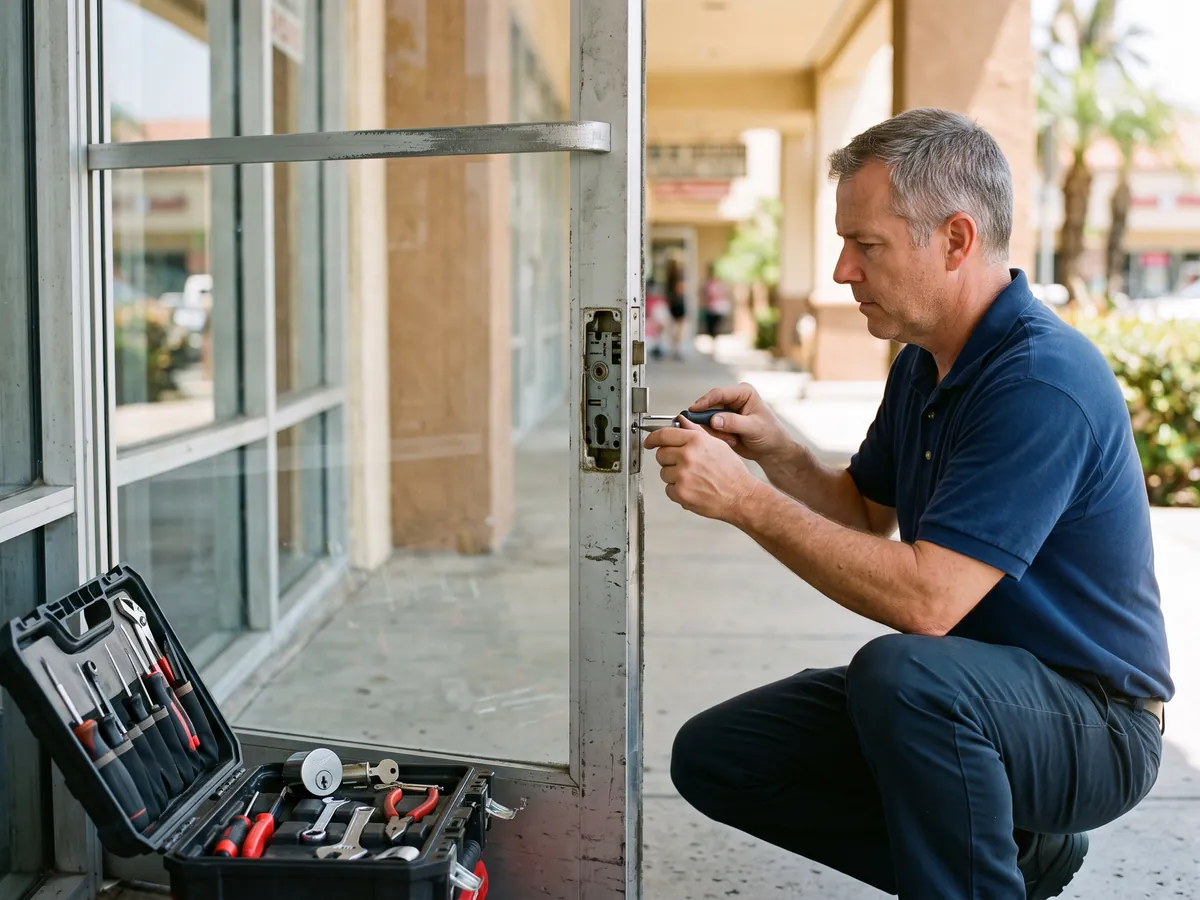
The front door of a shop in Fullerton gets locked and unlocked more than any other lock the business owns, and on an aluminum storefront that lock lives inside a stile barely two inches wide. When the key starts fighting you, the hookbolt stops short, or the paddle handle flops loose, customers notice before you do. Julian's Locksmith handles storefront lock repair on-site: we diagnose the deadlock, cylinder, cam, latch and strike as one system, explain what actually failed, and quote before touching anything. Most doors are back to locking properly on the same visit, using parts we carry in the van. Call (951) 903-3193 and tell us what the door is doing.
Narrow-stile aluminum doors define commercial Fullerton. You see them on Harbor Boulevard in the SOCO District, on shops along Orangethorpe Avenue and in the Amerige Heights Town Center, each with a slim vertical frame and not much room for a lock. The most common hardware is an Adams Rite deadlatch or hookbolt lock, often the MS1850 family, with a mortise cylinder on the outside and a thumbturn or a second key inside. When those locks fail, the cause is usually simple. The key may turn but not retract the latch because the cylinder's cam has worn or slipped on the tailpiece. The deadlatch may catch only some of the time because the door has sagged and the bolt no longer lines up with the strike. The hookbolt may drag on a bent strike plate. Paddle handles loosen when screws back out of thin aluminum. Storefront lock repair means replacing cams and cylinders, adjusting or replacing strikes, tightening or retapping paddle handles and swapping a worn lock body for a matching one. Because these doors take a beating, we also check hinges and pivots, closers and weatherstripping. A storefront that won't lock overnight is a real risk, so call as soon as you notice it. We quote first, and since we start at 6:30 a.m. on most days, many repairs can be done before you open.
What to know first in Fullerton
Matching parts is half of storefront work. A replacement deadlock has to share the original's backset, the distance from the stile edge to the center of the cylinder, with common sizes including 31/32, 1-1/8 and 1-1/2 inch. The faceplate must be flat or radiused to suit the stile edge, and the finish (clear anodized, dark bronze, black) should match the door so the repair doesn't look like a patch. Cylinders are the next puzzle. Storefront deadlocks use threaded mortise cylinders, but the cam on the back differs between lock makers, and the length has to suit the stile depth plus any trim ring. A cylinder an eighth of an inch too short leaves the cam floating; one that's too long can't seat. On older doors in Fullerton, the original lock may come from a brand that's no longer made. In that case we look for a direct replacement with the same case dimensions, an adapter faceplate, or a modest re-prep of the stile pocket, and we explain the tradeoffs before cutting anything. Getting these details right is why a careful repair lasts years instead of weeks.
How we can help in Fullerton
- Mortise cylinder and cam correction. A key that spins all the way around, or turns without moving the bolt, usually points to the cylinder rather than the lock. The set screw that keeps the mortise cylinder from rotating may have backed out, the cam may be worn, or someone installed a standard cam where an Adams Rite cam belongs. We fix the actual fault.
- Paddle handle repair and replacement. Paddle handles are handed and built to work with a specific latch, so a replacement has to match swing, latch type and stile. We identify the existing paddle, fit the correct replacement or a compatible set, and adjust it so customers in Fullerton can open the door with one easy motion.
- Rekeying storefront and back-door cylinders. Mortise cylinders on storefronts re-pin just like any other cylinder. After staff turnover or a lost key, we rekey the front door, match it to the back-door rim cylinder and any interior office locks, and cut a set of fresh keys. Old keys stop working before we leave.
- High-security and anti-pry upgrades. Narrow stiles have little metal around the cylinder, so a pulled or twisted cylinder is a common attack. We fit beveled or spinning cylinder guards, high-security mortise cylinders from makers like Medeco, Mul-T-Lock and ASSA with the correct storefront cam, and restricted keys that can't be copied without authorization.
- Opening a storefront lock that has failed. When a deadlock jams with the bolt thrown, you can't open the shop and staff are waiting outside. After verifying you're authorized, we work through the least destructive option first, usually picking or cylinder removal; drilling is a last resort. Then we replace whatever was damaged so you can lock up tonight.
What's different about Fullerton
Older downtown buildings in Fullerton often mix original storefront frames with newer replacement doors, and the hardware doesn't always agree. We find discontinued deadlocks, cylinders swapped in with the wrong cam, and strikes shimmed with whatever was handy. Sorting these out takes careful measuring, but it's doable on-site. If your building has a property manager or facade rules, let us know so the repair stays within them.
If you commute in to run a business in Fullerton, an early opening with a lock that won't cooperate wrecks the whole morning. We start at 6:30 a.m. every day, so a storefront lock problem at opening can often be handled before customers arrive. Calling from the road off I-5 with a clear description of the symptom lets us load the right parts.
Where Fullerton has older housing, the neighborhood commercial strips usually date from the same era, with storefront frames that have seen several tenants and several lock swaps. We often find original deadlocks next to mismatched cylinders and strikes moved more than once. We identify what's installed, replace what's worn, and explain when a frame has been modified so many times that a fresh strike location makes more sense.
Situations this covers
A hair salon owner on Harbor Boulevard finds that her key turns but the glass door stays latched, and the thumbturn on the inside barely moves. She suspects the whole lock has failed. We would remove the cylinder, see that its cam is cracked, install a new cylinder with the correct cam length, and test locking and unlocking with the door fully shut and slightly ajar. We would also check the strike, since a misaligned deadlatch can cause the same symptom.
- On a Thursday afternoon, a florist mentions the storefront key has been getting harder to turn all week. Rather than risk it failing over the weekend, they call. We'd find grit and old oil packed into the cylinder, clean and dry-lubricate it, lower a strike that sits slightly high, and the key turns easily again well before the weekend.
- A typical call from a nail salon whose glass door faces west: the deadlock works perfectly at opening, but by late afternoon the key barely turns. Heat swells the dark bronze door and frame, and a slightly worn pivot leaves no margin at the strike. We'd adjust pivot height, reset the strike, and test the hookbolt while the door is still warm, so the fix holds through the summer.
- Picture a dental office in an older plaza whose deadlock, from a brand no longer made, finally gives out. No direct replacement exists at that backset. We'd measure the stile pocket, compare an adapter faceplate against a careful re-prep for a current MS1850-series body, and explain the appearance and cost of each option before choosing.
How the visit works
- Describe the door and the symptom. Call (951) 903-3193 and tell us what happens when you use the key: does it turn hard, spin freely, or not go in at all? Mention whether it's a single door or a pair and whether the deadlatch and paddles still work. Those answers point us to the likely part.
- Verify authority to work on the door. Before we open, rekey or replace a business lock, we confirm you're entitled to authorize it. Photo ID plus a business license, lease, utility bill in the business name, or a letter from the owner usually covers it. This step protects you as much as anyone.
- Diagnose with the door open and closed. We also look past the reported symptom. A sticky key might be the complaint, but a stripped strike, a deadlatch plunger that isn't deadlocking, or a loose inactive-leaf flush bolt could matter more for security. We point those out with their costs, and you decide.
- Quote, then repair or replace. Repairs aim to keep what's sound. If the lock case is fine, we fix the cylinder, cam or strike instead of selling a new lock. When replacement makes more sense, we match backset, faceplate and finish so it fits the existing stile cutout without new cutting.
- Key the cylinders and test every function. If you want new keys, we re-pin the cylinders now and key them to your other doors where possible. Then we test everything: key from outside, thumbturn or cylinder inside, deadlatch with paddles, and the door closing on its own to confirm it latches.
- Hand off keys and notes. If you converted to a key-operated inside cylinder, we'll remind you about the required sign and leave the door working for free exit during business hours. If parts are on order, we schedule the return visit before leaving.
How we quote the job
- Adjustment versus replacement parts. We start with what's simplest to correct and work up. A thorough diagnosis tells us whether a modest adjustment will hold or whether you'd be paying twice by putting off replacement. You approve the approach, and the price is set before the work starts.
- Door and frame condition. When the lock problem comes from a worn bottom pivot, a racked frame or a stripped jamb, fixing it adds labor and parts like rivet nuts or pivot components. We separate lock costs from door-correction costs in the quote, so you see what's driving the total.
- Timing, access and number of doors. Urgency affects price. A lock failing at closing on a Thursday night is handled differently from a sticky key you can live with for a few days. Tell us your real deadline, and we'll suggest the most economical timing that still keeps your business secure.
Every job gets a clear quote before any work starts. Call (951) 903-3193 with the details and we'll tell you what to expect for your situation in Fullerton.
Mistakes to avoid
- Chaining or padlocking push paddles while people are inside. It blocks the required exit path and can violate fire codes. If the lock won't secure the door at night, call for a proper fix or a temporary lock instead of improvising.
- Swapping a thumbturn for a key cylinder inside without checking the egress rules. Key-locked main exits are typically allowed only with the required posted sign and where occupancy rules permit. Skipping that step can lead to a failed fire inspection and a liability headache.
- Forcing a longer or fatter screw into a stripped strike. Thin aluminum jambs strip easily, and a bigger screw only buys a few weeks. Proper fixes use threaded rivet nuts or reinforcement, so the strike stays exactly where the hookbolt needs it.
What to do before we arrive
- Keep the floor strike for your inactive leaf clean. Mop water, gravel and gum collect in that small hole, and a flush bolt that can't drop fully leaves the whole pair weak. A quick vacuum or pick-out during closing checks keeps it working.
- Teach staff the warning signs: a key that needs jiggling, a bolt that sounds different, or a latch that doesn't click. The person closing usually notices first, and an early report often turns a stressful lockout into a routine daytime visit.
- Don't hang your weight on the key to force a stiff deadlock. Instead, push or pull the door firmly toward the jamb while turning, which takes pressure off the bolt. If that frees it, call for strike or pivot adjustment before the key snaps off in the cylinder.
- Photograph the faceplate on the edge of your door with the door open. The stamping tells a locksmith the lock maker and often the model, which speeds up ordering. Keep the photo with your lease and alarm information so anyone covering for you can find it.
Reaching Fullerton
Fullerton is about 55 miles from our San Bernardino base, roughly 60 minutes in light traffic via I-215 South to SR-60 West through Jurupa Valley, Ontario and Chino. When you call, you get an arrival estimate based on where the technician is and the traffic at that moment.
If you're close to State College Boulevard, tell us which exit or cross street you're nearest. It trims the last mile and keeps the van from circling a block that looks right on the map but isn't.
About Fullerton: Brothers George and Edward Amerige of Malden, Massachusetts, bought 430 acres in 1887 to lay out the townsite, and Fullerton incorporated as a city in 1904.
| Neighborhoods | Raymond Hills, SOCO District, Amerige Heights, Golden Hill, Cal State Fullerton area, West Coyote Hills |
|---|---|
| ZIP codes | 92831, 92832, 92833, 92835 |
| Main routes | SR-91, SR-57, I-5, SR-90 |
| From our San Bernardino base | about 55 miles via I-215 South to SR-60 West through Jurupa Valley, Ontario and Chino, then SR-57 South (Orange Freeway) through Diamond Bar and Brea to the Imperial Highway, Yorba Linda Boulevard, Nutwood Avenue or Chapman Avenue exits; SR-91 West through Corona and the Santa Ana Canyon is the alternate for south Fullerton off Harbor Boulevard |
Lock or door hardware trouble in Fullerton?
Call (951) 903-3193 with the address and what the door or lock is doing. We'll quote the repair before any work starts.
Frequently asked questions
Can I upgrade to high-security cylinders on a storefront?
Yes. Medeco, Mul-T-Lock, ASSA and similar makers offer mortise cylinders that work in storefront deadlocks when fitted with the correct cam. They resist picking and bumping, and restricted keys can't be duplicated without authorization. Pair one with a cylinder guard, since narrow stiles leave little metal around the cylinder face.
Why does my storefront key spin without moving the bolt?
Usually the cylinder or cam, not the lock. The mortise cylinder is held by a set screw behind the faceplate; if it loosens, the cylinder can rotate in the stile so the cam misses the lock. A worn cam, or the wrong cam type, causes the same symptom. We can typically correct this on the spot, often reusing the existing deadlock.
What should I do if the storefront lock fails and I can't lock up?
Call (951) 903-3193 while you're still on-site and describe the symptom. Don't chain the paddles while anyone is inside, and try not to leave the shop unattended until the door is secured. If a part has to be ordered, we can install a temporary lock or secure the opening another way until the correct hardware arrives.
Can you repair an Adams Rite lock, or does it have to be replaced?
Often it can be repaired, or more accurately the problem around it can be. Many Adams Rite deadlocks are fine internally; the cylinder, cam, strike or door alignment is the fault. If the bolt is bent, the case cracked or the throw incomplete with the door open, we replace the body with a matching backset and faceplate. We'll show you which applies.
What hours can you come for a storefront lock problem?
We work every day, 6:30 a.m. to 11:30 p.m. We're closed overnight, between 11:30 p.m. and 6:30 a.m., and aren't a 24/7 service. If your lock is getting stiff, call early in the day so there's time to fix it before we close at 11:30 p.m. Call (951) 903-3193 for an honest ETA to Fullerton.
How long does a storefront lock repair take?
Most cylinder, cam and strike fixes take well under an hour once we're on-site, and deadlock or deadlatch replacements a bit longer. Re-prepping a stile for a different lock, or repairing pry damage, takes more. We'll give you an estimate on the phone and confirm it after diagnosis, so you know when the door will be back in service.
How far is Fullerton from your base?
Fullerton is about 55 miles from our San Bernardino base, roughly 60 minutes in light traffic. Arrival time depends on traffic and on the job the technician is finishing, so we give you an estimate on the phone before you commit.
Related services in Fullerton
- Narrow Stile Lock Repair in Fullerton
- Storefront Door Repair in Fullerton
- Storefront Door Lock Replacement in Fullerton
- Glass Door Lock Repair in Fullerton
- Locksmith for Retail Store in Fullerton
- Door Closer Repair in Fullerton
- Panic Bar Installation in Fullerton
- Commercial Door Hardware in Fullerton
- Business Lockout in Fullerton
- Commercial Lock Rekey in Fullerton
Storefront Lock Repair in nearby cities
- Storefront Lock Repair in AnaheimOrange County
- Storefront Lock Repair in PlacentiaOrange County
- Storefront Lock Repair in BreaOrange County
- Storefront Lock Repair in La HabraOrange County
- Storefront Lock Repair in Buena ParkOrange County
- Storefront Lock Repair in La MiradaLos Angeles County
- Storefront Lock Repair in StantonOrange County
- Storefront Lock Repair in Yorba LindaOrange County
