
Fullerton, Orange County
Key Control System in Fullerton: Know Who Holds Every Key
Short answer: Not sure where to begin? Start with an audit: list every door, count every key and write down who holds them. The gaps show what to fix first. Julian's Locksmith can run that audit on site in Fullerton, then recommend rekeying, restricted keys or a cabinet, whichever closes your biggest gap. Our California license is LCO7891.
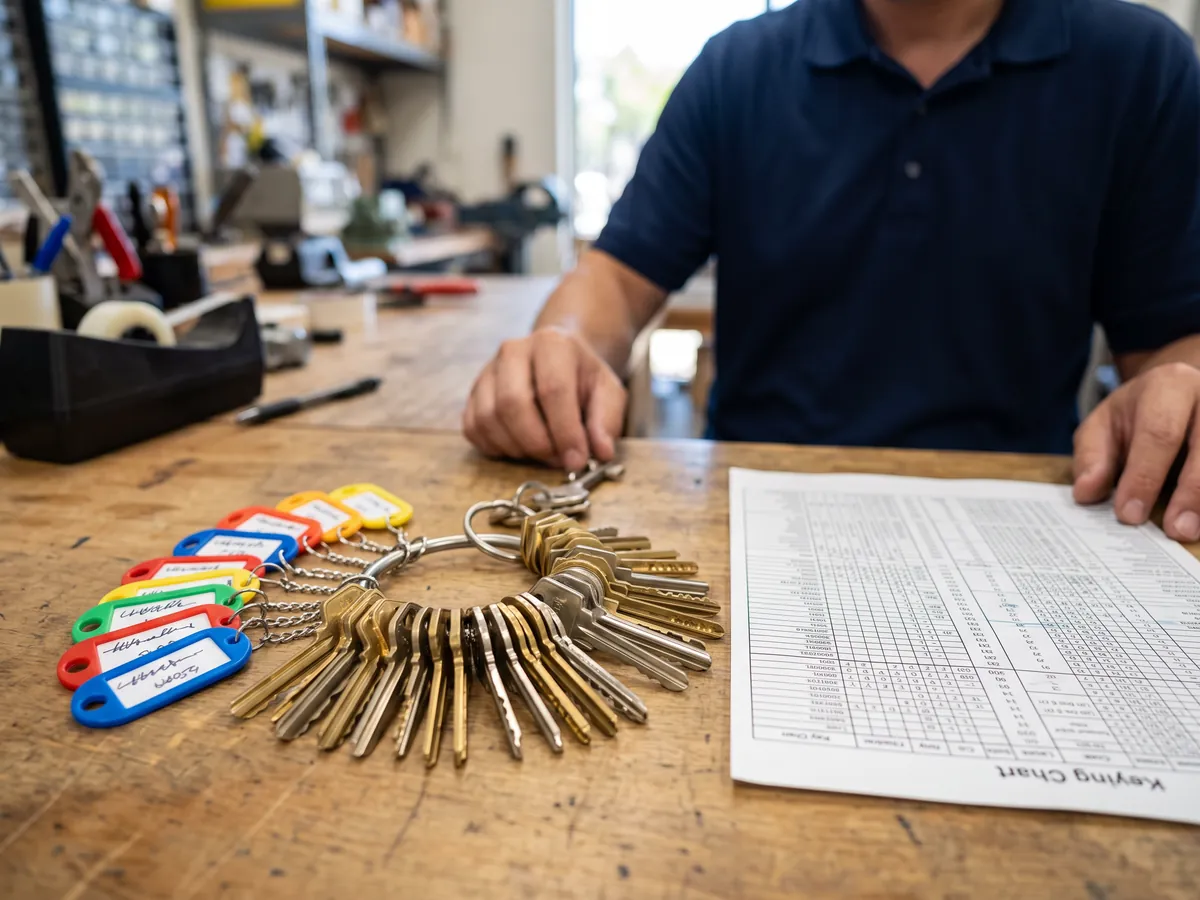
Here is how a key control job with Julian's Locksmith goes in Fullerton. We drive to you, so the first visit happens at your doors, not over the phone. We walk the property, list every lock and ask who actually uses each one. Then we propose a plan sized to your site: sometimes a log and a lockable cabinet are enough, sometimes it means restricted cylinders and cores. You get a written price before any hardware comes off a door. Our California locksmith license is LCO7891, and you can verify it at search.dca.ca.gov. Call (951) 903-3193 to book a walkthrough.
What to know first in Fullerton
Records are the least exciting part of key control and the part that decays fastest. Three documents carry most of the load. The keying schedule says which key opens which doors. The bitting list records the cut depths for every key and cylinder, so a lost key can be re-cut by code instead of guessed at. The key register tracks each physical key by number: who holds it, when it was issued and when it came back. Keep them separate and keep them safe. A bitting list left in the same unlocked drawer as the keys defeats the point, because anyone holding it can have a key cut. Stamp keys with a number that means nothing to a stranger, such as K-14, and never mark a key or tag with the door, the street address or the word master. In Fullerton, we hand over printed and digital copies at the end of the job, show the responsible person how to update them, and suggest a quarterly check so the register still matches what people are really carrying.
What we can do on-site
- Key cabinets, lockboxes and tamper-evident tags. A locked steel cabinet with numbered hooks is the simplest storage upgrade. We mount it to solid framing or masonry instead of drywall alone, pick a spot out of public view, and set up coded tags so the hooks never mention a door name. Electronic cabinets come from specialist makers, and we can mount and key them.
- Keying schedules, bitting lists and key registers. Registers fail when they are awkward. We design yours to fit how your site works: a one-page sheet for a small office, a spreadsheet with dropdowns for a building with a hundred keys, or a form tenants sign at move-in. A register that takes thirty seconds to update is far more likely to be updated.
- Rekeying to restore control. When a master, a control key or an unreturned set goes missing, rekeying the affected cylinders is the fix. We rekey on site, test every key, and issue the new set with new numbers. Cylinders on the same keyway often need repinning rather than replacing, which keeps hardware costs down.
- Fleet, vehicle and equipment key control. Many fleets leave ignition keys in the vehicle for convenience, which works until a truck disappears. A better habit is a morning sign-out and an evening return, enforced at one cabinet. We help design that routine, find a wall space with good sightlines and cut matched spares for each vehicle.
- Emergency-access planning and egress checks. When locks change, the keys in the fire department box must change too, or responders arrive with a key that no longer works. We add that step to every rekey checklist for Fullerton buildings that have a box, along with the alarm company's keyholder list and any after-hours contact sheets.
How Fullerton shapes the job
Apartment communities carry the heaviest key load: unit keys, a maintenance master, the leasing office, laundry, mailroom, trash enclosure and pool. Keep unit keys off the maintenance ring where possible, use cores or turnover rekeys to cut downtime, and put vendor access in tamper-evident pouches. California's Civil Code section 1954 sets notice rules for entering a unit, so your key policy should say who may enter, when and how it is logged.
Medical offices guard records rooms, supply and medication storage, labs and server closets, often with a changing mix of staff, temporary clinicians and vendors. Restrict the keyways on those rooms, keep the register current, and use cores where roles rotate. Your compliance officer or regulator decides what is required for controlled medications, so we install to your written policy and leave the clinical rules to you.
Older commercial buildings often mix generations of hardware: mortise locks, rim cylinders and a stairwell or lobby door controlled by the landlord. Start by finding out who controls what. Then restrict the suite's keys, keep a single master with the owner, and agree with the building manager on how entry will be logged. Mortise cases can usually take restricted cylinders, but we check cylinder length and cam first.
Example situations
- Imagine a church or community center where volunteers have run the kitchen, nursery and office for decades. Keys have multiplied, and the building has no master list. We would walk the building with the administrator, group the doors by who truly needs them, and propose a small master system on a restricted keyway, with a keyholder list the administrator reviews every January.
- Consider a property manager who has just taken over a small commercial building in Fullerton. The prior owner left three unlabeled rings and no chart. Without knowing who holds what, the safest first move is to rekey the exterior doors and mechanical room, then audit the tenant suites over the following weeks. New keys go on a restricted keyway, and the old rings are retired.
- Picture a dental office in Fullerton where the front desk holds a ring of seven keys and every hygienist has copies cut at the drugstore. The owner wants records and supplies secured without turning the staff into suspects. A sensible plan: restricted cylinders on the supply room and records closet, a short key register signed at hire, and a lockable cabinet for spares inside the business office.
- Typical for a new build: a builder's construction keys open every unit while crews finish, and tenants move in expecting nobody else holds a key. Before turnover in Fullerton, we would swap the construction cores for permanent cores keyed to the owner's hierarchy, collect every construction key and record the count. Skipping that step leaves a duplicate floating among subcontractors long after the final walkthrough.
How the visit works
- Walk the property together. We meet you at the property in Fullerton and walk every door, gate, cabinet and padlock with the person who knows the building best. We note the hardware, the keyway, the condition and who really uses each door. This is also when you tell us which doors keep you up at night.
- Audit and reconcile the keys. If a full audit is not practical on day one, we sample: the exterior doors, the highest-risk rooms and every master-level key. That is usually enough to show whether control is sound or shaky, and it lets you decide how deep to go without halting normal operations.
- Decide who needs what. We use a simple grid: doors down one side, roles across the top, and a mark where access is genuinely needed. Most sites discover that far fewer people need master-level access than currently have it, and that a few doors need no regular keyholder at all.
- Install the hardware. With the plan approved, we install restricted cylinders or interchangeable cores, mount the key cabinet to solid framing and adjust any hardware that does not line up. Doors that cannot take the new cylinders are noted in writing so they are not mistaken for protected doors.
- Cut, tag and issue the keys. We also give holders a one-paragraph rulebook: no lending, no copying, report a loss the same day, return keys on separation. People follow rules they can read in thirty seconds. The register copy they sign carries the same wording, which helps if you ever need to refer back to it.
- Schedule audits and agree a loss plan. The loss plan is one page. It says who to tell, which doors are rekeyed first, who authorizes the work, and how the register is updated afterward. A key lost late at night is the hard case: we close at 11:30 p.m. and reopen at 6:30 a.m., so the interim steps should be written down.
Pricing factors
- Standard cylinders or interchangeable cores. Core systems add a layer of key hierarchy, the control key, that needs its own care. That means a bit more planning time at the start and a small stock of spare cores if you want swaps to happen on the spot. We work out how many spares make sense for your turnover.
- Documentation and record setup. The audit and paperwork take real time: testing keys, recording bittings, building the schedule and the register. For small sites that is a few hours; for large buildings it is the biggest line item. Skipping documentation saves money on the day and costs more later, because the next lost key has no map.
- Urgency, timing and travel. An urgent rekey after a lost master or a firing is priced differently from a planned project, because it displaces other scheduled work. Planned phases let us group doors and travel efficiently. Where urgency is real we say so honestly, price accordingly and confirm everything before work begins.
Every job gets a clear quote before any work starts. Call (951) 903-3193 with the details and we'll tell you what to expect for your situation in Fullerton.
Mistakes to avoid
- Relying on a 'Do Not Duplicate' stamp. The stamp has no legal force and most kiosks cut the key regardless, especially on common keyways like Kwikset and Schlage. If copy control matters for a door, the protection has to be built into the key blank and the factory record, not the lettering.
- Storing spares and the bitting list in the same unlocked drawer. The drawer is the first place anyone looks, and holding both is the same as holding a key cutter. Split the documents from the hardware, and lock both away from the day-to-day work area.
- Handing one master key to many people. Master keys spread by convenience: a manager asks for one, then an assistant, then a supervisor. Each copy raises the stakes of a single loss. Decide at the start who truly needs master access and make everyone else request a door-level key.
What to do before we arrive
- Keep the bitting list apart from the keys. A list of cut depths is a recipe, and anyone holding it can have a key made without touching an original. Store it in a locked drawer or safe in a different room from the cabinet, and keep a second copy off site.
- Ask your insurance carrier or broker what, if anything, your policy says about key control or lock changes after a key loss. Some crime and property policies attach conditions, and it is far easier to learn that now than after a claim. Get the answer in writing and file it with your key policy.
- Treat the control key in an interchangeable core system like a grand master. It can pull every core in the building, so it belongs in the locked cabinet or with one named person, never on a general maintenance ring. If it goes missing, assume every core is affected and plan accordingly.
- Write the loss plan on a single page and tape it inside the cabinet door. It should name who to call first, which doors to treat as exposed, who can authorize a rekey and how to reach us at (951) 903-3193. When a key goes missing, panic costs more than the key does.
Reaching Fullerton
Fullerton is about 55 miles from our San Bernardino base, roughly 60 minutes in light traffic via I-215 South to SR-60 West through Jurupa Valley, Ontario and Chino. When you call, you get an arrival estimate based on where the technician is and the traffic at that moment.
Traffic matters more than mileage. We check conditions on SR-57 and its connecting routes before quoting you a time, and we don't pretend a long drive through heavy congestion is a short one.
About Fullerton: Leo Fender developed the Telecaster in Fullerton at the end of the 1940s, widely considered the first commercially successful solid-body electric guitar.
| Neighborhoods | East Coyote Hills, Richman Park, Golden Hill, West Coyote Hills, SOCO District, Sunny Hills |
|---|---|
| ZIP codes | 92831, 92832, 92833, 92835 |
| Main routes | SR-91, SR-57, I-5, SR-90 |
| From our San Bernardino base | about 55 miles via I-215 South to SR-60 West through Jurupa Valley, Ontario and Chino, then SR-57 South (Orange Freeway) through Diamond Bar and Brea to the Imperial Highway, Yorba Linda Boulevard, Nutwood Avenue or Chapman Avenue exits; SR-91 West through Corona and the Santa Ana Canyon is the alternate for south Fullerton off Harbor Boulevard |
Business lock or door work in Fullerton?
Call (951) 903-3193 with the address, the doors or hardware involved and when the site is open. We'll quote the job before any work starts and book a time within our hours that suits your schedule.
Frequently asked questions
Should we use mechanical keys or an electronic key control system?
It depends on the doors and the people. Mechanical restricted keys suit doors with a few trusted holders and low turnover. Electronic cabinets suit shared vehicle or equipment keys with many borrowers, and card or keypad readers suit doors with many users. Many Fullerton sites end up with a mix. We handle the locks and keys and coordinate with a low-voltage contractor when electronics are involved.
What is a restricted keyway and how do I know if I have one?
A restricted keyway uses a key profile whose blanks are not sold to the general public. Patented systems such as Medeco, Mul-T-Lock and Schlage Primus are the strongest examples. A useful clue is a brand name stamped on the key and an authorization card that came with the lock. Plain brass keys stamped Kwikset or Schlage with no card are almost certainly unrestricted.
What do you need from me before you work on my business or building?
We verify authority before changing locks. Expect to show photo ID and something that ties you to the property: a lease, a deed, a business license or a letter on company letterhead from the owner or management company. For existing restricted keys, we need the authorization card or the person named on file. We hold California license LCO7891, which you can look up at search.dca.ca.gov.
Can you convert my existing locks to a restricted system?
Often, yes. If your locksets accept standard cylinders, we can swap in restricted cylinders without replacing the hardware. Some older mortise cases, odd cylinders and discontinued locks need adapters or full replacement. We check every door on the walkthrough and tell you which ones convert easily and which do not before we quote. No work starts until you approve the quote.
What should we do if a master key is lost?
Treat every door that key opens as exposed. Check the keying schedule to list them, rank them by sensitivity, and rekey the most sensitive doors first. If you use interchangeable cores, swapping them is fast. Call us at (951) 903-3193 with the list. In the meantime, limit access to those rooms and mark the lost key's number as void in the register.
Does a 'Do Not Duplicate' stamp stop people from copying a key?
No. The stamp has no legal force, and many hardware stores and kiosks will copy the key anyway, especially on common keyways. Real copy control comes from a restricted keyway, where blanks are sold only through authorized dealers and duplicates need a signature from someone on file. Ask us which of your current keyways, if any, offer that protection.
How far is Fullerton from your base?
Fullerton is about 55 miles from our San Bernardino base, roughly 60 minutes in light traffic. Arrival time depends on traffic and on the job the technician is finishing, so we give you an estimate on the phone before you commit.
Related services in Fullerton
- Master Key System in Fullerton
- Employee Key Control System in Fullerton
- Restricted Key System in Fullerton
- Restricted Keyway in Fullerton
- Duplicate-Protected Keys in Fullerton
- Master Key Rekey in Fullerton
- Commercial Lock Rekey in Fullerton
- Business Master Key System in Fullerton
- Access Control in Fullerton
- Property Management Locksmith in Fullerton
Key Control System in nearby cities
- Key Control System in AnaheimOrange County
- Key Control System in PlacentiaOrange County
- Key Control System in BreaOrange County
- Key Control System in La HabraOrange County
- Key Control System in Buena ParkOrange County
- Key Control System in La MiradaLos Angeles County
- Key Control System in StantonOrange County
- Key Control System in Yorba LindaOrange County