
El Monte, Los Angeles County
El Monte Luxury Home Locksmith for Premium Hardware and Key Control
Short answer: A luxury home locksmith in El Monte handles the hardware and access problems a larger, high-value house creates: premium mortise and multipoint locks, oversized pivot and steel doors, high-security cylinders that keep the original finish, and key systems that give housekeepers, gardeners and contractors only the doors they need. Julian's Locksmith quotes every job before starting. Call (951) 903-3193.
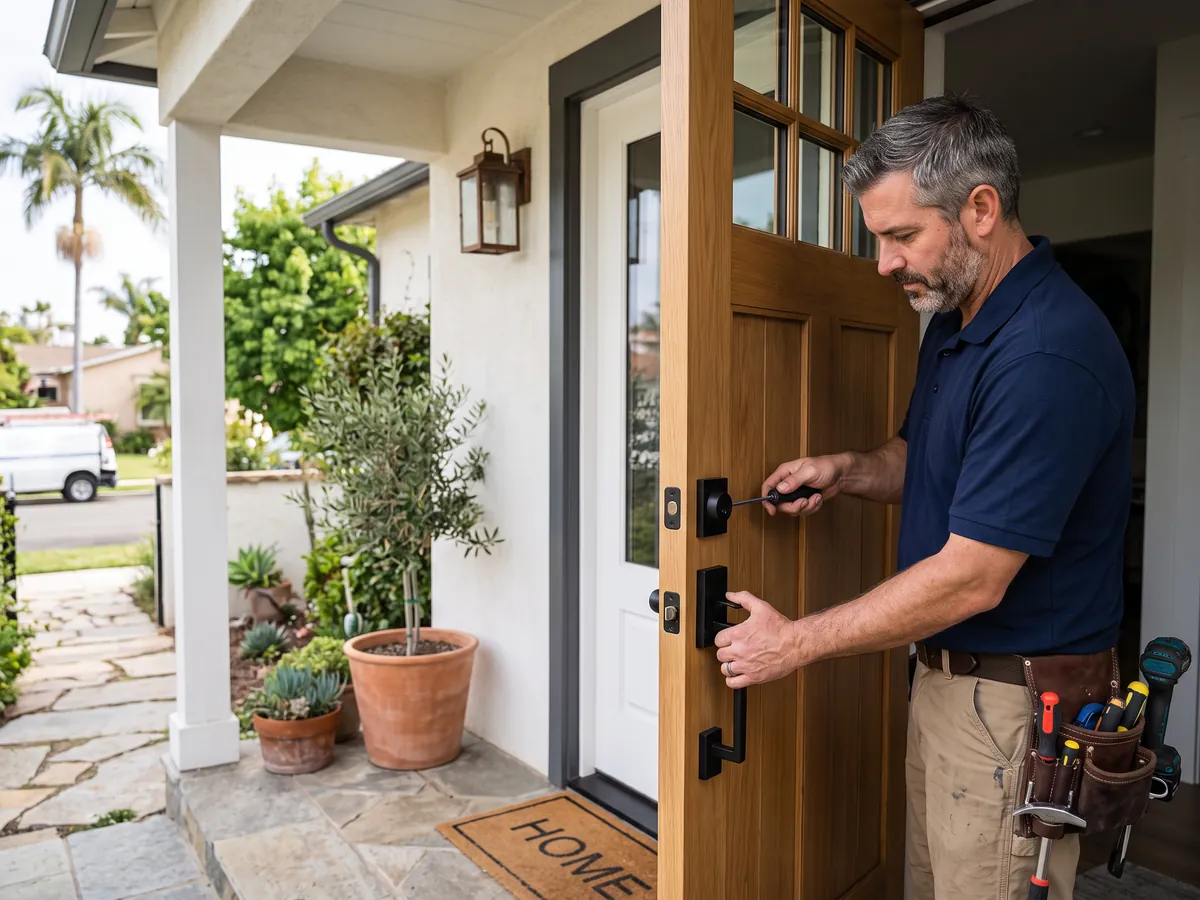
Owners of luxury homes usually want a quiet, practical conversation about security rather than a sales pitch. We start by walking the property with you: every exterior door, the garage entries, pedestrian gates, the guest house, the pool house and any room you want kept private. Then we explain where a luxury home locksmith adds real protection, such as reinforced strikes, high-security cylinders and key control, and where your alarm, camera or gate company should take the lead instead. Julian's Locksmith is licensed by BSIS under LCO7891, and our recommendations arrive as a written quote, with no pressure to buy anything you don't need.
Luxury Home Locksmith in El Monte: what to expect
Part of doing this work well is knowing where the locksmith's job ends. Smart locks such as the Schlage Encode, Yale Assure or Level Lock can join a whole-home automation system over Z-Wave, Zigbee, Wi-Fi or Matter, depending on the model. A luxury home locksmith installs the lock mechanically, sets the deadbolt throw, aligns the strike and confirms it locks reliably; your automation integrator then enrolls it in the system's scenes and logs. Driveway gate operators and call boxes belong to gate specialists, cameras and alarm panels to your security company, and electric strikes on pedestrian gates may involve a low-voltage contractor. Safe rooms and vault doors are engineered products; we service the locks, not the structure. Code considerations matter as well. Residential code generally expects a main exit door to open from inside without a key or special knowledge, so a double-cylinder deadbolt beside glass sidelites trades fire egress for a modest security gain, and we'll talk through better options. Knowing those boundaries keeps every trade working toward one plan instead of overlapping.
What we can do on-site
- High-security cylinders in existing premium trim. Cylinder length, cam style and finish all have to suit the lock body and the door thickness, which on custom doors is often unusual. We measure each door before ordering, so the cylinder sits flush instead of proud of the escutcheon, and the cam engages the mortise lock cleanly on the first turn.
- Mortise lock service for designer hardware. Mortise locks from makers such as Baldwin and Emtek last for decades when they're kept adjusted. We service the lock case, replace worn springs and levers, rekey the cylinder, and realign the strike so the latch and deadbolt throw fully. A sticky thumb latch is usually an adjustment problem, not a reason for new hardware.
- Smart locks that fit the automation system. We install smart locks such as the Schlage Encode, Yale Assure or Level Lock with attention to the mechanical side most installs rush: deadbolt throw, strike alignment, door gaps and reinforcement. A smart lock on a misaligned door drains batteries and jams. Your automation integrator then adds it to scenes, logs and alerts.
- Guest houses, casitas and pool houses. Pool houses and cabanas see sun, chlorine and water constantly, which wears out ordinary hardware quickly. We recommend corrosion-resistant finishes and outdoor-rated locks, service sticky cylinders, and make sure the pool equipment room and any storage for chemicals can be locked apart from the cabana itself.
- Wine rooms, gun rooms and private spaces. Gun rooms, home offices, jewelry closets and art storage all benefit from locks that household staff simply don't have keys to. We key these rooms on their own level, add reinforced strikes and solid door hardware where needed, and recommend keyless options where an owner prefers a code to a key.
How El Monte shapes the job
Upscale family homes in El Monte often run on a mix of nannies, tutors, housekeepers and drivers, plus teenagers who misplace keys. A layered key system lets the parents hold a key to everything, while staff carry service-level keys and kids use personal codes that can't be duplicated at a hardware counter. When a nanny moves on, one small rekey and a deleted code keep the household secure without disrupting anyone else.
Inland heat is hard on premium hardware. Dark wood and steel doors expand on west-facing elevations, smart lock and safe batteries fade faster, and some finishes weather unevenly. During a luxury home locksmith visit we tune heavy doors for summer movement, recommend lubricants suited to hot, dusty conditions, and set battery schedules for electronic locks that sit in the sun. Cylinders on gates and pool cabanas get the same attention, since they bake all afternoon.
Older luxury homes, such as period revivals and mid-century custom houses, often keep original mortise locks, rim locks and thumb-latch entry sets worth preserving. We service and rekey vintage hardware rather than replacing it, add high-security cylinders where the lock body allows, and fit discreet deadbolts where a historic door has only a latch. The goal is real protection with the character intact, so the front door still looks like it belongs to the house.
Situations this covers
- For example: a house manager in Downtown El Monte learns that a nanny who left on poor terms still has a service key and a door code. With a layered key system in place, we'd rekey only the service-level cylinders on the staff entrance, laundry door and side gate, delete her smart lock code, and cut new numbered keys for the remaining staff. The owners' keys never change.
- Picture a newly finished custom home near El Monte Aquatic Center. Every lock still runs on the builder's construction key, which dozens of workers carried, and two smart locks remain on the electrician's account. We'd re-core all cylinders to a restricted keyway, tune the multipoint French doors, transfer the smart locks to the owners and deliver a keying chart with numbered keys for each family member.
- A typical safe call: the jewelry safe in a primary closet beeps oddly and takes three tries to open. Corrosion on the battery contacts is the likely culprit. After confirming ownership, we'd clean or replace the battery connection, test the keypad, and if it's still unreliable, install a new electronic lock and set the code with the owner in the room.
- A typical conversation: an owner wants double-cylinder deadbolts on a front door framed by tall glass sidelites, worried someone could break the glass and reach the thumb-turn. We'd explain the egress risk in a fire, then suggest options such as a single-cylinder high-security deadbolt combined with laminated or filmed glass from a glazing contractor and an alarm sensor on the glass.
From your call to the finished job
- Initial conversation with the owner or house manager. Call (951) 903-3193 and tell us what prompted the call: a staff change, a new build, a door that won't lock, a safe, or a general security review. We'll ask about the number of buildings and exterior doors, the hardware brands you know of, and who currently holds keys or codes.
- Walk the property and inventory the hardware. During the walk we test each lock with its current key, check deadbolts for full throw, and look at strikes, hinges and pivots on the heavier doors. We also note anything outside our scope, such as a gate operator or an alarm contact, so you know who to call for those parts.
- Design the access plan. Next we agree on who should open what. Owners usually hold a top-level key; staff, guests and vendors receive keys or codes for only the doors their work involves. Private rooms stay on their own level. We put it all on a simple keying chart before cutting a single key.
- Order parts and match finishes. Where a custom or living finish can't be matched exactly, we show you the closest option before installing. Sometimes a cylinder in a compatible finish looks better than a near-miss, and unlacquered brass will patina to match over time. You decide before anything goes on the door.
- Install, align and protect the finish. We work to the household's schedule, keep the work area tidy and explain what we're doing to whoever is overseeing the visit. Where staff are present, we can work room by room so daily routines continue. Old cylinders and keys are handed back to the owner rather than discarded.
- Hand over keys, codes and records. Keep the keying chart somewhere secure, not taped inside a cupboard. If staff change or a key goes missing later, one call and the chart let us rekey just the affected level. We also suggest a periodic check of heavy doors, since sun and seasons move them.
Pricing factors
- Hardware line and cylinder type. Rekeying an existing cylinder costs far less than replacing it with a high-security one. Many owners combine the two: high-security cylinders on the exterior doors that face the street and service entrance, and standard rekeys on interior or less exposed locks. We'll show what each choice changes in the quote.
- Door type and condition. Doors that have been forced, warped by sun or reinstalled poorly can need strike relocation, shimming or hinge work before any lock functions well. We price that repair work separately from the lock itself, so you can see why a seemingly simple lock job on a premium door costs what it does.
- Finish matching and special orders. Replacing a discontinued designer lock body sometimes forces a choice between a compatible part and a full hardware change. A compatible case keeps your existing trim and finish; full replacement may mean new holes and door refinishing. We price both so the decision is clear before work begins.
Every job gets a clear quote before any work starts. Call (951) 903-3193 with the details and we'll tell you what to expect for your situation in El Monte.
Advice before you book
- Ask before ordering high-security cylinders whether your hardware accepts a retrofit. A five-minute check of the lock model can save buying an entirely new entry set, and it often means your designer's trim stays exactly where it is, with only the cylinder and key changing. Note the model number stamped on the latch faceplate if you can find it.
- Tell your locksmith which finish each door uses before parts are ordered. Oil-rubbed bronze, satin nickel and unlacquered brass all come in different cylinder finishes, and confirming them ahead of time is the difference between an invisible upgrade and a cylinder that stands out. A photo of each door's trim helps when ordering.
- Give every staff member and regular vendor a personal smart lock code rather than one shared code. Individual codes create an audit trail, and when someone's role ends you delete one code without disturbing anyone else's routine or having to reprogram the whole household. Most smart lock apps let you label each code with a name.
- Replace safe and smart lock batteries on a schedule instead of waiting for the low-battery warning. Inland heat shortens battery life, and a jewelry safe or wine room lock that dies while the owners travel leaves the house manager with an unnecessary opening call. Write the replacement date inside the battery cover.
Common errors that cost time and money
- Installing double-cylinder deadbolts on main exit doors without thinking about fire egress. If the key isn't in the lock, a family member or guest may not be able to get out quickly. Residential code generally discourages it, and better options usually exist.
- Leaving smart locks on the builder's or previous owner's account. Whoever controls the admin account controls the lock, including adding codes remotely from anywhere. Factory-reset and re-enroll every connected lock, keypad and video doorbell under the owners' account before the household moves in, and confirm the old account no longer lists the device.
- Forcing the handle on a multipoint door that won't lock. The resistance usually means a hook or bolt is hitting its keeper because the door has shifted. Forcing it breaks the gearbox, turning a quick adjustment into a special-order part and a door that won't secure meanwhile.
Reaching El Monte
El Monte is about 47 miles from our San Bernardino base, roughly 55 minutes in light traffic via I-215 South briefly to SR-210 West. When you call, you get an arrival estimate based on where the technician is and the traffic at that moment.
If you're close to Lower Azusa Road, tell us which exit or cross street you're nearest. It trims the last mile and keeps the van from circling a block that looks right on the map but isn't.
About El Monte: The El Monte Busway opened along I-10 in 1973 and became part of the Metro ExpressLanes in 2013; El Monte Station, rebuilt as a two-level terminal in 2012, is the eastern end of Metro's J Line.
| Neighborhoods | Rio Hondo and Santa Fe Trail area, Norwood Cherrylee, Flair Park, Five Points, Garvey Avenue corridor, Mountain View |
|---|---|
| ZIP codes | 91731, 91732, 91733 |
| Main routes | I-10, I-605, Rosemead Boulevard, Santa Anita Avenue |
| From our San Bernardino base | about 47 miles via I-215 South briefly to SR-210 West (Foothill Freeway), continuing on I-210 West to I-605 South, then exit Ramona Boulevard or I-10 West into central El Monte; alternate route is I-10 West the whole way, exiting at Peck Road or Santa Anita Avenue |
Home lock work in El Monte?
Call (951) 903-3193 with the address and a quick description of the doors and locks involved. We'll quote the job before any work starts.
Frequently asked questions
Can the guest house be keyed differently from the main house?
Yes. The guest house or casita can have its own key, so the occupant has privacy, while the owners' top-level key still opens it for emergencies. We can also add a deadbolt where the builder installed only a passage lever, and give guests a keypad code for a side gate. It's a common part of a luxury home locksmith key plan in El Monte.
Do you verify ownership before working on a luxury home?
Yes. Before opening, rekeying or changing any lock, we verify photo ID and proof of residence or ownership. When a house manager, estate manager or assistant arranges the work, we confirm the owner's authorization directly or in writing. That protects the household, keeps a clear record of who requested what, and follows how licensed locksmiths are expected to operate under California's Locksmith Act.
What's the difference between a restricted key and a high-security key?
A restricted key controls duplication: the blanks aren't sold openly, so copies come only through authorized channels. A high-security cylinder adds physical protection, such as sidebars, hardened inserts and resistance to picking, bumping and drilling, often to a UL 437 rating. Many patented systems do both. For a large home with staff, key control is usually the more important of the two.
Can you keep our key records and property details private?
Your keying chart, codes and combinations belong to you, and we hand those records to the owners or house manager at the end of the job. We don't publish photos of client homes. If your household uses a confidentiality agreement for vendors, mention it when you call so it can be reviewed before the visit is scheduled.
Are you licensed?
Yes. Julian's Locksmith holds California locksmith company license LCO7891, issued by the Bureau of Security and Investigative Services. You can verify it at search.dca.ca.gov before scheduling. For a high-value home where we'll handle keys, codes, combinations and keying charts, checking is reasonable, and we encourage owners and house managers to do it for every vendor with that level of access.
How should I control keys for household staff?
Use a restricted or patented key system with access levels: owners hold a key to everything, staff hold keys to service areas only, and private rooms stay on their own keys. Number each key and keep a sign-out register. Pair that with individual smart lock codes on high-traffic doors. When someone leaves, you change one level rather than rekeying the whole house.
How far is El Monte from your base?
El Monte is about 47 miles from our San Bernardino base, roughly 55 minutes in light traffic. Arrival time depends on traffic and on the job the technician is finishing, so we give you an estimate on the phone before you commit.
Related services in El Monte
- Residential Locksmith in El Monte
- High Security Lock Installation in El Monte
- Restricted Keyway in El Monte
- Key Control System in El Monte
- Mortise Lock Installation in El Monte
- Smart Lock Installation in El Monte
- Home Safe Opening in El Monte
- Safe Combination Change in El Monte
- Master Key System in El Monte
- Driveway Gate Lock in El Monte
Luxury Home Locksmith in nearby cities
- Luxury Home Locksmith in North El MonteLos Angeles County
- Luxury Home Locksmith in South El MonteLos Angeles County
- Luxury Home Locksmith in Temple CityLos Angeles County
- Luxury Home Locksmith in Avocado HeightsLos Angeles County
- Luxury Home Locksmith in RosemeadLos Angeles County
- Luxury Home Locksmith in Baldwin ParkLos Angeles County
- Luxury Home Locksmith in West Puente ValleyLos Angeles County
- Luxury Home Locksmith in ArcadiaLos Angeles County