
El Monte, Los Angeles County
Replacing a Door Lock in El Monte: What Fits, What Doesn't
Short answer: Not every sticky or loose door lock needs replacing. A worn cylinder, a loose mounting screw or a misaligned strike can mimic a dead lock, and fixing any of those costs less than new hardware. In El Monte, Julian's Locksmith checks the door first, then tells you honestly whether to adjust, rekey or replace.
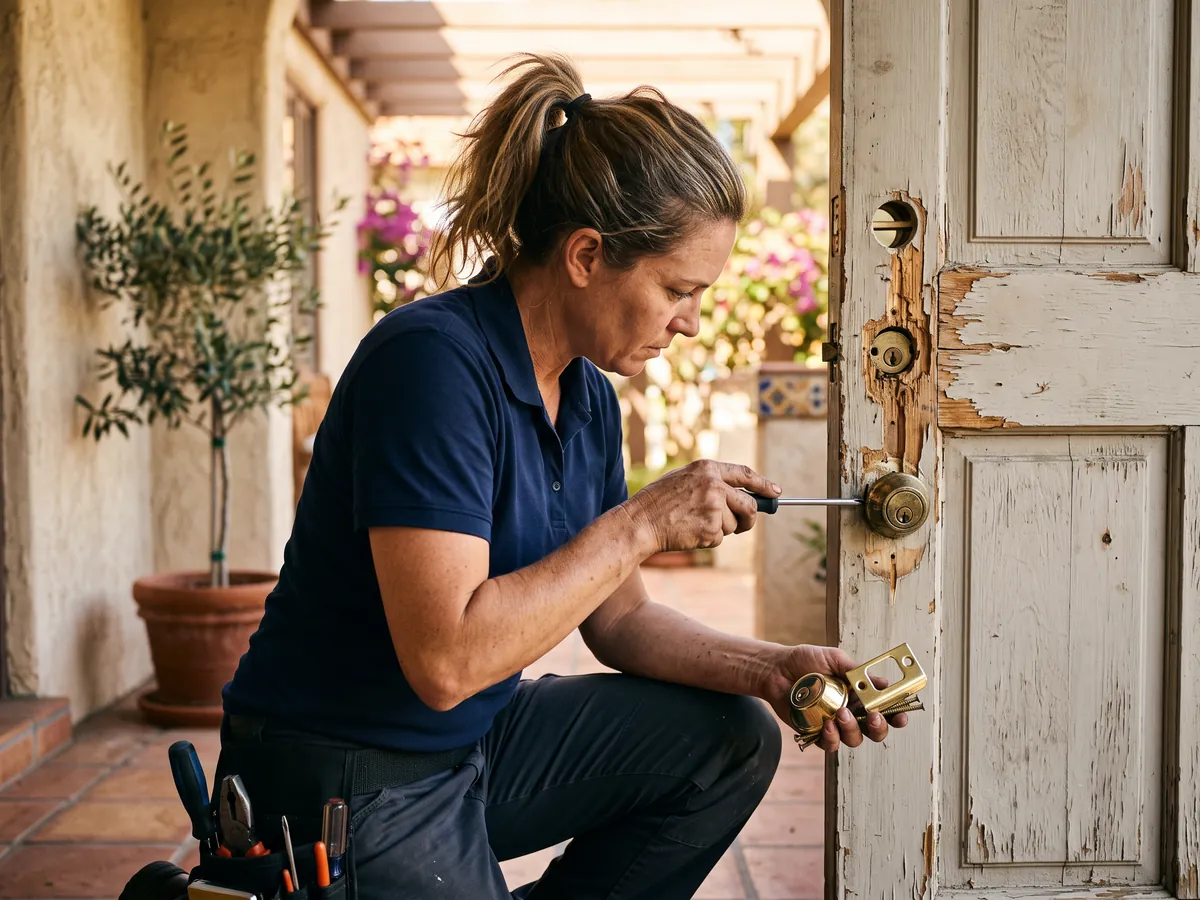
A door lock rarely dies in one dramatic moment. First the key needs a little wiggle, then the deadbolt stops halfway, then one warm afternoon it won't turn at all. Dust works into the keyway, springs tire, and metal parts that expand in the heat start to bind. Door lock replacement is the point where repair stops making sense: the mechanism is worn out, the housing is bent, or the latch no longer pulls in cleanly. Julian's Locksmith comes to your door in El Monte, works out which part has actually failed and replaces only what that door needs. If a cleaning or a strike adjustment solves it, we will say so and save you the cost of new hardware.
How this works in El Monte
Four measurements cover most residential door lock replacement. The cross bore is the large round hole through the face of the door; 2-1/8 inches is the standard, and nearly every current knob, lever and deadbolt is built for it. The edge bore is the smaller hole in the door's edge where the latch slides in, usually 1 inch. The backset is the distance from the door's edge to the center of the big hole, almost always 2-3/8 or 2-3/4 inches, and most new latches adjust between the two. The thickness is typically 1-3/8 inches on interior doors and 1-3/4 inches on exterior ones. Add two details: the latch faceplate, which may be square-cornered or rounded, and the strike on the frame. If everything matches, the job is a straight swap. If the old lock left a bigger hole, an adapter plate or trim ring covers it. If the door was never drilled, we bore it with a hole saw and jig so the cuts are straight and square.
How we can help in El Monte
- Steel and fiberglass doors. Prefinished steel and fiberglass doors can't simply be redrilled if the first attempt goes wrong. That is why we measure twice, pick a lock that matches the factory prep and leave the door finish intact, rather than guessing at a hole size and hoping.
- Interior passage, privacy and dummy sets. Hollow-core interior doors are light and thin, so they take light latches only. We install passage and privacy hardware with a 2-3/8 or 2-3/4 inch latch to suit the door's backset, and we do not put a deadbolt in a door that cannot support one.
- Sliding glass door locks. When a slider will not lock, the latch is not always to blame. A dragging door on worn rollers or a dirty track can keep the hook from reaching the keeper. We clean and adjust first, replace the handle and latch if they are cracked, and test that the door glides and locks.
- Garage-to-house and fire-rated doors. Garage entry doors take punishment from carried boxes, bumped bikes, dust and heat. If the knob has loosened or the latch sticks, we replace the set, check the weatherstripping and make sure the door shuts completely, because a lock that never engages secures nothing.
- Oversized, mismatched or damaged door prep. A door damaged by a pry bar or a failed lock needs repair before it can hold new hardware. We replace splintered wood with a reinforcement plate, close old holes and set the new lock in sound material, so the replacement does not fail the next time someone leans on the door.
Local factors in El Monte
For an apartment in El Monte, door lock replacement depends on who owns the lock. California law requires landlords to provide working deadbolts on main entry doors, so a broken one is often their repair. Some buildings keep every unit on a master key system, which limits what hardware can be fitted. Before we replace anything, we confirm who authorizes the work and whether the new lock must match a building key plan. Patio and interior door locks follow similar rules.
Families in El Monte put doors through constant use: kids slamming them, groceries bumping them, bikes leaning on the garage entry. Door lock replacement in these homes is mostly about durability and convenience. Levers survive small hands better than knobs, privacy locks need a dependable emergency release, and the door from the garage deserves a sturdy deadbolt. We often replace several worn sets in one visit, key the exterior doors alike and make sure everyone in the house can use them.
El Monte has plenty of older houses where door lock replacement is not plug-and-play. Original doors may carry mortise locks, skeleton-key escutcheons, glass knobs or bores drilled to sizes no longer standard. Thick old wood often takes modern hardware well once the prep is cleaned up, and we can sometimes keep a period knob while updating the mechanism inside. We check the latch mortise, the bore and the frame before we quote, because old doors like to surprise people.
Common situations
- A pair of French doors off a dining room closes unevenly, and the passive leaf can be pushed open from outside because its top flush bolt has snapped. We replace both flush bolts and the worn active-door lock, adjust the hinges so the leaves meet flat and test the pair from both sides. The owner wanted to keep the original brass look, so we matched it.
- A family near El Monte Aquatic Center has a sliding patio door whose handle snapped off in a hand. The hook latch hangs loose inside the frame. We read the screw-hole spacing, match a replacement lock, adjust the keeper on the jamb and clean the track so the door glides. We also suggest a simple bar for nights away, since a factory hook alone is a modest barrier.
- A buyer closes on a house with a steel side door and finds the previous owner drilled an oversized cross bore for a cheap knob, so nothing fits properly. We fit a trim plate that covers the extra gap, set the new lock square and add a reinforced strike. The door looks tidy, the bolt throws cleanly and the steel skin stays undented.
- A keypad lock on a rear door stopped responding after leaking batteries corroded its contacts. The old unit can't be cleaned back to life. We replace it with a new keypad deadbolt that fits the existing holes, set fresh codes, key the backup cylinder to the house key and show the owner where the low-battery warning appears.
From your call to the finished job
- Tell us which door and what it's doing. Describe the symptom in plain words: the key goes in but will not turn, the knob turns without pulling the latch, the door needs a shove to lock. We ask a few questions about the door's age and material, then give you an honest arrival estimate for El Monte and what we expect to carry.
- Confirm who you are, then look at the door. California's Locksmith Act is administered by the Bureau of Security and Investigative Services, and our license, LCO7891, can be checked at search.dca.ca.gov. We ask for ID and proof of residence or ownership, then look over the door, frame and strike before anything comes off.
- Read the door and match the hardware. We check the door's material and thickness, measure the cross bore, edge bore and backset, and note the latch faceplate and handing. Those numbers decide whether a new lock drops in or needs an adapter. Then we pick a function and grade that suits the door's job.
- Agree the quote, then take the old lock off. Once we know what the door needs, we give you a quote covering the lock, any parts and the labor. You decide before we start. When you approve, we remove the old hardware carefully and keep it handy so you can compare parts or take it with you.
- Fit, align and make it close properly. The new lock goes in square, with the latch bevel facing the way the door closes and the screws pulled evenly. We set or replace the strike with long screws and adjust the hinges if the door hangs crooked, because a lock only works as well as the door behind it.
- Key it, test it and hand it over. If the new lock should match your other locks, we key it to your existing key or rekey a group of doors together. Then we test each key in each lock, so nobody discovers later that the back door key does not work.
Pricing factors
- How closely the new lock matches the old prep. Older doors sometimes carry mortise pockets or unusual bores from hardware that is no longer made. Matching them can mean a special part or modifying the door. We tell you early which route costs less and which looks better, so you can choose with the facts.
- Grade, brand and finish. Locks come in grades. Grade 3 suits light residential use, Grade 2 is a solid choice for most front and back doors, and Grade 1 is the heaviest-duty option. Brand and finish move the price too, so we show you the trade-offs between them.
- Keying and number of keys. A lock that arrives keyed to its own key is the simplest to install. Keying it to match your other doors, or rekeying several cylinders to one key, adds time. Extra keys and restricted keyways add to the quote, and we list each choice separately.
Every job gets a clear quote before any work starts. Call (951) 903-3193 with the details and we'll tell you what to expect for your situation in El Monte.
What to do before we arrive
- Remember that wood doors move with the seasons. A lock that binds in humid weeks and runs freely in dry ones is usually reacting to a swollen door. Adjusting the strike or a hinge fixes it more reliably than a new lock, and we are happy to check before you replace anything.
- Check that the door closes and latches on its own weight before you blame the lock. If it needs a shove, look at the hinges, the strike and the weatherstripping first. A lock can't work well on a door that is leaning, and new hardware simply inherits the problem.
- Remove door hardware before painting rather than taping around it. Paint that glues itself to a latch edge or a strike makes the bolt drag and the lock feel sticky. If the door has already been painted over, a careful scrape of the latch edge and strike often restores smooth movement.
- Keep a thumb-turn or lever on the inside of every exit door. A lock that needs a key to open from inside can slow escape in a fire, and building codes expect exit doors to open without a key. If you want a keyed inside cylinder for some reason, talk to us first.
Mistakes to avoid
- Picking the wrong function. A keyed entry set on a bathroom, a passage set on a bedroom or a dummy pull on a door that needs a latch all fail in daily life. Decide whether the door must lock, from which side and who has to open it in an emergency before you buy.
- Oiling a stuck lock and ignoring the cause. Spray oil attracts dust and turns into a gummy paste in the keyway. If a cleaned, dry-lubricated lock still sticks, the mechanism is worn, and more spraying only delays a replacement you were going to need anyway.
- Replacing a lock that was never the problem. When a door sticks, the bolt misses the strike or the key works only when you lift the handle, the cause is often a sagging hinge, a shifted strike or seasonal swelling. A new lock in the same spot misses the same way.
Reaching El Monte
El Monte is about 47 miles from our San Bernardino base, roughly 55 minutes in light traffic via I-215 South briefly to SR-210 West. When you call, you get an arrival estimate based on where the technician is and the traffic at that moment.
We plan the drive the way a delivery route gets planned: freeway first, Santa Anita Avenue where it makes sense, then the side streets you describe. A landmark or the color of your building helps the technician spot you.
About El Monte: In 1858 an adobe building in El Monte served as Monte Station, a stop on the Butterfield Overland Mail stagecoach route.
| Neighborhoods | Norwood Cherrylee, Airport area off Santa Anita Avenue, Five Points, Peck Road corridor, Flair Park, Tyler Avenue civic area |
|---|---|
| ZIP codes | 91731, 91732, 91733 |
| Main routes | I-10, I-605, Rosemead Boulevard, Santa Anita Avenue |
| From our San Bernardino base | about 47 miles via I-215 South briefly to SR-210 West (Foothill Freeway), continuing on I-210 West to I-605 South, then exit Ramona Boulevard or I-10 West into central El Monte; alternate route is I-10 West the whole way, exiting at Peck Road or Santa Anita Avenue |
New or replacement locks in El Monte?
Call (951) 903-3193 and tell us which doors and what kind of hardware you have in mind. If you already bought the lock, keep the box handy so we can check it fits the door, and we'll quote the install before any work starts.
Frequently asked questions
How long does door lock replacement take?
A single standard door is usually a short visit, because the old lock comes out and the new one goes into the same holes. Reinforcing a strike, repairing a damaged edge or adapting an unusual door adds time, as does each additional door. When you call, we give you an honest estimate, and on site we confirm it once we have measured the door.
How do I know what size lock my door needs?
Measure four things. The big round hole through the door face is usually 2-1/8 inches across, the smaller hole in the door edge is usually 1 inch, the backset from the edge to the center of the big hole is 2-3/8 or 2-3/4 inches, and the door is typically 1-3/8 or 1-3/4 inches thick. Most new locks fit those standards. If your numbers differ, tell us when you call in El Monte, and we will bring the right adapter.
Can you fit a lock on an unusual or older door?
Usually, yes. Older doors sometimes have mortise pockets, nonstandard bores or thicker slabs, and some carry locks the maker no longer produces. We measure, identify what we can, and use adapter plates, trim rings or a repaired bore as needed. If a custom part is required, we tell you early so you can choose between a special order and a different style.
Can you replace the lock on a garage entry or fire-rated door?
Yes, with care. Doors between a garage and a house are usually solid or rated, and changing their holes can affect the rating. We use hardware that fits the existing prep, avoid new cutting, and make sure the door still closes and latches on its own. If your door label or local rules call for more, we say so before starting.
Do I need a whole new lock or just a new cylinder?
If the key sticks or won't turn but the bolt or latch moves smoothly by hand, the cylinder may be the only problem, and replacing it can cost less than a full lock. If springs, latches or the housing are worn, cracked or pried, replace the lock. A cylinder must match the lock's brand and keyway, so we inspect the lock before promising a partial fix.
Should I replace the deadbolt when I replace the knob?
Not automatically. The deadbolt does the work of resisting force, so if it is in good condition and works smoothly, you may keep it. If the two are different finishes or brands and you want them matched, or if you want both keyed alike, replacing the pair makes sense. We check each one and tell you honestly which still deserves to stay.
How far is El Monte from your base?
El Monte is about 47 miles from our San Bernardino base, roughly 55 minutes in light traffic. Arrival time depends on traffic and on the job the technician is finishing, so we give you an estimate on the phone before you commit.
Related services in El Monte
Door Lock Replacement in nearby cities
- Door Lock Replacement in North El MonteLos Angeles County
- Door Lock Replacement in South El MonteLos Angeles County
- Door Lock Replacement in Temple CityLos Angeles County
- Door Lock Replacement in Avocado HeightsLos Angeles County
- Door Lock Replacement in RosemeadLos Angeles County
- Door Lock Replacement in Baldwin ParkLos Angeles County
- Door Lock Replacement in West Puente ValleyLos Angeles County
- Door Lock Replacement in ArcadiaLos Angeles County