
Eastvale, Riverside County
A House Locksmith in Eastvale Who Looks at the Whole Building
Short answer: Older houses and newer tracts need different lock work. A 1940s bungalow may have mortise locks and thin doors, a 1970s ranch has knob locks and aluminum sliders, and a 2000s tract has builder-grade deadbolts with short strike screws. A house locksmith in Eastvale fits upgrades to what's already there. Julian's Locksmith, license LCO7891, comes to you.
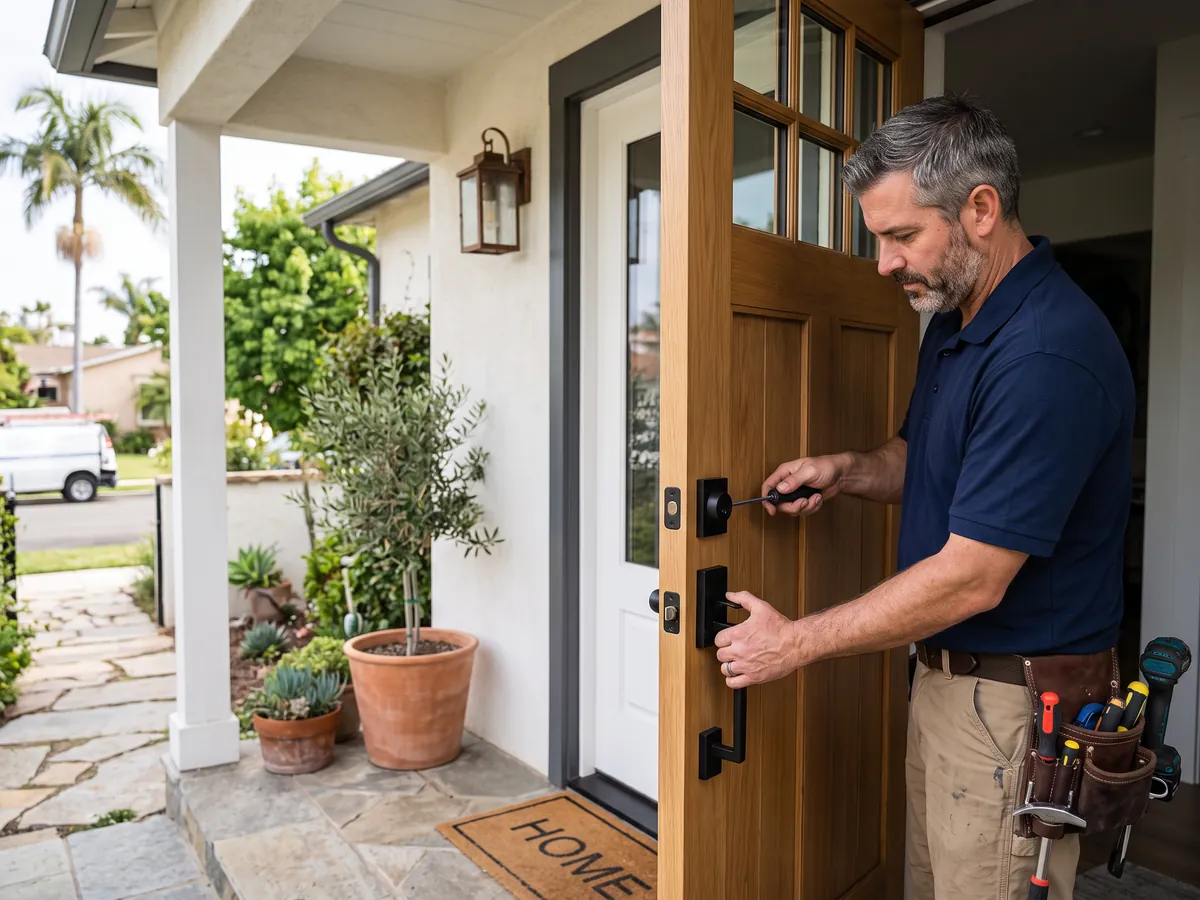
A deadbolt is only as strong as the wood it locks into. On many houses the strike plate is held by two short screws that bite only into the soft door jamb, so a firm kick splits the frame before the lock gets a chance to resist. Fixing that is some of the most valuable house locksmith work there is, and it rarely costs much: longer screws reaching the framing, a reinforced strike, sometimes a full-length jamb plate. In Eastvale, Julian's Locksmith does this on-site, often during the same visit as a rekey or new deadbolt. Ask for it whenever we are already at the door for something else.
House Locksmith in Eastvale: what to expect
The age of a house tells a house locksmith a lot before the toolbox opens. Houses from the 1910s through the 1940s often have mortise locks set in thin solid-wood doors, interior skeleton-key locks, and hardware worth restoring rather than replacing. Post-war ranch houses frequently started with knob locks alone; deadbolts were added later, sometimes at a 2-3/8 inch backset and sometimes at 2-3/4, so replacement parts need to match. Houses from the 1970s and 1980s brought aluminum sliders with modest hook latches and plenty of hollow-core interior doors, occasionally including the one to the garage. Tract houses from the 1990s onward usually have standard bores, Kwikset or Schlage builder hardware and keys that passed through many hands during construction. The newest houses may have fiberglass entry doors with multipoint locks or smart-ready deadbolts. Knowing which era your Eastvale house belongs to means the right parts are in the van and the fix respects the door you have.
How we can help in Eastvale
- Garage-entry and garage side doors. We also handle the manual lock on an overhead garage door and the cylinder in its outside handle. Openers, springs and tracks belong to a garage door company. We'll tell you plainly when a problem is on their side of the line instead of ours.
- Sliding patio doors and French doors. Newer fiberglass and steel patio doors often use multipoint hardware with a gearbox that throws hooks or bolts into the frame. When the handle won't lift or the key won't turn, the gearbox is usually the culprit. We identify the system and source the correct replacement part, which sometimes means ordering.
- Window locks and sash hardware. Ground-floor windows need working locks just like doors. We replace broken sash locks on single-hung windows, install sliding-window locks and pin locks, and add ventilation stops so a window can stay open a few inches without opening further from outside. We match finishes to the existing window hardware wherever we can.
- House lockouts handled without damage. Houses offer more entry options than apartments: a back door with a simpler lock, a garage-entry knob, a slider. We use the least destructive route and never break glass. If every lock is high security, we'll say so on the phone, along with what that may mean for time and cost.
- Side gates, sheds and detached structures. Side gates give access to the back of the house, so they deserve a real lock. We install keyed gate locks, latch shields that stop over-the-top reaching, and padlock-ready latches. For pool gates, we keep the required self-closing, self-latching function intact. We also make sure the gate swings fully closed on its own.
Local factors in Eastvale
New tract houses come with builder-grade locks, standard bores and strike plates usually held by short screws. The first upgrades worth making are a whole-house rekey, since many people handled keys during construction, and long screws in every strike. Sliders and garage-entry doors on new houses are often basic as well. Because the door prep is standard, swapping in higher-grade or smart deadbolts usually goes quickly.
In family neighborhoods, the garage-entry door and the slider to the backyard get far more use than the front door, and they often have the weakest hardware. Kids leave sliders unlatched and the garage-entry door unlocked. We put solid deadbolts on those doors, keep spring hinges pulling the garage door shut, and add slider bars that are easy enough for older kids to use.
When a house sits empty all day while everyone commutes, the doors facing the backyard and side yard do most of the security work. We focus on those first: solid deadbolts, long-screw strikes, slider bars and locked side gates. An early start at 6:30 a.m. every day also means a deadbolt that won't throw at departure time can be looked at before you lose the day.
Common situations
- Imagine French doors to a backyard patio where the inactive leaf's top flush bolt was never thrown because it's too high to reach comfortably. With only the bottom bolt engaged, the pair can be pushed open with the deadbolt still locked. We replace the flush bolts with easier-reach models and align both strikes so the pair locks as one unit.
- Consider a 1960s house where the original detached garage has been converted into a guest room, with an exterior door that came from a home-improvement store and a knob lock. We add a deadbolt, reinforce the frame, and key the door separately from the main house, so the owner decides who gets access to which building. A peephole and a brighter porch light round out the visit for the guest room's new entrance.
- Take a hillside house in Eastvale where the stucco has settled over the years. The front deadbolt now hits the edge of the strike and only throws with the door pulled hard. We enlarge and reposition the strike opening, deepen the bolt pocket, and tighten the top hinge with a long screw. The bolt slides home without help again.
- One older house has wooden sash windows whose locks were painted over during a remodel. Two won't latch at all. We free the locks, replace the broken ones, and add ventilation stops on the ground-floor windows so the owners can keep them cracked open on warm nights without leaving them wide open. Before leaving, we show them how to confirm each sash lock is engaged with a quick tug on the lower sash.
How the visit works
- Describe the house and the problem. Photos help a lot. Snap the outside face of each lock, the edge of the door showing the latch faceplate, and anything unusual like a mortise lock or a multipoint handle. That lets us bring the right cylinders, strikes and hardware on the first trip.
- Arrival and ownership check. On arrival we confirm the job and check that you own or live in the house. A driver's license with the address works; so does a deed, lease, utility bill or property tax statement. It's required before opening a locked house or changing who can get in.
- Walk the perimeter. We go door by door around the house: front entry, back door, garage-entry and garage side doors, sliders, French doors and side gates. At each one we test the latch and deadbolt, check strike and hinge screws, and look at the frame. Ground-floor windows get a quick check too.
- A prioritized quote. Prices are given before any work begins. If something changes once hardware comes off, such as a rotted jamb or a mortise case that's cracked inside, we stop, show you, and requote. Nothing gets added to the bill without your agreement.
- Do the work, door by door. Rekeys, strike reinforcement, latch replacements and new deadbolts happen on-site. We work one door at a time so the house is never left with every lock apart at once. Drilling dust gets vacuumed and old hardware is boxed for you or taken away.
- Final check from both sides. The last check is the one homeowners notice most: every door closing and locking with ordinary effort. If a door still needs a push, a lift or a slam to lock, we keep adjusting until it doesn't. Only then do we pack up the van.
How we quote the job
- Door material and existing prep. Solid wood, steel, fiberglass and hollow-core doors each take hardware differently. A steel door may need a specific reinforcer; a fiberglass door with a multipoint lock needs that system's parts. Doors already drilled to a standard bore and backset accept new locks with the least labor.
- Frame and strike condition. Reinforcing a sound frame is a modest add-on: longer screws, a heavier strike, perhaps a reinforcement plate. A frame already split by a forced entry or softened by rot costs more, because the wood has to be repaired or replaced before any hardware can hold properly.
- Timing and travel. After a break-in, securing the house can't wait, and we prioritize those calls. If a door can't be fully repaired the same day because a frame needs carpentry or a part needs ordering, we secure it temporarily and quote the permanent fix separately.
Every job gets a clear quote before any work starts. Call (951) 903-3193 with the details and we'll tell you what to expect for your situation in Eastvale.
What not to do
- Leaving a hollow-core door between the garage and the house. It offers little resistance to forced entry and falls short of what California's residential code generally expects for fire separation. A solid or fire-rated door that closes on its own, with a real deadbolt, fixes both problems.
- Upgrading the front door and ignoring the rest of the house. A Grade 1 deadbolt in front does little if the back door has only a knob lock, the slider latch is worn out, or the garage side door can be shouldered open. Security should be planned around the weakest entry, not the most visible.
- Installing a premium deadbolt and reusing the short screws that came with the old strike. The lock is rarely what fails in a kick-in; the jamb is. Without three-inch screws into the framing, and ideally a reinforced strike, the expensive lock's strength never gets used.
What to do before we arrive
- Photograph each exterior lock face and the latch edge of each door before you call a locksmith, and note the house's approximate build year. That gives us brand, keyway, backset clues and finish, and means the van arrives with parts likely to fit your house.
- Look at what's within arm's reach of each thumbturn: glass panels, sidelights, mail slots, pet doors. If someone could reach through and turn it, consider security film, relocating the lock or a different door style, rather than switching to a double-cylinder deadbolt.
- When painting exterior doors or trim, remove the strike plates and mask the deadbolt and latch, or take them off entirely. Paint in a strike pocket or on a latch bolt is a classic cause of a deadbolt that suddenly won't throw after a weekend project.
- Install ventilation stops on ground-floor sliding windows so you can leave them open a few inches on warm evenings. A stop set at four inches or so lets air in while keeping the window from being slid wide open from outside. Remove or release them on bedroom windows if they'd slow an escape.
Reaching Eastvale
Eastvale is about 27 miles from our San Bernardino base, roughly 34 minutes in light traffic via Little Mountain Drive and Highland Avenue to SR-210 West. When you call, you get an arrival estimate based on where the technician is and the traffic at that moment.
Our path into Eastvale depends on where the previous job wrapped up. Sometimes that's a straight run via Archibald Avenue; other times it's surface streets the whole way. Either way, you get a heads-up call when the technician is close.
About Eastvale: Eleanor Roosevelt High School opened on Scholar Way in September 2006 and enrolled more than 4,300 students in the 2024-25 school year.
| Neighborhoods | Steeplechase, Riverstone, Sumner Ranch, Stoneridge, Providence Ranch, Citrus Ranch |
|---|---|
| ZIP codes | 91752, 92880 |
| Main routes | I-15, SR-60, Limonite Avenue, Hamner Avenue |
| From our San Bernardino base | about 27 miles via Little Mountain Drive and Highland Avenue to SR-210 West (Foothill Freeway), then I-15 South to the Limonite Avenue exit (Exit 103) for central and south Eastvale, or Cantu-Galleano Ranch Road (Exit 105) for Hamner Avenue and Goodman Way; I-215 North to I-15 South at Devore, or I-10 West to I-15 South, are the alternates |
Home lock work in Eastvale?
Call (951) 903-3193 with the address and a quick description of the doors and locks involved. We'll quote the job before any work starts.
Frequently asked questions
What kind of lock should the door from my garage have?
Treat it as an exterior door. It should have a deadbolt as well as a latch, a reinforced strike, and hardware that works with its self-closing hinges or closer. California's residential code generally expects that door to be solid or fire-rated and self-closing, so check with your local building department before replacing the door itself. We can rekey that door to your house key in the same visit.
What grade of deadbolt should my house have?
For exterior doors, ANSI Grade 1 or a solid Grade 2 deadbolt is a sensible target. Grade 3 builder hardware works but wears faster and resists less force. Just as important is a strike fastened with three-inch screws. A Grade 1 bolt sitting in a weak strike with short screws doesn't deliver its rated strength. We can recommend specific models for each door during a visit.
Can you secure a side gate?
Yes. We install keyed gate locks, latch shields that block reaching over the top, and padlock-ready latches operated from the yard side. We also adjust sagging gates so latches line up again. Pool gates are different: they need to stay self-closing and self-latching, so any lock we add has to preserve that function.
How much does it cost to have a house locksmith secure every door?
It depends on how many entry points you have, whether locks are rekeyed or replaced, the grade of hardware, and the condition of doors and frames. We don't quote blind. After walking your house in Eastvale, we price each item separately so you can approve everything at once or tackle it in stages. If something unexpected turns up once a lock is apart, we stop and requote before continuing.
What hours do you work, and are you open on Saturdays?
We work every day from 6:30 a.m. to 11:30 p.m., weekends included. We're closed overnight, and we aren't a 24/7 service. For whole-house work, booking ahead within those hours is easiest; for urgent problems, call (951) 903-3193 and we'll give you an honest ETA.
Can you check my house after a break-in?
Yes. After the police report is made, we secure damaged doors, replace or rekey locks, reinforce split frames when the wood allows, and check every other entry point, since a burglar may have tested more than one. If a frame needs carpentry first, we secure the door temporarily and return for the permanent fix.
How far is Eastvale from your base?
Eastvale is about 27 miles from our San Bernardino base, roughly 34 minutes in light traffic. Arrival time depends on traffic and on the job the technician is finishing, so we give you an estimate on the phone before you commit.
Related services in Eastvale
- Residential Locksmith in Eastvale
- Home Locksmith in Eastvale
- House Lockout in Eastvale
- House Rekey in Eastvale
- Rekey All House Locks in Eastvale
- Deadbolt Installation in Eastvale
- Front Door Lock Replacement in Eastvale
- Mortise Lock Repair in Eastvale
- Side Gate Lock in Eastvale
- House Lock Replacement in Eastvale
House Locksmith in nearby cities
- House Locksmith in NorcoRiverside County
- House Locksmith in Mira LomaRiverside County
- House Locksmith in PedleyRiverside County
- House Locksmith in Glen AvonRiverside County
- House Locksmith in CoronaRiverside County
- House Locksmith in Jurupa ValleyRiverside County
- House Locksmith in Home GardensRiverside County
- House Locksmith in OntarioSan Bernardino County