
Eastvale, Riverside County
Glass Door Lock Repair in Eastvale: Start With the Door Type
Short answer: We fix the lock, not the glass. In Eastvale, Julian's Locksmith repairs patch locks, rail locks, center locks, cylinders and sliding hook bolts on commercial glass doors, and we adjust pivots where they affect the bolt. Cracked glass and automatic door operators belong to a glazier or operator company. We verify your authority and quote first: (951) 903-3193.
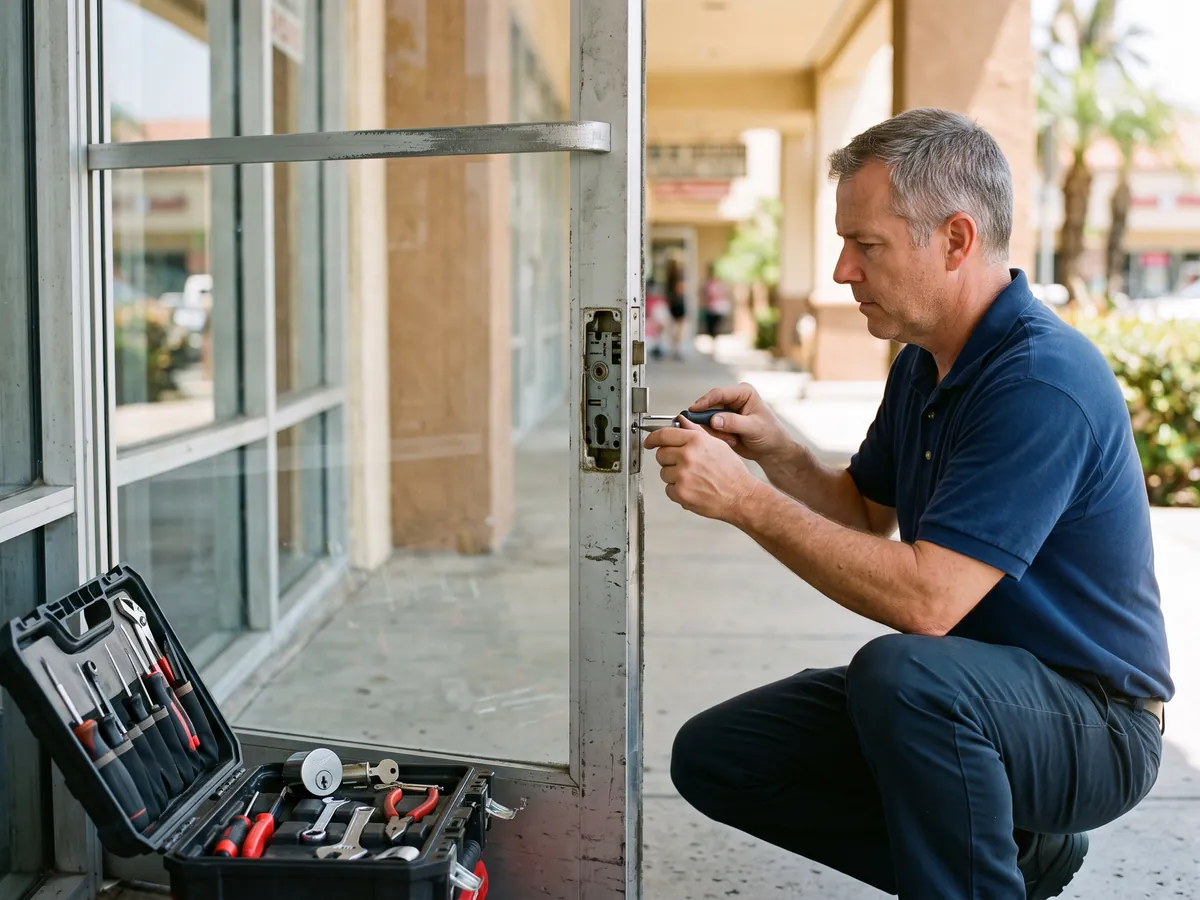
Glass doors move more than they look like they do. A heavy frameless door hangs on a top and bottom pivot, and a floor closer takes its weight and controls its speed. As the pivot wears, the door sinks a hair, and a bolt that used to drop cleanly into the floor strike starts catching its edge. Afternoon sun, slamming and grit in the strike make it worse across Eastvale. Glass door lock repair often means fixing that alignment as much as the lock itself, so we check the pivots, the closer and the strike before replacing a lock that may be healthy. Call (951) 903-3193. Honest answers matter here, since a pivot adjustment is a far smaller job than a lock the door never needed.
How this works in Eastvale
Three families of glass doors need three kinds of repair. Frameless doors use patch fittings at the corners, or a rail clamped along the bottom, with a lock body that throws a bolt into a floor, header or jamb strike. Pairs of frameless doors often use a center lock where the two leaves meet. Framed glass doors keep their hardware in the aluminum stile, so they behave like storefront doors, with deadlatches, hookbolts and mortise cylinders. Sliding doors lock with a hook-type bolt that catches a jamb strike. Glass door lock repair in Eastvale begins with a look at the edges, the hinges and the handle, because those reveal the family. A glass door that won't lock may have a worn cylinder, a damaged lock body, a misaligned strike or a sagging leaf. Photos help: take one of the bottom corner, one of the strike and one of the whole door.
What we can do on-site
- Patch lock repair and replacement. Patch locks wear where they work hardest: the cylinder, the bolt and the springs inside the case. We open the case when the model allows it, replace worn parts or the whole lock, and match the original footprint exactly, because the existing glass holes can't be changed to suit a different lock.
- Cylinders, cams and rekeying. Glass door hardware usually takes a standard mortise cylinder, but the collar, length and cam have to match the lock. We measure the old cylinder, fit one with the right tailpiece and cam, and key it to your existing key or a new one. The wrong length is a common cause of a key that turns with no effect.
- Framed glass doors with stile locks. Glass set into aluminum stiles keeps its lock in the frame, so the repair resembles other storefront work: a mortise cylinder, a deadlatch or a hookbolt lock, and a strike in the jamb. Wide-stile doors accept a standard mortise lock; narrow-stile doors use compact deadlocks, which our storefront pages cover.
- Sliding glass entry doors. Commercial sliding glass doors lock with a hook bolt that catches a strike in the jamb. When the tracks fill with grit, the door sits low and the hook misses. We clean the tracks, adjust the rollers where they allow it, and repair or replace the hook lock and its strike.
- Interior glass office and conference doors. Privacy and security are different things on a glass door. Opaque film can give privacy, but a lock still has to engage and resist tampering. We repair and recommend interior locks that suit the glass, and discuss clamp-on options when a door has no existing cutout for a lock.
How Eastvale shapes the job
Warehouse and distribution buildings in Eastvale usually keep their glass at the front office and reception, with framed glass doors facing the lot. Those doors take dust and delivery traffic, and shared office keys spread quickly. We repair glass door locks at the front of the building and rekey when staff change, while dock and roll-up doors use separate hardware.
Inland Eastvale summers heat dark-framed glass doors and metal hardware enough to change clearances. A frameless pivot can settle, a hook bolt can rub the jamb, and old lubricant can gum a cylinder, so a glass door lock that works at breakfast may stick by mid-afternoon. We adjust clearances, clean strikes and use dry lubricants that tolerate heat. We test on a warm door when we can, because a lock that behaves at 8 a.m. can fail at 3 p.m.
Newer commercial buildings and tenant improvements in Eastvale feature large glass entries and interior glass offices, often installed quickly. Pivots may be set roughly, floor strikes sit slightly off and cylinders are keyed to a construction system. We correct alignment, rekey to your own key and document the hardware so future repairs are straightforward. That note saves the next trade, and the next owner, a lot of guesswork.
Common situations
- While looking at a failing patch lock on a medical office door, we notice a small chip in the glass edge beside the fitting. We'd stop, explain that tempered glass with edge damage can fail without warning, and ask the owner to call a glazier. Once the glass is sound, we'd return and finish the lock. Keeping customers safe comes before finishing the repair.
- A downtown boutique needs glass door lock repair on a pair of frameless doors with a center lock. The left leaf has dropped, so the bolt only half-engages the keeper and the pair rattles in the wind. We'd level the leaves, replace the worn keeper, and test the lock from both sides with the doors shut. The owner wants it fixed before the weekend rush, so we'd confirm whether a part is needed before booking the visit.
- In a west-facing office suite, the glass door's key turns easily at 8 a.m. but sticks by afternoon when the aluminum frame warms. The hookbolt rubs the jamb strike. We'd ease the strike, adjust clearance and treat the cylinder with dry lubricant, then check the door again once it has warmed up. The tenant mentioned the problem began with the first hot week of the year.
- A dealership showroom needs glass door lock repair on frameless entry doors with a rail lock. Salespeople slam the doors, and the rail lock's bolt no longer lines up with the floor strike. We'd inspect the pivots, adjust the door, replace a worn bolt, and suggest a floor stop to protect the glass. The sales manager wants the doors working before a weekend sales event, so we'd quote the parts first.
Step by step with Julian's Locksmith
- Tell us what kind of glass door it is. Describe the door: bare glass with metal clamps at the corners, glass set in an aluminum frame, or a sliding leaf on a track. Tell us what the key and bolt do. Call (951) 903-3193, and if you can, take photos of the bottom corner, the strike and the whole door.
- Confirm you can authorize the work. Glass storefronts are often landlord property, so we confirm who can approve work. Photo ID plus a lease, business license, utility bill or a note from the property manager usually suffices. We note who approved the repair and what was changed. Digital copies of a lease page are fine.
- Check the glass and fittings first. A short, careful look comes first: glass edges, corner fittings, rail, and any sign of earlier repairs or forced entry. We photograph what we find, which helps with landlord or insurance questions, and we proceed only when the glass looks sound. Anything that looks marginal gets a plain-language explanation.
- Diagnose the lock, cylinder and strike. We work the key with the door open, then closed. A bolt that moves freely open but not closed points to alignment or the strike; one that binds when open points to the lock body or cylinder. We test the strike for debris, the cam for wear and the thumbturn for slip.
- Repair or replace, quoted first. If we find a second problem once the lock is open, we stop and requote. For anything involving the glass itself, we name the glazier's role and keep our scope to the lock, strike, handles and adjustments that don't touch the glass.
- Test, key and hand over. We run the lock from both sides, with the door open and closed, and confirm every key works and old keys don't. We also check that the door opens from inside without a key when the building is occupied. Any mismatch is fixed before we hand the keys over.
What affects the cost
- Matching existing cutouts and parts availability. Discontinued glass door hardware is the main driver of delay and cost. If your lock is out of production, we look for a compatible model that fits the existing cutouts, or tell you honestly if the glass would have to change, which is a glazier's decision.
- Glass and fitting condition. If the glass edge is chipped or a patch has loosened, a glazier needs to look before lock work continues. Their work is separate from ours and billed separately, and a sound pane protects both the repair and the people using the door. We tell you what we see before we charge for anything.
- Electrified, alarmed and closer components. A closer that no longer latches the door, or an alarm contact that reads wrong, can make a healthy lock seem faulty. We check these before blaming the lock, and we coordinate with your alarm vendor when needed, so repairs don't trigger false alarms.
Every job gets a clear quote before any work starts. Call (951) 903-3193 with the details and we'll tell you what to expect for your situation in Eastvale.
Common errors that cost time and money
- Ignoring a chip beside a fitting because the door still works. Edge damage in tempered glass can spread without warning, and the whole pane can fail suddenly. Treat it as a stop sign and call a glazier. The repair is small if done now, and large if the glass lets go.
- Treating the lock as the entire security plan. A glass door can be broken regardless of the bolt. Lock quality, laminated glass, lighting, alarms and key control work together, so ask what each can and can't do. Ask us which layers suit your door.
- Drilling tempered glass for a new lock or hasp. The pane will shatter, usually all at once, and a stopgap becomes a glazing emergency. Glass door hardware must fit the cutouts already in the glass or mount to the frame instead. The right fix is almost always a better-matched part, not a bigger hole.
What to do before we arrive
- Keep the floor strike clean. Sweep or vacuum the strike hole each evening, and keep mop water out of it. Grit, gum and dried cleaner keep a bolt from dropping fully, and a glass door can look locked when the bolt is only resting on the lip. It takes less than a minute and prevents most complaints about a bolt that won't seat.
- Tell your landlord when you find a problem with a glass storefront door. In many leases the owner controls the glass system, and early notice avoids disputes over who authorized the repair and who pays for related glass work. A short email also gives you a record.
- Don't slam it. A heavy glass door slammed shut loads the pivots, the patches and the bolt in a way a framed door shrugs off. A floor closer set too fast is the usual cause; ask us or your door contractor to check the closing speed. Many floor closers have adjustable speed valves for sweep and latch, and a small turn usually settles things.
- Write down the manufacturer and model if you can find it. Many glass door locks carry it on the face, the case or the rail. A name such as dormakaba or C.R. Laurence lets us find an exact-fit replacement faster than a description alone. The same name often points to the matching strike, keeper and cylinder as well.
Reaching Eastvale
Eastvale is about 27 miles from our San Bernardino base, roughly 34 minutes in light traffic via Little Mountain Drive and Highland Avenue to SR-210 West. When you call, you get an arrival estimate based on where the technician is and the traffic at that moment.
If you're close to Sumner Avenue, tell us which exit or cross street you're nearest. It trims the last mile and keeps the van from circling a block that looks right on the map but isn't.
About Eastvale: Eastvale covers roughly the westernmost quarter of Rancho Jurupa, a grant of about 48 square miles that Mexican Governor Juan Alvarado gave to Juan Bandini in 1838.
| Neighborhoods | Sumner Ranch, Riverstone, Steeplechase, Providence Ranch, Rivermist, Cloverdale Farms |
|---|---|
| ZIP codes | 91752, 92880 |
| Main routes | I-15, SR-60, Limonite Avenue, Hamner Avenue |
| From our San Bernardino base | about 27 miles via Little Mountain Drive and Highland Avenue to SR-210 West (Foothill Freeway), then I-15 South to the Limonite Avenue exit (Exit 103) for central and south Eastvale, or Cantu-Galleano Ranch Road (Exit 105) for Hamner Avenue and Goodman Way; I-215 North to I-15 South at Devore, or I-10 West to I-15 South, are the alternates |
Lock or door hardware trouble in Eastvale?
Call (951) 903-3193 with the address and what the door or lock is doing. We'll quote the repair before any work starts.
Frequently asked questions
Can you repair locks on commercial sliding glass doors?
Yes. Most commercial sliders use a hook-bolt mortise lock that catches a jamb strike. We clean the track, check rollers where we can, and repair or replace the lock, strike and cylinder. We don't service the operators and sensors of motorized sliders; those belong to the operator's service company, although we can handle the keyed lock on them.
Why does my glass door key spin or the bolt not throw?
A key that spins freely usually means a worn or wrong-length cam or tailpiece in the cylinder, so the key moves but the lock does not. A bolt that moves but doesn't reach its strike is more likely alignment: a dropped door, a worn pivot or a dirty floor strike. We test the cylinder, bolt and strike separately to find which. Sometimes both are true, so we don't assume.
Why does my glass door lock only stick in the afternoon?
Heat. Metal hardware and aluminum frames expand in afternoon sun, shrinking the clearance between the bolt and strike, and old lubricant can thicken in a cylinder. In Eastvale this is common on west-facing doors. We adjust clearances, clean the strike and use a dry lubricant, so the lock works in the morning and the afternoon. Shade film or an awning on west-facing glass can also reduce the heat the hardware sees.
Are you licensed, and what proof do you need from me?
Our California locksmith company license is LCO7891, issued by the Bureau of Security and Investigative Services; you can verify it at search.dca.ca.gov. We ask for photo ID and proof you can authorize work on the door, such as a lease, business license or a note from the property manager. We quote before we start. We keep a written record of who authorized what, which protects both of us.
How do I tell what kind of glass door I have?
Look at the edges and hinges. Bare polished glass edges, with metal clamps at the corners and pivots at the top and bottom, mean a frameless door. Glass held in aluminum stiles with side hinges means a framed door. A leaf on a track means a slider. Photograph the bottom corner, the lock and the strike and describe them when you call (951) 903-3193.
Will a better lock make a glass door burglar-proof?
No. A better lock stops quiet or opportunistic entry and shows reasonable care, but a determined thief can break glass. Security comes from several layers: a sound lock, good key control, laminated glass or film from a glazier, lighting and an alarm. We'll tell you what the lock can realistically do instead of overselling it. Laminated glass and film are glazier products, and we're happy to coordinate.
How far is Eastvale from your base?
Eastvale is about 27 miles from our San Bernardino base, roughly 34 minutes in light traffic. Arrival time depends on traffic and on the job the technician is finishing, so we give you an estimate on the phone before you commit.
Related services in Eastvale
- Storefront Lock Repair in Eastvale
- Storefront Door Repair in Eastvale
- Storefront Door Lock Replacement in Eastvale
- Aluminum Storefront Door Repair in Eastvale
- Narrow Stile Lock Repair in Eastvale
- Storefront Door Closer Repair in Eastvale
- Storefront Lockout in Eastvale
- Commercial Door Won't Lock in Eastvale
- Commercial Door Repair in Eastvale
- Locksmith for Retail Store in Eastvale
Glass Door Lock Repair in nearby cities
- Glass Door Lock Repair in NorcoRiverside County
- Glass Door Lock Repair in Mira LomaRiverside County
- Glass Door Lock Repair in PedleyRiverside County
- Glass Door Lock Repair in Glen AvonRiverside County
- Glass Door Lock Repair in CoronaRiverside County
- Glass Door Lock Repair in Jurupa ValleyRiverside County
- Glass Door Lock Repair in Home GardensRiverside County
- Glass Door Lock Repair in OntarioSan Bernardino County
