
Duarte, Los Angeles County
Narrow Stile Lock Repair in Duarte: Diagnose the Symptom, Fix the Lock
Short answer: Narrow stile lock repair is a specialty because the stile leaves no room for a standard deadbolt. A locksmith has to match backset, faceplate, cylinder length and cam. We verify you are the owner, manager or authorized tenant, then repair the lock on site. We work every day, 6:30 a.m. to 11:30 p.m. Call (951) 903-3193.
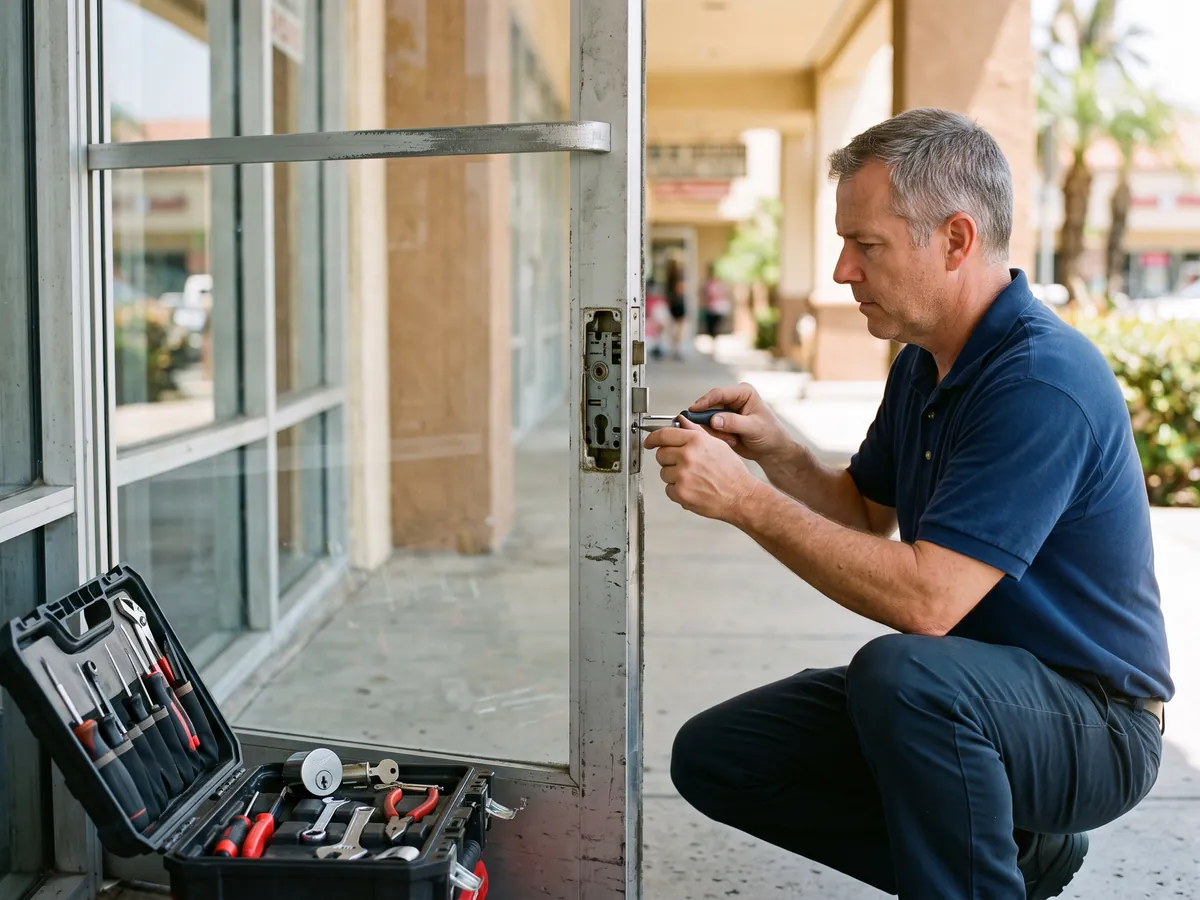
Look closely at an aluminum storefront door and you'll see the lock has almost no room to live. The stile, the vertical piece the lock sits in, is roughly two inches wide, so the hardware is a slim mortise case with a small cylinder, a short bolt and a faceplate barely wider than a finger. When something goes wrong in there, it looks like a mystery from outside. Narrow stile lock repair in Duarte is the work of finding which small part has failed: the lock case, the cylinder, the cam or the strike across the gap. Julian's Locksmith diagnoses it on site and fixes it, usually without removing the door.
How this works in Duarte
A narrow stile door gives you almost no room to improvise, which is why the fit of a replacement lock matters more here than on a house door. Four measurements decide what goes in the stile: the backset, meaning the distance from the stile edge to the center of the cylinder; the height and thickness of the lock case; the faceplate, which may be flat or radiused to suit the stile edge; and the cylinder length, which has to suit the door thickness and any collar or ring. Add the lock's function, whether a deadlatch, a deadlock or a combination, and its finish, and you have what a supplier needs to know. Narrow stile lock repair in Duarte therefore includes identification. We pull the lock, read the stamped model, measure what isn't stamped and photograph the stile pocket. If you send photos before we visit, we can usually bring the right body, cylinder or cam the first time.
How we can help in Duarte
- Key spins but the bolt doesn't move. When the key turns freely, the break is usually between the cylinder and the lock case. The cam may be worn, cracked or the wrong profile, or the cylinder may be rotating in its pocket because the set screw has loosened. We reseat or replace the cylinder, fit the correct cam and check that the bolt follows the key through its whole travel.
- Hookbolt or deadbolt that sticks, hangs or won't retract. If the bolt works freely with the lock out of the stile but drags once installed, the pocket may be pinching the case or the faceplate may sit proud. We re-seat the lock, check the pocket for burrs or damage and adjust the fit so the bolt runs without effort.
- Latch that won't catch, and deadlatch plunger problems. A latch that bounces back out, or won't stay in, may need a new latch assembly or a strike moved a fraction of an inch. We move the strike only as far as the door's actual position requires, then test the latch with the door pulled shut and pushed open, to be sure it catches without binding.
- Strike alignment and replacement. The strike across the gap does as much work as the lock. We check its height, depth and opening width, look for polished wear marks showing where the bolt rubs, and adjust or replace the strike. Anchoring it in the jamb with the right fasteners keeps it from drifting again.
- Loose lock cases and stripped faceplate screws. Movement in the lock case gives itself away: the cylinder wobbles in its ring, the key feels sloppy, the faceplate shows a bright crescent where it rubs. We catch that early, re-seat the lock and stop a small movement from turning into a damaged stile.
Local factors in Duarte
Clubhouses and activity centers in 55-plus communities need entrance hardware that is easy for everyone. Stiff keys and heavy thumbturns are a real problem for arthritic hands. Narrow stile lock repair there includes smoothing the key action, fitting easy-grip inside turns and checking that the latch releases with minimal effort. If keys are shared among volunteers, we can restrict duplication and keep count of who holds what.
Strip centers along Encanto Parkway tend to repeat the same narrow stile door and lock from suite to suite. That is an advantage for narrow stile lock repair: once we identify the model on one door, we can bring matching parts for its neighbors. Managers also tend to prefer consistent keying and finishes across the center. Tell us the suite and whether the landlord holds keys or specifies hardware, so repairs don't disturb the key system.
Clinics and medical offices near Royal Oaks Park need entrance locks that work smoothly for staff opening early and closing late, and that never leave patients stuck. We pay attention to inside trim and egress: thumbturns and paddles have to release easily. Keying matters too, because staff, cleaning crews and building management may all need access. We repair the lock and keep your key hierarchy intact, or help you tidy it up.
Situations this covers
- A boutique owner finds the cylinder pulled out about a quarter inch and scratches around the keyway. Someone tried to grab it with a wrench. After verifying ownership we would replace the damaged cylinder, add a beveled guard ring if the stile allows, check the lock case for bent parts, and note the damage for the owner's insurer.
- An insurance office's door was patched by a previous contractor: the cylinder is too short and the cam barely touches the lock lever. The key works until staff turn it in a hurry, and then it slips. We would measure the stile, fit a cylinder of the right length with the correct cam, and explain how close the lock came to failing outright.
- A dental office finds that its lock works fine with the door open but binds once the door is shut, and the key gets harder to turn as the day warms. The bolt is dragging on the strike. We would find the polished wear mark, move the strike a fraction of an inch to where the bolt really lands and leave the lock alone, since the lock itself was never the problem.
- A property manager with eight storefronts in a center near City of Hope National Medical Center asks us to look at a sticky lock in suite three. The lock is a common model, and the other seven doors are the same age. We would repair suite three, note the model and backset, then check the others for wear and leave a short report so the manager can schedule the rest.
From your call to the finished job
- Describe the symptom precisely. Call (951) 903-3193 about narrow stile lock repair and answer three questions: does the bolt move at all, does the problem happen with the door open, and what changed recently? A repair, a slam, a pry attempt or a hot week all point to different parts. Photos of the stile edge are welcome.
- Confirm authority to work on the door. We confirm that you are the owner, a manager or a tenant authorized to approve work before we touch the lock. A lease, a business license or a call to your property manager will do. It keeps strangers from altering a business's locks, and it is part of how we work under our license, LCO7891.
- Test the lock in stages. Testing includes feel as well as function. We note how the key turns, how the bolt sounds and where it drags. A grating cylinder, a bolt that clunks at the end of its travel and a latch that sticks on the way out each describe a different fault.
- Remove, identify and inspect the lock. Identification matters because replacement parts have to fit the pocket. We photograph the lock and stile, write down the model, backset, function and finish, and keep the information with your records so the next repair goes faster.
- Repair or replace, then reinstall. You hear the options first: repair the existing case, replace it with a matching body, or replace only the cylinder and strike. We quote before starting, work with parts that fit and choose a finish to match your door. Nothing is installed until you approve it.
- Test, label and hand off. We run the lock through repeated cycles with the door open and closed, check the latch with a firm pull from outside and make sure the thumbturn and trim work from inside. You receive working keys, a short explanation of what failed and advice on what to watch next.
Pricing factors
- Matching the lock to the stile. Narrow stile locks have to match backset, faceplate, case size and function. A common model is simple to source. An older or discontinued lock may need a close equivalent or a modified faceplate. We explain the trade-offs, including how a mismatch affects fit and finish.
- Condition of the stile and strike. The strike's anchorage matters as much as the lock. Loose or damaged jamb metal may need reinforcement or a different fastening. Reinforcing it is a smaller cost than living with a lock that keeps failing because its strike won't hold, and we check the jamb's fasteners before we quote.
- Timing and urgency. Planning ahead gives us time to source an unusual lock body and fit it during a quiet hour. A call made after 11:30 p.m. may have to wait until 6:30 a.m., and a lock that can't be repaired at once is secured as well as we can in the meantime.
Every job gets a clear quote before any work starts. Call (951) 903-3193 with the details and we'll tell you what to expect for your situation in Duarte.
What to do before we arrive
- Rekey or replace the cylinder when staff who held keys leave. If you already need a repair, ask us to rekey the cylinder while it is out; it adds little to the visit. A rekey costs far less thought than wondering who still carries a key to your front door.
- Don't tape, wedge or prop the latch back to dodge a sticky lock. A door held open on its latch isn't locked, and tape leaves residue that gums the mechanism. If the lock is too troublesome to use, call, and we'll make the door secure while we repair it.
- Cut new keys from the original or from the code, not from a worn copy. Each generation of copy adds a little error, and a key that is a few thousandths off makes a perfectly good cylinder feel sticky. Keep one original somewhere safe for exactly this reason.
- With the door open, push the latch bolt in with your finger and release it. It should snap back crisply every time. A latch that is slow, sticky or only half returns is an early warning, and it is often the difference between a quick cleaning and a replacement case later.
Common errors that cost time and money
- Hitting or kicking the door to seat the bolt. It may work once, but it bends the hookbolt, loosens the strike and can crack the glass or its gasket. If the bolt only catches under force, the door or strike needs adjusting, not a blow.
- Spraying oil or multipurpose lubricant into the cylinder. It feels like a fix for a day, then lint, dust and cooking vapor turn it into a paste that coats the pins. The cylinder ends up needing cleaning or replacement instead of the simple dry lubrication it needed.
- Ordering a replacement lock body online from a half-remembered model number. Backset, faceplate, case size and function all have to match, and a lock that is almost right won't fit the pocket. Photograph the stile and the lock, and let us confirm the match before anything is ordered.
Reaching Duarte
Duarte is about 42 miles from our San Bernardino base, roughly 47 minutes in light traffic via Palm Avenue to I-215 North and I-15 South. When you call, you get an arrival estimate based on where the technician is and the traffic at that moment.
Homes and businesses just off I-210 are routine stops for us. Give the suite or unit number and any gate instructions, and say whether the van can park out front or should pull into a side lot.
About Duarte: City of Hope began as the Los Angeles Sanatorium, a tuberculosis facility that opened in Duarte on January 11, 1914, with two canvas cottages on 10 acres.
| Neighborhoods | Central Duarte around Duarte High School and Northview Park, Royal Oaks Drive near the Bradbury line, City of Hope campus area along East Duarte Road, Duarte Station area at Highland Avenue, West Duarte between Mountain Avenue and Buena Vista Street, Encanto Parkway and Valley View Park on the east side |
|---|---|
| ZIP codes | 91010, 91008 |
| Main routes | I-210, I-605, Huntington Drive, Duarte Road |
| From our San Bernardino base | about 42 miles via Palm Avenue to I-215 North and I-15 South, then SR-210 West (Foothill Freeway), continuing as I-210 West through Glendora, Azusa and Irwindale; exit Mount Olive Drive for Las Lomas, Royal Oaks Drive and the east side, or Buena Vista Street for Huntington Drive, City of Hope and Duarte Station |
Lock or door hardware trouble in Duarte?
Call (951) 903-3193 with the address and what the door or lock is doing. We'll quote the repair before any work starts.
Frequently asked questions
What is backset, and why does it matter in a narrow stile?
Backset is the distance from the edge of the stile to the center of the cylinder. In a narrow stile there is almost no room for error, so a replacement lock with the wrong backset won't line up with the cylinder hole. Narrow stile backsets are small, around an inch or a little more. We measure it every time rather than guess, then match the new lock to it.
Can you identify my lock from a photo?
Often we can narrow it down. A photo of the stile edge showing the faceplate, plus the cylinder and any stamped markings, tells us the family and the likely backset. We still measure and confirm when the lock is out of the door, because a near match won't fit. Send photos to info@julians-locksmith.com or describe what you see when you call (951) 903-3193.
Can a standard deadbolt go in a narrow stile door in Duarte?
Normally not. The cross bore for a residential deadbolt is two and an eighth inches across, wider than the stile itself, so drilling it would gut the door. Narrow stile doors use slim mortise locks, or surface-mounted hardware on the frame in some cases. We can recommend an option that fits without drilling into places that should not be drilled.
My key turns all the way around but the bolt doesn't move. Why?
The cylinder is turning, but the movement isn't reaching the lock. The cam may be worn, cracked or the wrong profile. The cylinder may also have loosened in the stile and be rotating with the key, or be a little too short to engage the lock. We remove the cylinder, check the cam and length and fit the correct parts. The bolt then follows the key.
What decides whether you repair or replace the lock?
Condition and fit. If the case is straight, the bolt moves freely and the springs are sound, we repair the lock or replace the small parts. If the bolt is bent, the case is cracked or the mechanism is worn out, we replace the body with a matching one. We explain the reasoning and quote both so the choice is yours.
Do you rekey the cylinder during narrow stile lock repair?
Yes, if you want it. With the cylinder out, rekeying to a new key adds little to the visit and is sensible if staff have left or keys have been lost. We can also key a replacement cylinder to match your other doors, or pin it to a master system. Tell us which option you prefer, and we'll quote it separately.
How far is Duarte from your base?
Duarte is about 42 miles from our San Bernardino base, roughly 47 minutes in light traffic. Arrival time depends on traffic and on the job the technician is finishing, so we give you an estimate on the phone before you commit.
Related services in Duarte
- Storefront Lock Repair in Duarte
- Aluminum Storefront Door Repair in Duarte
- Storefront Door Lock Replacement in Duarte
- Storefront Door Repair in Duarte
- Glass Door Lock Repair in Duarte
- Commercial Door Won't Lock in Duarte
- Commercial Latch Repair in Duarte
- Commercial Lock Repair in Duarte
- Broken Key Extraction in Duarte
- Storefront Lockout in Duarte
Narrow Stile Lock Repair in nearby cities
- Narrow Stile Lock Repair in BradburyLos Angeles County
- Narrow Stile Lock Repair in MonroviaLos Angeles County
- Narrow Stile Lock Repair in IrwindaleLos Angeles County
- Narrow Stile Lock Repair in AzusaLos Angeles County
- Narrow Stile Lock Repair in Baldwin ParkLos Angeles County
- Narrow Stile Lock Repair in ArcadiaLos Angeles County
- Narrow Stile Lock Repair in North El MonteLos Angeles County
- Narrow Stile Lock Repair in CitrusLos Angeles County
