
Devore, San Bernardino County
Car key replacement in Devore, CA, by make and model
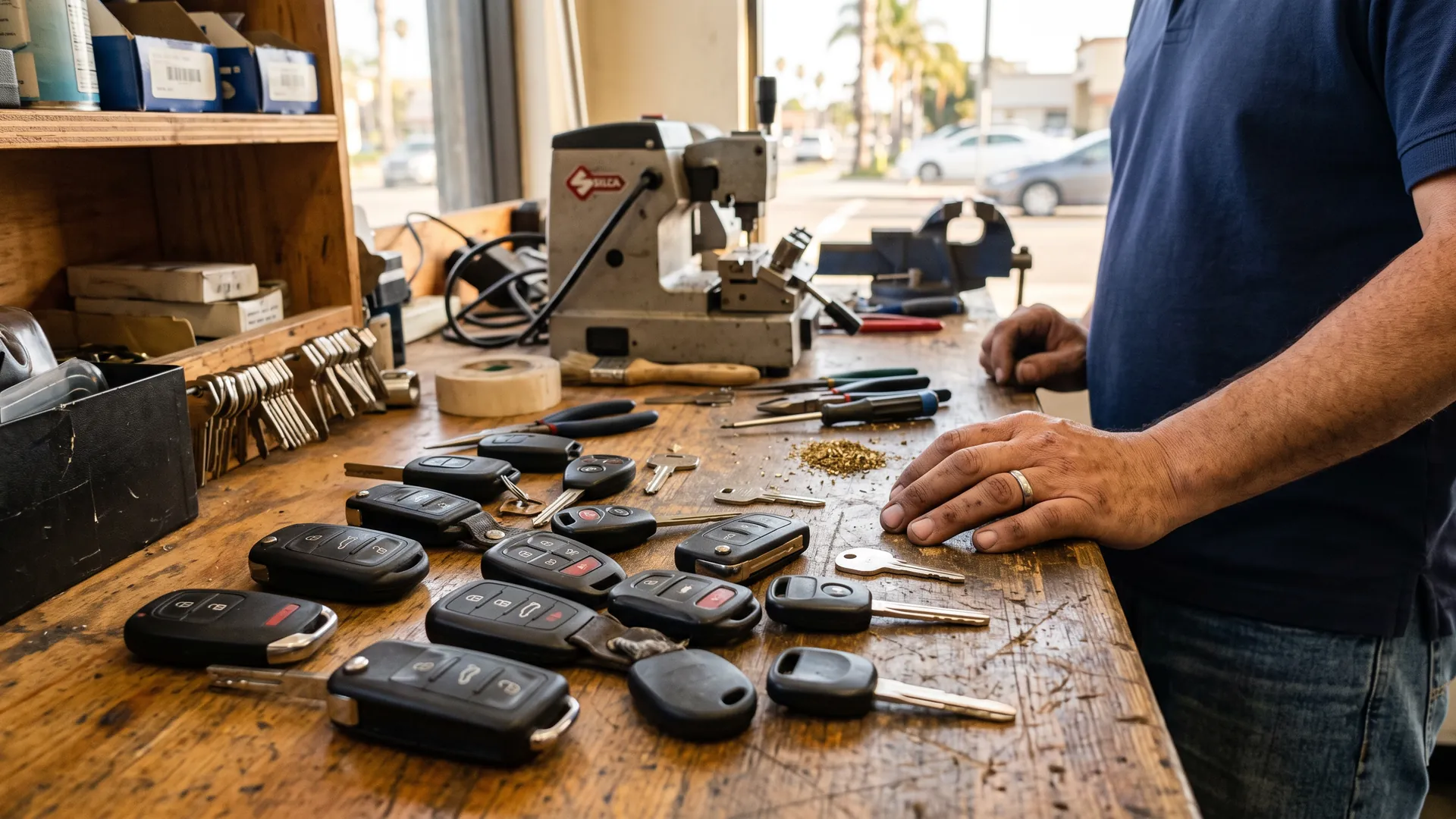
Short answer: Julian's Locksmith cuts and programs car keys on site in Devore for 40 makes and hundreds of models from 2000 to 2026: transponder keys, remote head and flip keys, and push-to-start smart keys. Choose your make below for model-by-year key details, or call (951) 903-3193 with your VIN.
Choose your make
- Acura keys14 models
- Alfa Romeo keys5 models
- Audi keys37 models
- BMW keys31 models
- Buick keys17 models
- Cadillac keys26 models
- Chevrolet keys42 models
- Chrysler keys15 models
- Dodge keys24 models
- Fiat keys6 models
- Ford keys37 models
- Genesis keys9 models
- GMC keys21 models
- Honda keys17 models
- Hummer keys5 models
- Hyundai keys27 models
- Infiniti keys31 models
- Jaguar keys10 models
- Jeep keys14 models
- Kia keys26 models
- Land Rover keys11 models
- Lexus keys19 models
- Lincoln keys15 models
- Mazda keys24 models
- Mercedes-Benz keys28 models
- Mercury keys11 models
- MINI keys9 models
- Mitsubishi keys16 models
- Nissan keys28 models
- Pontiac keys16 models
- Porsche keys11 models
- Ram keys11 models
- Saturn keys9 models
- Scion keys8 models
- Subaru keys14 models
- Suzuki keys12 models
- Tesla keys6 models
- Toyota keys35 models
- Volkswagen keys28 models
- Volvo keys23 models
The key types we replace
- Basic mechanical key. With no key left at all, a mechanical-key vehicle is the most straightforward all-keys-lost case there is. Nothing has to be programmed, so the work comes down to reading the lock. We can often get the key code from the VIN through manufacturer channels once ownership is verified. When that isn't available, we decode a door lock with a Lishi-style pick and decoder, which reads each wafer position without removing anything, then cut a key to those depths. Any cuts the door lock doesn't reveal are worked out by progression, test-fitting in the ignition until it turns. For a vehicle of this type, it is usually the least involved key replacement we do.
- Transponder (chip) key. A transponder key carries a small chip in its head, usually a glass capsule or a carbon wafer, with no battery of its own. When you turn the key in a vehicle that uses one, an antenna ring around the ignition energizes the chip and asks for its code. If the answer matches what the immobilizer has stored, the engine is allowed to run. If it doesn't, you get the classic symptoms: the engine cranks but won't fire, or it fires and dies after a second, and the security light on the dash flashes or stays lit. That's why a perfectly cut copy without a programmed chip will open the doors but won't start the car.
- Remote head key. Remote-head keys take a beating. The rubber button pad wears through, the plastic housing splits at the seam, and the blade can snap right at the head after years of being used as a pry tool or hanging from a heavy key ring. When the electronics inside are still healthy, we can often move the circuit board and chip into a new shell and cut a fresh blade to your code, which keeps the existing programming intact. If the board is cracked or water-damaged, a new key is the honest answer. Either way, for your vehicle, we open the old key and show you what's broken before recommending anything.
- Key with separate remote fob. Some vehicle owners carry two pieces: a transponder key for the ignition and a separate remote fob on the same ring. Because they work independently, you only have to replace what's actually missing or broken. A lost remote still leaves you with a key that opens the doors and starts the engine, so it's an inconvenience rather than an emergency. A lost key is the more urgent half, since it has to be cut and its chip programmed before the car will run. We stock and program both sides, and if the whole ring is gone, we handle the key first and then pair a new remote.
- Flip (switchblade) key. The hinge is the weak point on most flip keys. The pivot pin loosens, the spring loses tension, the release button sticks, and eventually the blade either won't lock open or flops out on its own. Carrying the key half-open in a pocket speeds that wear along. If the electronics are healthy, a replacement shell with a new hinge and pin often brings a vehicle flip key back to crisp action: we transfer the board and chip, move or recut the blade, and test every function. If the board has broken solder joints or water corrosion, we'll show you the damage and quote a new key instead.
- Smart proximity key (push-to-start). A smart or proximity key lets a vehicle open when you touch the door handle and start with a push of a button while the fob stays in your pocket or bag. Antennas in the doors and cabin send out a low-frequency wake-up signal; the fob answers on a higher radio frequency with an encrypted reply, and the car only allows a start once it confirms the fob is inside. When the fob battery is weak, that conversation fails, which is why most designs include a backup: hold the fob against the start button or set it in a designated pocket. The owner's manual shows where, and it's worth checking before you need it.
- Key card. Key cards are tougher than they look, but they do have weak spots. A card carried in a back pocket flexes every time you sit, and a cracked internal antenna simply stops reading. Heat matters too: a card left on the dashboard of a parked vehicle through an inland summer afternoon can warp. Keep the card flat in a wallet slot, and if it shares space with transit or hotel cards, present it alone when it won't read, because stacked NFC cards can confuse the reader. Treat it as a real key, never a spare left in the glove box, since anyone who finds it inside the car may be able to drive away.
- Phone as key. Phone keys fail in ordinary ways: a dead battery, an app that logs you out after an update, Bluetooth switched off, or a new phone that hasn't been set up yet. That's why every vehicle with a phone key, including a vehicle, should have a working physical backup, whether that's a key card, a fob or a keypad code. Some phones keep a power reserve that lets the wallet key work for a while after the screen goes dark, but don't count on it in a parking garage. Where your platform allows a locksmith to program a backup fob or card, we can do that on-site; where it doesn't, we'll explain the dealer path.
How the job works
- Identify the exact key your vehicle uses. We ask a few quick questions on the phone: the year, whether the car starts with a turn key or a button, how many keys you have left, and whether the remote still works the doors. Then we check the VIN against our programming references so the van arrives with the correct blank or fob, not a close guess.
- Verify ownership before any work. California holds licensed locksmiths responsible for knowing whose car they're making keys for. We record your name, the VIN and the plate on a work order. If you aren't the registered owner, you'll need the owner's written authorization along with your own photo ID before we begin.
- Get the key code or decode the lock. A key is cut from a code, not a guess. When the factory code can be retrieved through manufacturer channels after ownership is verified, we use it. When it can't, we decode a door lock with a pick-decoder tool that reads the wafer positions without damaging anything, then work out any missing cuts.
- Cut the blade on-site. Our van carries a code-cutting machine that handles both traditional edge-cut blades and the laser-cut, side-milled profiles common on newer keys. The blade is cut to the code, then test-fitted in a door lock and the ignition or emergency keyhole to confirm smooth operation before any programming begins.
- Program the chip, remote or smart key. Programming tells the car's computers that the new key belongs to the vehicle. Transponder chips are added to the immobilizer, remote buttons to the body control module, and proximity fobs to the keyless system. If a step requires dealer-only access on your vehicle, you'll have heard that before we arrived, not halfway through the job.
- Test everything and clear out old keys. Before we leave, every function gets checked: doors, trunk or liftgate, panic button, remote range, engine start, and the emergency blade in the driver's door. If keys are missing, we delete them from the car's memory where the system allows, so a lost key can no longer start the engine.
Dealer or mobile locksmith?
The biggest difference between a dealership and a mobile locksmith is where the work happens. A dealer programs keys in its service bay, so if every key is lost, the car usually has to be towed there, and you work around the service department's schedule and the time it takes to order a key by VIN. Julian's Locksmith brings the cutting machine, key blanks and programming equipment to the car, whether it sits in your driveway, a workplace lot or a parking structure. For a vehicle we can program on-site, that means no tow and no shuttle rides back and forth. The trade-off is real, though: on vehicles where only the dealer can program keys, a tow or appointment may still be necessary, and we'll say so before you spend anything on our visit.
Proof of ownership
Making car keys is regulated work in California. Locksmiths are licensed and overseen by the Bureau of Security and Investigative Services under the Locksmith Act, Business and Professions Code section 6980 and following, and Julian's Locksmith holds company license LCO7891. Verification protects you more than anyone: a locksmith who will make a key for whoever asks will also make one for someone who wants your car. We record your name, the vehicle and its VIN on a work order, and we politely decline jobs where ownership can't be established. You can look up our license at search.dca.ca.gov.
Frequently asked questions
When can you come out to Devore for a car key?
We work every day from 6:30 a.m. to 11:30 p.m., weekends included. Weekends are included. Call (951) 903-3193 and we'll give you an honest ETA to Devore based on where we are at the time. If you're stuck outside our hours, it's usually smarter to leave the car parked and locked, get home safely, and call when we open than to pay for an overnight tow.
Do you come to Devore to make car keys, or do I bring the car to you?
We come to you. Julian's Locksmith is a mobile-only service, so the van drives to wherever the car is parked in Devore: your driveway, an apartment lot, a workplace or a shopping center. That matters most when every key is lost, because it saves you a tow. Just make sure we'll have room to work beside the driver's door and that the vehicle is accessible when we arrive.