
Cypress, Orange County
Locked Out of Business in Cypress: Find the Cause, Get Back In
Short answer: Most business doors open without breaking anything, using picks, decoders, bypass tools and shims matched to the lock. What changes the job is the reason you're locked out. Keys inside or lost keys are entry work. A failed lock or reader may need repair. A landlord-changed lock needs the landlord's authorization first. Tell us which in Cypress at (951) 903-3193.
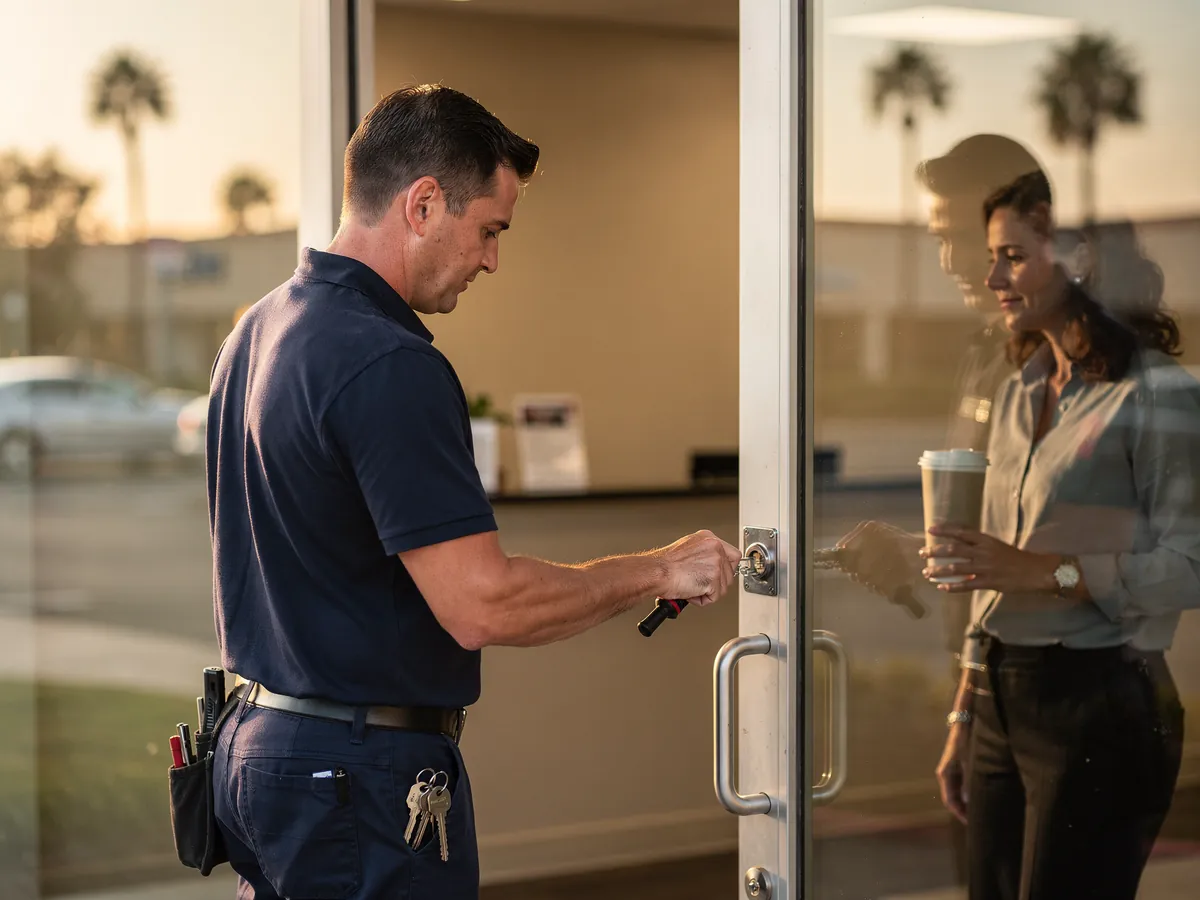
Getting the door open is only half of being locked out of business premises. The other half is learning why it happened, because the cause is usually fixable. A single key kept off the property, a former employee who never returned theirs, a keypad running on old batteries, a cylinder worn smooth or a door that has drifted out of alignment will lock somebody out again. When we've opened your door in Cypress, we explain what we saw, then suggest only what the cause calls for: a spare in the right hands, a rekey, fresh batteries or a repaired latch. Think of it as a short post-mortem on the door, kept practical and free of upsells.
What to know first in Cypress
Authority is the first thing a locksmith has to settle, and it's simple once you know what to bring. An owner shows photo ID plus a business license, lease, utility bill or tax document that carries the same name. A manager or employee shows ID plus confirmation from the owner or property manager, which we verify directly by phone. Franchise staff may need the franchisor's contact. If a business is co-owned and the partners disagree, or a landlord has changed a lock, we need the person with the legal right to authorize. We aren't lawyers, and we won't referee a lease dispute from the sidewalk. We will open a door as soon as the right person says yes. Every entry is written on a work order with the name of whoever authorized it, which gives you a record if anyone asks later. Businesses that run from a kiosk, a pop-up or a home-based studio can show a city permit, a vendor agreement or a confirmation from the property owner that we can verify directly.
Work included on a typical visit
- Keys locked inside at closing. The most common business lockout is also the simplest: the door shuts with the keys on the counter, in a coat or in the till. We pick the cylinder or bypass the latch, let you in and leave the hardware undamaged. Afterward we can cut a spare for a trusted keyholder, so closing time never depends on one key ring.
- Lost, stolen or unreturned keys. Employees leave, and sometimes their keys don't come back. When a former worker still holds a key, the question is trust as much as security. We rekey the cylinders it opened, cut a labeled set for current staff and suggest a key log. With a restricted keyway, copies need your signature, which closes the gap.
- Back doors, roll-up gates and padlocked entrances. Padlocks and hasps on roll-up doors, shipping containers and yard gates open by picking, shimming or, for hardened shackles, cutting as a last resort. Cutting destroys the padlock but leaves the door intact. We can supply replacement padlocks, keyed alike if you want one key across your gates. Tell us the shackle size and whether the padlock is weather-rated or hardened.
- Interior doors, cash rooms and file cabinets after you're in. Server closets, records rooms and safes are another category. We open server and records rooms with your authorization. Safes are separate work that sometimes requires drilling, and we say so up front. For anything holding regulated records, such as medical or financial files, you may want a manager present. We never read or move records; we only open the door.
- Rekeying, spare keys and key control afterward. A restricted keyway, such as those from Medeco, Schlage Primus or Mul-T-Lock, makes copies depend on your authorization card. That matters when staff come and go. We explain how the system works, what it adds and what it doesn't, so you can decide whether it's worth it for your doors.
What's different about Cypress
Businesses that serve commuters open early, close late and have little margin for error. A coffee counter near a freeway on-ramp loses its busiest hour to a lockout. Our day starts at 6:30 a.m. seven days a week, which helps with 7 a.m. openings. If you open earlier, arrange a keyholder plan with a neighboring tenant or the property manager, and call us for the repair afterward along Walker Street.
Shopping centers and strip malls put dozens of businesses behind similar aluminum storefront doors, and those doors share parking lots, rear service corridors and landlord rules. If you're locked out near Los Alamitos Race Course, tell us your suite number and which side of the center it faces. We check whether the property manager keeps a master key, verify the lease and keep the entry low-key, so customers don't see a break-in scene. Mention any rolling gate or security grille, since it adds a second lock to the job.
Campus-area businesses live on class schedules: coffee shops opening for the first lecture, copy shops before finals, tutoring centers after dark. Part-time staff often hold keys without owning the business. If a student employee is locked out near Cypress Community Center, we call the owner or manager for authorization. Semester breaks change schedules, so mention if the shop is on reduced hours. Student employees can reach us with the owner's approval on the line.
Common situations
- Consider a dental office in a medical plaza near Oak Knoll Park. After a power flicker, the magnetic lock on the suite door won't release, and the first patients are arriving. We'd check the power supply, the exit button and the fire-alarm relay, open the door by the safest route available, and tell the office manager if the control panel needs its own technician.
- It's 11:10 on a Friday night, and a boutique owner locking up has just snapped a key in the door lock. Her best day is Saturday, and she wants to open tomorrow. We close at 11:30 p.m. every night, so we'd say honestly whether we can get there and finish in time. If we can't, a locked-up shop for the day is better than a broken door.
- A restaurant's back-door keypad dies on a hot afternoon, the battery drained, and the cooks are waiting outside with a food delivery. The keyed override sits behind a small cap that nobody remembers. We'd talk them through finding it, head over if that fails, open the door, replace the batteries and reset the code so anything shared with former line cooks stops working.
- A manager arrives to find the suite key no longer turns because the building was rekeyed after a break-in elsewhere in the complex. The property manager's line goes to voicemail. We'd suggest the building's after-hours maintenance number first. If management authorizes it, we open the door, record who approved, and cut keys for the new system so nobody is guessing about access again.
From your call to the finished job
- Name the cause of the lockout. Describe the door as you would to a coworker: glass or solid, one lock or several, a keypad, a card reader, an alarm panel inside. Mention whether staff are waiting, deliveries are due and whether a building manager is on site. We use that to choose a route and plan how to reach you.
- Try the free routes first. If a keyholder is a short drive away, a spare may be the cheapest answer, and we're fine with that. We'd rather you open your doors with a key in your hand than pay for entry you didn't need. Tell us you're waiting on a callback, and call us back when you know.
- Authorize the entry. If the owner isn't answering, check the lease. It often names a landlord contact who can verify tenancy. Franchise units may route authorization through the franchisor. We understand the delay is painful, and we move the moment the right person confirms, but we won't open a business on a hunch.
- Choose the route and protect the building. We tell you the plan before we start, including the fallback. If picking won't succeed on a damaged or high-security cylinder, we explain the next step, such as drilling and replacing it, and ask for your approval. Glass is always the last option, and the decision is yours.
- Open, test and make the door usable. Once the door is open, we test it as a door: key in, key out, latch catching, bolt reaching the strike, closer pulling it shut. If the lock failed, we repair it or fit a replacement from the van so you can close tonight. If it can't be fixed on the spot, we secure it temporarily.
- Close the loop on keys and codes. A final walk-through covers every door that uses the same key or code. We test each one and show you where problems are likely to appear next, such as a stiff cylinder or a door that rubs. Then you get the work order, which records who authorized entry, what we did and what we recommend.
Pricing factors
- Why you're locked out. The reason shapes the whole invoice. A shop locked out because of a forgotten key is a short visit. A shop locked out because a former employee kept keys also needs rekeying. A shop locked out because an electric lock failed may need a specialist. We would rather tell you which on the phone than surprise you later.
- Door type, lock grade and number of locks. A single Grade 2 deadbolt on a hollow metal door is routine. A storefront door with a narrow-stile lock and a hookbolt, two locks on the same door, a security gate in front or a high-security cylinder takes more time. Tell us how many locks stand between you and the inside.
- Entry method and what has to be replaced. Parts come from the van when we have them. A standard commercial cylinder, a knob set or a padlock can be installed on site; unusual hardware like a specific mortise body or an exit device trim may need ordering. We tell you which side of that line you're on, and we secure the door meanwhile.
Every job gets a clear quote before any work starts. Call (951) 903-3193 with the details and we'll tell you what to expect for your situation in Cypress.
Advice before you book
- Write a keyholder list this week: names, roles and mobile numbers for everyone who can open the business, plus the property manager's after-hours line. Keep one copy in your phone and one with a second manager. When a lockout hits, that list is the first thing you reach for, and it's often the fastest fix.
- Know your alarm company's procedure and your verbal passcode. Before anyone opens a door during a lockout, call and say a locksmith will enter. That prevents a false dispatch and puts the company on record in case anything later looks off. Save the monitoring number under a name you'll recognize.
- Never hide a spare key outside: not under a mat, in a planter or in a magnetic box on the frame. Thieves know every spot. A better plan is a second key with a trusted keyholder, or a coded key safe mounted properly in a concealed, secure location. We can suggest where for your door.
- Keep each door's key on its own ring. A single master ring for the whole building is the worst case when it's lost. Separate rings by door or zone, label them with codes rather than names, and store the spares in a locked cabinet, not in the manager's desk drawer.
Common errors that cost time and money
- Overstating your authority. Telling a locksmith you're the owner when you're an employee may save a minute, but it undermines everyone. An honest answer gets a quick phone check with the real owner. A locksmith who opens doors for any claim is one you shouldn't want near your business. We verify before we open for exactly this reason.
- Rekeying only the front door. Back doors, side entrances, the roll-up gate padlock and the storeroom often share the same key. Change one lock and leave the rest, and the lost key still opens the building. Count every lock that key touches before deciding what to rekey. A short written key list makes that count easy.
- Choosing a locksmith by price alone. A teaser quote that grows once the van arrives is a familiar pattern with commercial locks. Ask for the license number, the company name and the total, including drilling and parts. Ours is LCO7891, and you can verify it at search.dca.ca.gov. A clear total up front is the mark of a careful company.
Service in Cypress
Cypress is about 63 miles from our San Bernardino base, roughly 68 minutes in light traffic via I-215 South through Colton and Grand Terrace to SR-91 West through Riverside, Corona and the Santa Ana Canyon. When you call, you get an arrival estimate based on where the technician is and the traffic at that moment.
Rush hour on Moody Street can stretch a drive considerably. We'd rather give you a realistic arrival window than an optimistic one, and we'll call you if a closure or a crash changes the plan.
About Cypress: The city takes its name from Cypress Elementary School, built in 1895 and named for the cypress trees planted to shelter the schoolhouse from Santa Ana winds.
| Neighborhoods | Oak Knoll Park neighborhood, Katella Avenue corridor and Race Course district, Civic Center area on Orange Avenue, College Park beside Cypress College, Arnold Cypress Park area off Watson Street, Veterans Park area |
|---|---|
| ZIP codes | 90630, 90720 |
| Main routes | I-605, SR-91, SR-22, Katella Avenue |
| From our San Bernardino base | about 63 miles via I-215 South through Colton and Grand Terrace to SR-91 West through Riverside, Corona and the Santa Ana Canyon, then the Valley View Street exit and south into Cypress; alternate via SR-57 South to SR-22 West and the Valley View Street exit when the 91 is jammed |
Mornings start early here: phones are answered from 6:30 a.m. seven days a week, which suits commuters who discover a missing key in the driveway and shop owners who can't open the front door. Saturday and Sunday are no different. Every day runs to 11:30 p.m.
Expect a few questions and a signature. A licensed California locksmith has to document who asked for a lock to be opened or a key to be made, and we follow that rule on every job in Cypress. If a locksmith skips the ID check entirely, ask yourself whose door they'd open next.
Locked out in Cypress?
Call (951) 903-3193 with the address and what's locked. You'll get an arrival estimate and a quote before anyone heads out, and when we arrive we'll ask for ID that ties you to the property. If a child or pet is shut inside a hot car or building, call 911 first.
Frequently asked questions
Our electric lock or maglock stopped working after a power cut. Is that a lockout?
It can be. A fail-secure strike stays locked without power, while a magnetic lock normally releases. We check the power supply, the exit button and the panel, and open the door mechanically if there's a key override. Magnetic locks are life-safety devices tied to fire alarms, so some repairs belong with your low-voltage or fire-alarm contractor.
My key goes in but won't turn at the shop door. What's wrong?
Likely a worn or dirty cylinder, a bent or worn key, or a bolt binding against the strike. The key may be a poor copy, or the door may have shifted. Don't force it; commercial keys snap. We pick the cylinder open, find the cause, clean, rebuild or replace it, then cut a fresh key.
How much does it cost when you're locked out of a business?
We don't post flat prices because the job varies. The main factors are why you're locked out, the door and lock type, how many locks are involved, the time of your call within our hours, site access and whether anything must be replaced or rekeyed. Call (951) 903-3193 and we'll quote before anyone heads to Cypress.
What do you do after the door is open?
We test the lock and door, find the cause of the lockout and tell you what we found. Common follow-ups are rekeying after lost keys, replacing a worn cylinder, resetting keypad codes and cutting spares. Each is quoted separately, and you decide. We also leave a work order that records who authorized entry. A short summary of what we found stays with you for your records.
The keypad on my door won't take the code. Can you get me in?
Usually. Fresh batteries fix many keypads, so try them first. If that fails, most commercial keypad locks also have a keyed override cylinder, and we can open through it or pick it. Then we test the lock, reset the master code and reprogram user codes. Networked access control may need the system vendor as well.
We trade late on Saturdays and you're closed after 11:30 p.m. What should we do?
Plan ahead. We're closed between 11:30 p.m. and 6:30 a.m., so a lock problem noticed late at night needs a call before 11:30 p.m. or waits until 6:30 a.m. Keep a second keyholder, a spare key held off-site and your landlord's after-hours number ready for the hours we're closed. We're happy to fix anything weak on a weekday, before your busy days.
How far is Cypress from your base?
Cypress is about 63 miles from our San Bernardino base, roughly 68 minutes in light traffic. Arrival time depends on traffic and on the job the technician is finishing, so we give you an estimate on the phone before you commit.
Related services in Cypress
- Business Lockout in Cypress
- Office Lockout in Cypress
- Storefront Lockout in Cypress
- Commercial Building Lockout in Cypress
- Business Lock Rekey in Cypress
- Commercial Lock Repair in Cypress
- Business Locksmith in Cypress
- Locksmith for Retail Store in Cypress
- Locksmith for Office Building in Cypress
- Commercial Lock Rekey in Cypress
Locked Out of Business in nearby cities
- Locked Out of Business in Los AlamitosOrange County
- Locked Out of Business in Hawaiian GardensLos Angeles County
- Locked Out of Business in La PalmaOrange County
- Locked Out of Business in StantonOrange County
- Locked Out of Business in Buena ParkOrange County
- Locked Out of Business in CerritosLos Angeles County
- Locked Out of Business in ArtesiaLos Angeles County
- Locked Out of Business in Seal BeachOrange County


