
Corona, Riverside County
Emergency Locksmith Help in Corona for Homes, Cars and Businesses
Short answer: An emergency locksmith in Corona handles the lock and key problems that can't wait: lockouts from a house, car or business, keys snapped inside a cylinder, doors that won't lock after a break-in, and lost keys that call for a same-visit rekey. Julian's Locksmith drives to you, checks ID and ownership, and quotes the job before starting. Call (951) 903-3193.
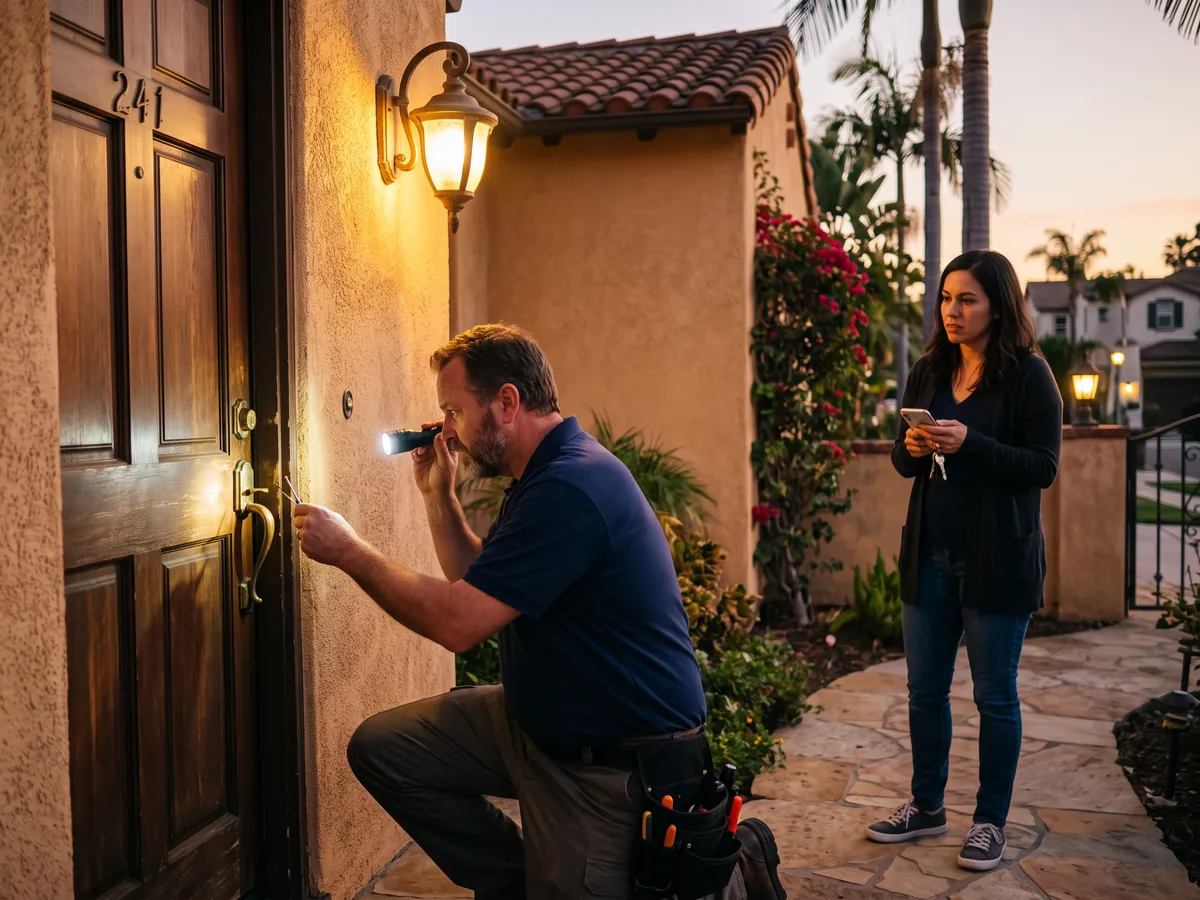
Plenty of locksmith ads promise they never close. We don't, because it isn't true for us and you deserve to plan around facts. Julian's Locksmith runs emergency calls in Corona from 6:30 a.m. to 11:30 p.m. every day. We are closed overnight. Within those hours, lockouts, broken keys, break-in damage and stranded vehicles get treated as priority work by an emergency locksmith who drives to you. Outside them, this page explains what to do until we reopen, including when a property manager, roadside assistance or 911 is the better call.
An emergency locksmith call in Corona often starts on the 91. Someone is stuck outside a locked door, or a car sits dead at the curb while commuters back up toward the 15 interchange, and the first thing we work out is how far the van has to travel. Our base in San Bernardino is roughly 36 miles from central Corona, so after asking where you are, what is locked or broken and whether anyone is at risk, we give you an honest ETA instead of a promise we can't keep. If a child or pet is shut inside a car during a Corona August, call 911 first. Heat inside a closed vehicle climbs fast, and fire crews can reach the door sooner than any locksmith can cross the county line. Break-ins are the other kind of emergency. A forced back door downtown off Main Street or a pried side gate in Green River has to be made secure before anyone talks about upgrades, so the van carries deadbolts, strikes and reinforcement plates. Leave a damaged frame alone until police finish their report. We take calls every day from 6:30 a.m. to 11:30 p.m., weekends included.
Emergency Locksmith in Corona: what to expect
The moment the door opens is the middle of an emergency call, not the end. Whatever caused the problem usually needs attention while we're standing there. A key that snapped was probably worn thin, so we cut a new one by code or from the pieces. A deadbolt that wouldn't throw likely has a misaligned strike that will fail again next week. Keys lost along with your address mean the cylinders get rekeyed. A forced door needs a reinforced strike and 3-inch screws reaching the framing, because a factory strike held by short screws is the weak point. That's why an emergency locksmith van from Julian's carries pins, followers and key blanks, common Kwikset and Schlage deadbolts and knobsets, heavy-gauge strikes, mortise cylinders and cams, padlocks and transponder blanks. In Corona, most urgent calls end in a single visit with the door locking properly and the cause dealt with. When something needs a part we don't stock, or a different trade, we secure what we can and lay out the next step clearly.
How we can help in Corona
- Vehicle lockouts, including trunks. An air wedge and long-reach rod open most locked cars, trucks and SUVs without a mark. A padded bladder lifts the top corner of the door a few millimeters, the rod presses the lock switch, and the gap closes completely when the wedge deflates. Slim jims don't belong inside modern doors full of wiring and airbag sensors.
- Business and storefront lockouts. Office suites, warehouse man doors and roll-up doors each fail differently. A grade 1 mortise lock may take patient picking; a dock door padlock with a rusted shackle may need cutting and replacing on the spot. We carry common padlocks, cylinders and cams so the building is lockable again before we pull away.
- Stranded-driver car keys. Lost every key to the car? We can usually make a new one where the vehicle sits: decode the door lock or retrieve the key code, cut a blade on the van's machine, and program the transponder or smart fob through the OBD-II port. Bring the registration or title and an ID that matches it.
- Doors that won't lock or latch. On storefront doors, the end-of-day failure is a hookbolt that won't swing out, or a cylinder that spins without moving anything. A loose set screw or a stripped cam is the usual cause. Leaving a business unlocked overnight isn't an option, so the emergency locksmith repairs or replaces the mortise cylinder and cam on the spot.
- Dead smart locks, keypads and safes. An urgent safe call usually involves medication, passports or a firearm someone needs for work. Electronic safes often fail from dead batteries or a worn keypad, which can sometimes be bypassed with external power or an override key. Others need manipulation, or a precise drill point and a repair. Proof of ownership comes first.
Local factors in Corona
Warehouses and distribution centers near Corona run early shifts, and a locked man door or seized dock padlock can idle a whole crew. We start at 6:30 a.m., cut and replace seized padlocks, rekey after a supervisor's keys go missing, and repair heavy-duty mortise locks and exit devices. Have the authorized contact available, and tell us the building and door or dock number when you call.
Inland heat turns ordinary lockouts into safety problems. A car interior parked in direct summer sun becomes dangerous quickly, keypad batteries fade sooner, and metal doors swell until deadbolts bind in their strikes. In Corona, if anyone is trapped in a hot car, call 911 immediately. For other lockouts, wait in shade or air conditioning and tell us if heat exposure is a concern.
Older Corona homes often keep original hardware: mortise locks with skeleton-key interiors, deadbolts added decades later to thin doors, and wood frames dried out by years of sun. Those details shape an emergency call. An old mortise lock may need careful picking rather than a bypass, and a kicked door in a plaster-and-lath house tends to split the jamb. We bring heavy strikes and long screws to reinforce what the original builder never planned for.
Common situations
Picture a Thursday night around 10 p.m. A restaurant owner on West Sixth Street closes up and finds the back door pried, the jamb split around a tired mortise latch. Police have written the report, but the door will not stay shut. A typical response is to square up the frame, fit a Grade 1 or Grade 2 deadbolt with a wide strike anchored into solid framing, and make the door lockable for the night. A full replacement can wait for a carpenter, and the owner leaves with a working key and a plan for the rest.
- For example, a commuter pulls into a park-and-ride off SR-71 at dawn, grabs a coffee, and locks the fob in the cupholder of a push-start sedan. The train leaves soon. We'd confirm the year and model on the phone, open the car with an air wedge and reach tool, check the registration against the driver's license, and then test the fob's coin cell, since a weak battery is often why the car locked with the fob still inside.
- For example, a shipping supervisor arrives at 6:30 a.m. to open a roll-up dock door, and the padlock on the hasp won't release; its shackle has seized with rust and grit. A truck is already backing in. We'd try the key with penetrating lubricant first, then cut the shackle cleanly if needed, and install a new shrouded padlock from van stock so the dock can be locked again at the end of the shift.
- Picture a hiker returning to a trailhead parking area outside Corona to find that the only car key fell from a pocket somewhere on the trail. With every key lost, we'd verify the registration and ID, decode the door lock with a Lishi tool, cut a blade on the van's machine, and program a new transponder key through the OBD-II port. Some models need a dealer step, which we'd mention on the first call.
Step by step with Julian's Locksmith
- Check for danger first. If an intruder might still be inside after a break-in, step away and call the police, not a locksmith. Let officers clear the property and take their report. Once they leave, the emergency locksmith can secure the damaged door, and the report number will help with any insurance claim.
- Call and describe the problem. Tell us what's locked (house, car, office, safe), what went wrong (lockout, broken key, damaged lock, lost keys) and exactly where you are: street address, cross street, parking level or unit number. Precise details let us load the right tools before the van leaves.
- Hear the quote and an honest ETA. Before we dispatch, you hear what the job is likely to involve, a quote for that work, and a realistic arrival estimate. If the situation turns out different on site, we requote before continuing. You never pay for extra work you didn't approve first.
- Prepare while you wait. Don't try to force the lock while you wait. Prying, drilling or jamming a screwdriver into the keyway can turn a quick picking job into a lock replacement. If a child or pet is safe inside the house, stay at the door and keep talking to them.
- Verification and damage-free entry. For businesses we confirm you're the owner or an authorized manager, often with a quick call to the owner. For rentals, a lease or the landlord's confirmation works. Once identity is settled, the actual opening is usually quick; the careful part comes first.
- Secure it before we leave. An emergency isn't over when the door opens. If the key snapped, we cut a new one. If the lock was failing, we repair or replace it. If keys went missing, we rekey. Fixing the cause now beats a second emergency call next month.
What affects the cost
- Security level of the lock or vehicle. Builder-grade pin-tumbler locks open faster than high-security cylinders from Medeco, Mul-T-Lock or ASSA Abloy, which are built to resist picking. That resistance is why you bought them, and during a lockout it can mean more time on the door or a cylinder replacement instead of a quick pick.
- Timing of the call. Late-evening calls, close to our 11:30 p.m. cutoff, involve different scheduling than a midday visit. If the time of day affects your price, you'll hear that on the phone before dispatch. An emergency surcharge should never appear on the invoice when nobody mentioned it at the start.
- Damage and earlier attempts. What happened before we arrived affects the job. A keyway packed with superglue, a cylinder drilled halfway, or a door pried with a screwdriver often turns entry into replacement. If someone already tried, tell us on the phone; it helps us bring the right parts the first time.
Every job gets a clear quote before any work starts. Call (951) 903-3193 with the details and we'll tell you what to expect for your situation in Corona.
Mistakes to avoid
- Copying a spare and calling it done after losing keys tagged with your address, or a wallet holding your license. A copy doesn't stop the lost key from working. Rekeying the exterior locks is the step that actually closes the gap, and it's usually less work than people expect.
- Breaking a window to get into your own house or car. Replacement glass often costs more than an emergency locksmith visit, leaves an opening you then have to secure overnight, and carries a real risk of deep cuts. Save glass-breaking for genuine threats to someone's life, and let responders handle it.
- Calling a locksmith when the situation belongs to 911. A child or pet in a hot car, or someone unresponsive inside a home, needs emergency responders who can force entry on the spot. A locksmith is the right call when nobody is in danger, not when every moment counts.
What to do before we arrive
- Mount a small combination lockbox somewhere out of sight, such as inside the side-yard gate or behind a shrub, holding one house key and a mechanical car blade. Change the code after sharing it with a contractor, dog walker or house sitter, and check the key still works every few months.
- If a key breaks in a lock, keep every piece. A locksmith can usually read the cuts and make a new key from the fragments, which matters when it was your only copy. Don't push the stub deeper, and don't spray oil or squeeze glue into the keyway before extraction.
- Keep phone photos of your driver's license, vehicle registration, insurance card and a recent utility bill together in one album. When your wallet is locked inside the house or car, those images can speed up ownership checks instead of leaving everyone waiting for the door to open.
- Business owners should keep a written list of who may authorize emergency work: owners, managers and the building's property manager. Share it with the staff who open and close. When a manager calls about a lockout before the first shift, that list keeps the door from staying shut while everyone chases the owner.
Getting to Corona
Corona is about 36 miles from our San Bernardino base, roughly 40 minutes in light traffic via I-215 South through Colton and Riverside to SR-91 West, exiting at Main Street or Lincoln Avenue for central Corona. When you call, you get an arrival estimate based on where the technician is and the traffic at that moment.
Homes and businesses just off Foothill Parkway are routine stops for us. Give the suite or unit number and any gate instructions, and say whether the van can park out front or should pull into a side lot.
About Corona: The city sits at the upper end of the Santa Ana River Canyon, with the Santa Ana Mountains and Cleveland National Forest along its western and southern edges.
| Neighborhoods | Sierra del Oro, Corona Hills, Sierra Bella, Green River, Mountain Gate, Eagle Glen |
|---|---|
| ZIP codes | 92879, 92880, 92881, 92882, 92883 |
| Main routes | SR-91, I-15, SR-71, Main Street |
| From our San Bernardino base | about 36 miles via I-215 South through Colton and Riverside to SR-91 West, exiting at Main Street or Lincoln Avenue for central Corona; SR-91 West to I-15 South for Dos Lagos, Eagle Glen and The Crossings; I-10 West to I-15 South as the alternate into north Corona |
Here are our real hours: 6:30 a.m. to 11:30 p.m., every day of the week, weekends included. We aren't a 24/7 locksmith and won't pretend to be. If you're locked out while we're closed, your auto club or your property manager's emergency line may get you in sooner, and we're glad to book you for the moment we reopen.
Safes get the same scrutiny. Before drilling or manipulating one, we need reason to believe it's yours: a purchase record, the fact that it sits in your home or business, or estate paperwork if you inherited it. A safe exists to keep people out, so proof of ownership isn't optional.
Locked out in Corona?
Call (951) 903-3193 with the address and what's locked. You'll get an arrival estimate and a quote before anyone heads out, and when we arrive we'll ask for ID that ties you to the property. If a child or pet is shut inside a hot car or building, call 911 first.
Frequently asked questions
Should I call 911 or a locksmith if a child is locked in a car?
Call 911 first, every time, especially during the warm months in Corona. Firefighters and police can break a window immediately, and a window is far cheaper than heatstroke. If the child is calm, the engine and air conditioning are running and the cabin is cool, you can call us as well, but never let a locksmith's arrival estimate delay that 911 call.
Do you handle smart lock and keypad emergencies?
Yes. Most come down to dead batteries, which we fix after opening the door through the key override or by powering the keypad from its emergency terminals. We also deal with jammed motors, lost codes and locks that dropped off the app. Common brands include Schlage Encode, Kwikset Halo, Yale Assure, Lockly and Ultraloq. Some failures mean a replacement.
Can you make a car key if I've lost every key?
Usually, yes. With proof of ownership, we decode the lock or obtain the key code, cut a new blade on the van's machine, and program the transponder or smart key through the OBD-II port right where the car is parked. Some makes and newer models require dealer programming, and we'll tell you on the phone if yours is one of them.
How quickly can an emergency locksmith get to me?
That depends on where our technician is when you call and on traffic between there and you. We give an honest arrival estimate on the first call rather than a promise we can't keep, and we'll update you if something changes. If the estimate is too long for your situation in Corona, you're free to make other arrangements.
Do you open safes in an emergency?
Yes, when you can show the safe is yours. Electronic safes often fail from dead batteries or a bad keypad, and some can be powered externally or opened with an override key. Mechanical safes may need manipulation, or drilling followed by repair. A safe opening can take longer than a door, so the emergency locksmith sets expectations before starting.
Is Julian's Locksmith licensed in California?
Yes. Julian's Locksmith holds California locksmith company license LCO7891, issued by the Bureau of Security and Investigative Services, which administers the state's Locksmith Act. You can confirm it at search.dca.ca.gov. Asking any locksmith for a license number before work starts is one of the simplest ways to tell a local company from a call center reselling jobs.
How far is Corona from your base?
Corona is about 36 miles from our San Bernardino base, roughly 40 minutes in light traffic. Arrival time depends on traffic and on the job the technician is finishing, so we give you an estimate on the phone before you commit.
Related services in Corona
Emergency Locksmith in nearby cities
- Emergency Locksmith in Home GardensRiverside County
- Emergency Locksmith in El CerritoRiverside County
- Emergency Locksmith in NorcoRiverside County
- Emergency Locksmith in EastvaleRiverside County
- Emergency Locksmith in Mira LomaRiverside County
- Emergency Locksmith in PedleyRiverside County
- Emergency Locksmith in Jurupa ValleyRiverside County
- Emergency Locksmith in Glen AvonRiverside County


