
Cerritos, Los Angeles County
Commercial Lock Rekey in Cerritos
Short answer: A commercial lock rekey changes the internal pins of each cylinder so a new key works and every old key stops working, without replacing the door hardware. Most mortise, rim and key-in-lever cylinders in Cerritos businesses can be re-pinned on site. Julian's Locksmith checks each lock first, tells you which ones should be replaced instead, and quotes before starting. Call (951) 903-3193.
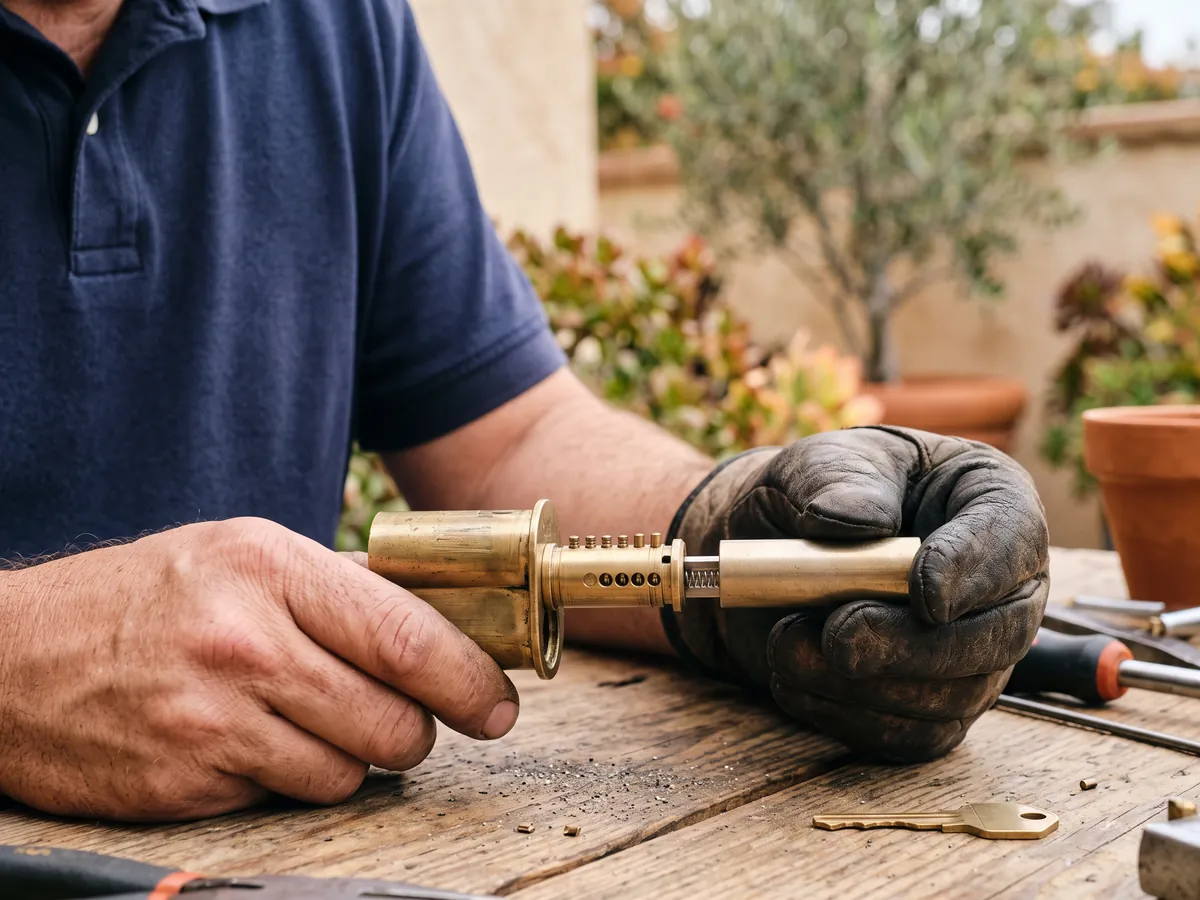
A rekey is one step in securing a business, not the whole job. It retires old keys for the cylinders we re-pin, and that's all. Nobody has changed the alarm code, the keypad PIN, the safe combination or the fob list. Nobody has collected the keys that employees already hold. Before you book a commercial lock rekey in Cerritos, make a short checklist of every way into the building and every secret that opens it. We'll rekey the cylinders, test each door with an old key to show it fails, and point out what we noticed that a rekey can't fix. Call Julian's Locksmith at (951) 903-3193.
What to know first in Cerritos
Think of three tools. Re-pinning keeps the cylinder and changes its pins; it suits sound cylinders on a standard keyway. Recoring applies to interchangeable-core locks, where we swap the whole core for one pinned to the new key, often the fastest option for a many-door system. Replacement fits when the cylinder is worn, damaged or built so cheaply that it won't hold up, when its keyway has been discontinued or when you want to move to a restricted keyway whose keys can't be copied freely. A keyway change can't be done by re-pinning, because the shape of the slot is fixed. The same goes for a lock body that is residential grade on a heavy-use door, cracked or out of code, such as a double-cylinder deadbolt on an exit. We examine each lock, show you the wear we find and give you pricing for both paths side by side. Many businesses end up with a mix, rekeying the sound locks and replacing the two or three that argue for it.
How we can help in Cerritos
- Bringing a mixed set of keyways onto one key. When one business holds Schlage, Yale, Sargent and unmarked cylinders, each on its own key, we can often re-pin them to a single new key if the keyways match. Where they don't, a cylinder swap is cleaner. The result is fewer keys per ring, which also means fewer lost ones.
- Recoring interchangeable-core locks. The control key is the key to the whole system, so we handle it carefully. If yours is lost or in the wrong hands, recoring alone won't help, because anyone holding a control key can pull cores. We explain how to move the control key itself to a new level and how to keep it locked up.
- Doors that also have electronic parts. Keypad locks, card readers and electric strikes usually keep a mechanical override cylinder. A rekey covers that cylinder only; the electronics are separate. We can change keypad codes at the same visit when the lock allows it, and we tell you plainly when a credential list lives in the system's own software.
- Rekeying under a landlord's building standard. Many landlords run a building-standard keyway and hold an emergency key for every suite. Check your lease before we start. If rekeying is allowed, we re-pin to the new key and arrange a copy for the manager if required. If it isn't, we won't touch landlord-controlled cylinders.
- Forgotten openings that stay on the old key. Roll-up doors, yard gates and fenced storage areas depend on padlocks and cylinder locks that rarely get attention. Some can be re-pinned; many cheap padlocks can't. We replace those with rekeyable or higher-grade versions and bring them onto your key system.
How Cerritos shapes the job
Dealerships, body shops and used-car lots near Pioneer Boulevard keep more than building keys: key boxes, service-bay doors, parts cages and vehicle key cabinets. Those cabinets deserve their own key and their own log, apart from the front door. We rekey the building and the cabinets to different levels, so a porter's key never opens the vehicle keys. Lot gates and fuel-island cabinets get their own level too.
Warehouses and distribution yards around Cerritos have more openings than owners count: dock doors, personnel doors, cage gates, yard gates and trailer-side locks. Forklifts and weather beat up cylinders and padlocks, so many are worn before they are rekeyed. We test for wear first, rekey what's sound, replace what isn't and keep a separate key level for the dock crew.
Strip malls and shopping centers in Cerritos often put dozens of tenants on one landlord's key system, with a storefront door, a rear service door and a stockroom per shop. When a store changes hands, the rear door is the one most often forgotten. Check your lease, rekey the rear door and the stockroom, and make sure the landlord's emergency key is the only copy outside your control.
Example situations
- A community nonprofit has a dozen volunteers carrying keys to a fellowship hall, a kitchen and a storage shed, and nobody knows who still holds what. We rekey all three, split the doors into two key levels so kitchen volunteers don't automatically get the office, and recommend restricted blanks so copies can't be made casually.
- A boutique near Cerritos High School wants its locks changed before Monday's opening. Sunday is a working day for us, so we start at 6:30 a.m., rekey the front, rear and stockroom doors, test each with an old key and leave the new keys with the owner by midday. The shop opens on schedule without a closed sign.
- Picture a child care center whose front door has a keypad lock with a mechanical override. The director changes the keypad code herself, but the override key is still the one given to a former assistant. We rekey the override cylinder, check that the door releases freely from inside and show that the old key no longer turns.
- A typical call: an auto repair shop near SR-91 has three bay doors, an office and a parts room, each on a different key left behind by three owners. The current owner wants fewer keys on every ring. We identify the keyways, re-pin the compatible cylinders to one shop key, swap two worn ones and give the office its own key.
How the visit works
- List every opening. Before the visit, list every key-operated opening: exterior doors, interior doors, roll-up doors, padlocks, cabinets, roof hatches and alarm boxes. Count them, even the ones you rarely use. A complete list is the difference between a firm quote and a rough guess, and it keeps a forgotten door from staying on the old key.
- Identify the cylinders on site. While we're there, we test door operation: closer sweep, latch retraction, strike alignment and whether the door locks as intended. A rekey exposes problems that habit had hidden. We report what we find and leave the repair decision to you.
- Decide rekey, recore or replace, door by door. If a lock is a poor candidate for rekeying, we show you why: a loose plug, a missing part, a keyway with no available blanks. Sometimes replacing a cylinder costs about the same as rebuilding it, and we say so honestly, so you aren't paying for labor that isn't worth it.
- Choose the key system and quantities. If you want a master or manager's key, now is the time to say so. We explain how a master adds pin work and why it should stay with one or two people. If that's more than your business needs, we'll suggest a simpler layout that still gives you a clear key for each level.
- Re-pin, cut and test. Cutting happens on site too. Keys are cut by code or from the first rebuilt cylinder, then tried in every lock they should open and in the ones they shouldn't. If a key binds, we recut it. A key that feels rough on day one will feel worse on day ninety.
- Prove the old keys are dead and close out. At each rekeyed door we try an old key to show it no longer turns the plug. We then hand over the new keys, a short key chart and notes on which doors were touched. The work order records who approved the job and when.
Pricing factors
- Cylinders, not doors. The quote follows cylinders, not doors. A storefront door with a deadbolt and a rim device has two. An exit door with an alarmed bar has one under the trim. Roll-up doors, padlocks and cabinets add up. Count every keyed point and give us the number; we refine it on the walk-through.
- Cylinder family and pin count. Age and brand play a role too. A mortise cylinder from a well-known maker is easy to service; an unlabeled imported cylinder may have odd dimensions and no parts support. If we can't confidently rebuild a cylinder, we recommend replacement instead of improvising.
- Re-pinning versus replacement parts. Sometimes the lock body, not the cylinder, needs attention: a bent latch, a worn cam or a loose rose. We quote those fixes separately and only with your approval. Doing them at the same visit saves a second trip, but you never owe us for repairs you didn't agree to.
Every job gets a clear quote before any work starts. Call (951) 903-3193 with the details and we'll tell you what to expect for your situation in Cerritos.
Advice before you book
- Ask whether the new keys will be restricted before you order extras. A standard key can be copied at nearly any hardware store, which can quietly undo the rekey. A restricted key costs more but keeps duplication under your authorization.
- Issue keys by door access, not by person. A manager's key and a staff key shouldn't be the same just because it's convenient. Two or three levels fit most small businesses, and labeling them with codes keeps a lost key from advertising what it opens.
- Collect the old keys from employees and count them. Ask each person to hand theirs in during a short window, then trade for the new key. A signed list of who returned what is worth more than any lock, because it shows whether a key is still out there.
- Gather every old key you can find, even the odd ones. We use them during testing to prove they no longer work, and they help us spot keyways you didn't know you had. Bag them by door if you can, and don't throw any away until after the test.
Common errors that cost time and money
- Assuming a rekey stops copies of the new key. It retires the old keys, but a standard key can be duplicated at nearly any store. Choose restricted keys for doors with many holders and log who has each one, or the problem returns within a year.
- Rekeying the locks but leaving the keypad PIN, alarm code and safe combination as they were. A former employee who remembers a code doesn't need a key at all. List every secret, not just every key, and change each at the same visit.
- Paying to re-pin a cylinder that is already failing. A plug that spins, pins that stick or a bent cam will keep misbehaving. Test first, replace what fails and pin the replacement to the same key as the rest of the system.
Reaching Cerritos
Cerritos is about 65 miles from our San Bernardino base, roughly 66 minutes in light traffic via I-215 South through Colton and Riverside to SR-91 West. When you call, you get an arrival estimate based on where the technician is and the traffic at that moment.
If you're close to Bloomfield Avenue, tell us which exit or cross street you're nearest. It trims the last mile and keeps the van from circling a block that looks right on the map but isn't.
About Cerritos: The Cerritos Towne Center was built on about 125 acres of former dairy farms between the 91 Freeway, Bloomfield Avenue, 183rd Street and Shoemaker Avenue.
| Neighborhoods | Heritage Park area, Cerritos Towne Center, Brookhaven Street and Acoro Street area, Pat Nixon Park and South Street, Cerritos Sports Complex and Bloomfield Avenue south end, Cerritos Auto Square district |
|---|---|
| ZIP codes | 90703 |
| Main routes | SR-91, I-605, I-5, Bloomfield Avenue |
| From our San Bernardino base | about 65 miles via I-215 South through Colton and Riverside to SR-91 West (Artesia Freeway) through Corona, the Santa Ana Canyon and north Orange County into Cerritos, exiting at Valley View Street, Bloomfield Avenue, Pioneer Boulevard, Norwalk Boulevard or Studebaker Road depending on the address; alternate via I-10 West to I-605 South, exiting at South Street for Los Cerritos Center and Cerritos Auto Square |
Business lock or door work in Cerritos?
Call (951) 903-3193 with the address, the doors or hardware involved and when the site is open. We'll quote the job before any work starts and book a time within our hours that suits your schedule.
Frequently asked questions
My landlord controls my locks. Can I still rekey?
It depends on the lease. Some landlords keep a building-standard cylinder and an emergency key and don't permit changes, while others allow tenant rekeys with a copy for the manager. Check the lease or ask your property manager, and send us the answer. We won't touch landlord-controlled cylinders without clear authorization.
How do I decide between rekeying and replacing commercial locks?
Rekey when the lock is sound, commercial grade and compliant. Replace when it's worn, residential grade on a heavy-use door, damaged or out of code, or when you want a restricted keyway, which a rekey can't provide. Julian's Locksmith examines each door, shows you the wear and writes up both options so you can compare them.
How long does a commercial lock rekey take?
It depends on the cylinder count, the lock types and whether any need replacement. A few doors are often a single visit, while a large building takes longer or is phased. Interchangeable cores go faster than conventional cylinders. After the walk-through we give you a realistic time frame instead of a number promised over the phone.
How many keys do I get, and who can copy them?
You decide how many keys we cut. We cut by code on site and test each one. Whether others can copy them depends on the keyway. Standard keys can be duplicated at most hardware stores, while restricted keys require authorization from you. For doors that many people hold keys to, we recommend restricted blanks and a simple log.
Will my old keys really stop working?
Yes, for every cylinder we rekey. After the work we try an old key at each door to show that it no longer turns the plug. Locks we didn't touch stay on their old keys, so the door list matters. Keep one old key per door for a week and test it yourself, then call us if any still turns.
What's the difference between rekeying and recoring?
Rekeying changes the pins inside a cylinder you keep. Recoring applies to interchangeable-core locks: we pull the figure-eight core with a control key and install a core already pinned to the new key. Recoring is often faster across many doors, but it needs a working control key and the right core platform. We tell you which fits your locks.
How far is Cerritos from your base?
Cerritos is about 65 miles from our San Bernardino base, roughly 66 minutes in light traffic. Arrival time depends on traffic and on the job the technician is finishing, so we give you an estimate on the phone before you commit.
Related services in Cerritos
- Lock Rekey in Cerritos
- Commercial Rekey in Cerritos
- Business Lock Rekey in Cerritos
- Commercial Lock Replacement in Cerritos
- Restricted Keyway in Cerritos
- Key Control System in Cerritos
- Master Key Rekey in Cerritos
- Commercial Locksmith in Cerritos
- Tenant Turnover Rekey in Cerritos
- Duplicate-Protected Keys in Cerritos
Commercial Lock Rekey in nearby cities
- Commercial Lock Rekey in ArtesiaLos Angeles County
- Commercial Lock Rekey in La PalmaOrange County
- Commercial Lock Rekey in Hawaiian GardensLos Angeles County
- Commercial Lock Rekey in NorwalkLos Angeles County
- Commercial Lock Rekey in LakewoodLos Angeles County
- Commercial Lock Rekey in BellflowerLos Angeles County
- Commercial Lock Rekey in Buena ParkOrange County
- Commercial Lock Rekey in CypressOrange County