
Brea, Orange County
Commercial Lock Rekey in Brea: Rekey, Recore or Replace?
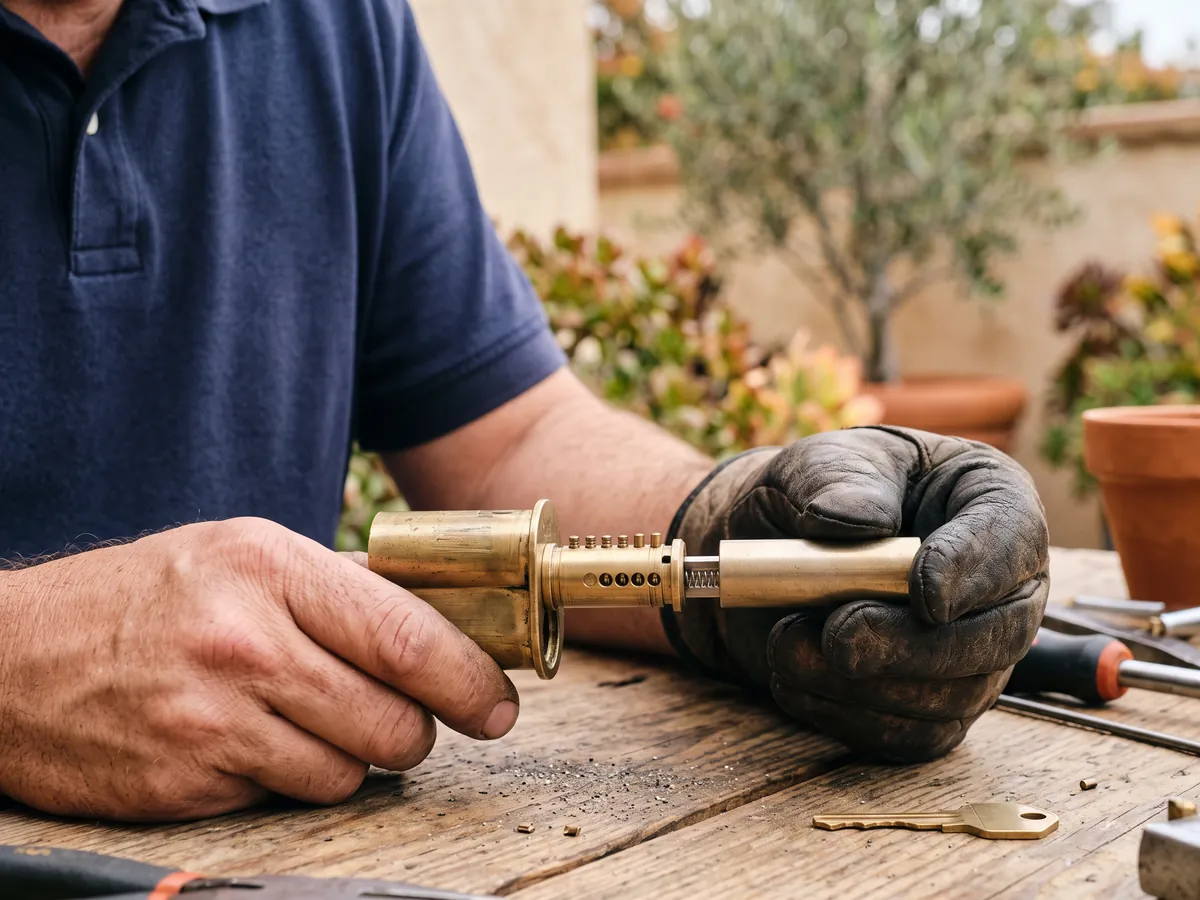
Short answer: A commercial lock rekey changes the internal pins of each cylinder so a new key works and every old key stops working, without replacing the door hardware. Most mortise, rim and key-in-lever cylinders in Brea businesses can be re-pinned on site. Julian's Locksmith checks each lock first, tells you which ones should be replaced instead, and quotes before starting. Call (951) 903-3193.
A commercial rekey puts a stranger in front of your doors with the tools to defeat them, so verify who you're hiring. Ask for the business name and the California locksmith license number, then check it at search.dca.ca.gov. Julian's Locksmith holds license LCO7891. We verify you, too: we ask for proof that you own the business or are authorized to act for it, such as a lease, deed, business license or a letter from the owner, along with photo ID. Our hours are 6:30 a.m. to 11:30 p.m., seven days a week. We're closed overnight. Call (951) 903-3193 from Brea.
How this works in Brea
Here is the honest list. A commercial lock rekey changes which keys operate the cylinders we touch, and it retires every old key for those cylinders. It does not change copies of the new keys, so key control after the job matters as much as the job itself. It does not change the PIN on a keypad lock, the codes on your alarm panel, the credentials on a fob or card system, or the combination on a safe or cash drop, though we can often change a keypad code or safe combination at the same visit. It does not affect a lock we didn't open, such as a roof hatch, a back gate padlock or a cylinder the landlord controls. And it can't fix a door that doesn't latch, a hasp screwed on from the outside or a window that opens without a key. We go through your doors and tell you what the rekey will cover and what it won't, so you can decide what to add before we pack the van.
Work included on a typical visit
- Bringing a mixed set of keyways onto one key. Consolidation has a limit. A cashier, a driver and a manager rarely need the same doors, and one key that opens everything is a master by another name. We help you decide which doors to group by role, so each person carries what the job requires and nothing more.
- Doors that also have electronic parts. Smart and keypad locks offer a chance to retire keys altogether, but a mechanical backup remains on many models, and that cylinder is a hole in the plan if it stays on the old key. We rekey those backup cylinders so the override matches your current key system.
- Rekeying under a landlord's building standard. Where a lease lets you add your own lock or change cylinders, we document the original cylinders and keep them, so the suite can be restored at move-out. Some buildings require written approval before any change, and fire access may call for specific keys. Ask your manager and send us what they say.
- Forgotten openings that stay on the old key. Roll-up doors, yard gates and fenced storage areas depend on padlocks and cylinder locks that rarely get attention. Some can be re-pinned; many cheap padlocks can't. We replace those with rekeyable or higher-grade versions and bring them onto your key system.
- Alike, different and master: planning which doors share a key. Before we pin anything, we sort the doors. Back-of-house doors might share one key, the front door and office another, and a manager's key might open both. Keyed-alike groups are simple; keyed-different doors need more keys. We sketch the plan with you and keep it to one page.
How Brea shapes the job
Converted houses used as offices, salons or small shops in older Brea neighborhoods often mix residential locks with commercial needs. A knob and a deadbolt from the 1960s can be rekeyed, but they may not meet commercial egress rules or hold up to staff use. We rekey what's sound and recommend commercial-grade levers or exit hardware where the occupancy and the code call for it.
Older commercial buildings in Brea often have mortise locks, transom windows and suite doors that predate the current tenants. Mortise cylinders are straightforward to re-pin, and the lock cases can often stay. Check with the landlord about the building standard and any shared stairwell or elevator-lobby doors, since a rekey of your suite should not disturb your neighbors' access. Ask whether the building keeps a lock schedule on file.
Strip malls and shopping centers in Brea often put dozens of tenants on one landlord's key system, with a storefront door, a rear service door and a stockroom per shop. When a store changes hands, the rear door is the one most often forgotten. Check your lease, rekey the rear door and the stockroom, and make sure the landlord's emergency key is the only copy outside your control.
Common situations
- Two partners dissolve their small design studio near Brea Civic & Cultural Center, and one buys out the other with the transfer set for Monday. We schedule the rekey for Sunday morning. With the buyout agreement and photo ID as proof of authority, we re-pin the entry and studio doors, and the departing partner sees the old key fail.
- A facility manager at a charter school calls after losing the control key for the school's interchangeable-core locks. Because that key can pull any core, losing it matters more than losing any single door key. We recore the office wing, set up a new control key, explain how to store it and quote the other wings in phases.
- Picture a child care center whose front door has a keypad lock with a mechanical override. The director changes the keypad code herself, but the override key is still the one given to a former assistant. We rekey the override cylinder, check that the door releases freely from inside and show that the old key no longer turns.
- A community nonprofit has a dozen volunteers carrying keys to a fellowship hall, a kitchen and a storage shed, and nobody knows who still holds what. We rekey all three, split the doors into two key levels so kitchen volunteers don't automatically get the office, and recommend restricted blanks so copies can't be made casually.
From your call to the finished job
- List every opening. Walk the space with a notepad or your phone camera. Note each door's location, whether it has a deadbolt, a lever or an exit device, and what kind of key it takes. Send us the photos. Even a rough list lets us bring the right pinning kits and spare cylinders.
- Identify the cylinders on site. On arrival we look at each cylinder: brand, type, keyway and condition. Many carry the maker's name around the face. We try a key, check the cam or tailpiece and note any wear. That inventory decides which locks can be re-pinned and which need to be replaced.
- Decide rekey, recore or replace, door by door. If a lock is a poor candidate for rekeying, we show you why: a loose plug, a missing part, a keyway with no available blanks. Sometimes replacing a cylinder costs about the same as rebuilding it, and we say so honestly, so you aren't paying for labor that isn't worth it.
- Choose the key system and quantities. Next we decide how many keys, of what kind, for which doors. Standard keys are quickest; restricted keys add control. We sketch which doors share a key and who gets which, and we confirm how many copies you want cut now. Extra copies cost less at this visit than later.
- Re-pin, cut and test. Cutting happens on site too. Keys are cut by code or from the first rebuilt cylinder, then tried in every lock they should open and in the ones they shouldn't. If a key binds, we recut it. A key that feels rough on day one will feel worse on day ninety.
- Prove the old keys are dead and close out. We also give you a close-out list: collect old keys, update alarm and keypad codes, review credential lists and decide who holds spares. Rekeying is the central step, but these small tasks complete it. If you'd like, we'll walk through the list before we leave.
What affects the cost
- Key quantity and key type. Cutting by code from a record is faster than copying from a worn key, and it gives cleaner results. If we're building a small system, we cut keys on site and test them in the rebuilt cylinders, which adds a little time but prevents a drawer full of keys that stick.
- Structure of the key system. A single key for everything is the simplest and cheapest, but it creates one point of failure. Separating staff, management and owner doors costs a little more in pin work and gives you much better control. Most small businesses land on two or three levels.
- Scheduling, access and travel. Our hours run every day from 6:30 a.m. to 11:30 p.m. Work scheduled before opening or after closing, or on short notice, can be priced differently than a planned daytime visit. Travel from our San Bernardino base also counts, and a few days' notice lets us plan the visit so the whole job can be finished in one trip.
Every job gets a clear quote before any work starts. Call (951) 903-3193 with the details and we'll tell you what to expect for your situation in Brea.
Practical tips before you call
- Treat an interchangeable-core control key like a master. Keep it locked up, give it to one or two people and write down who holds it. Anyone with a control key can pull cores, so losing one is a bigger event than losing a door key.
- Photograph your key chart and keep a copy off site. A chart that lives only in the office drawer disappears with the office. Store a copy with your accountant or in a private cloud folder, tag keys with codes and keep the decoder separate.
- Read your lease before the rekey. Some landlords require a copy of every key or a building-standard cylinder, and others forbid changes without written approval. A short email to the property manager before the visit saves a conflict later. Send us what they reply.
- After the rekey, test every door yourself. Use the new key from outside, the thumbturn or lever from inside, and let the door close on its own. A latch that doesn't catch is a security gap the new key can't fix. Call us right away if anything feels off.
Mistakes to avoid
- Letting departing staff say they returned all keys without checking. People forget copies, lend keys to relatives or keep a spare in a car. A rekey ends that uncertainty, but only if you actually test the old keys afterward. Ask for every key back in one sitting and write down each name.
- Buying whatever cylinders are cheapest each time one fails. Over a few years a business ends up with five brands, four keyways and a ring of keys no one can sort. Standardize your next replacements to the current system. Keep a short list of approved models for your openings so a maintenance person can reorder the right part.
- Assuming a rekey stops copies of the new key. It retires the old keys, but a standard key can be duplicated at nearly any store. Choose restricted keys for doors with many holders and log who has each one, or the problem returns within a year.
Getting to Brea
Brea is about 51 miles from our San Bernardino base, roughly 55 minutes in light traffic via I-215 South briefly to SR-210 West. When you call, you get an arrival estimate based on where the technician is and the traffic at that moment.
Our path into Brea depends on where the previous job wrapped up. Sometimes that's a straight run via Berry Street; other times it's surface streets the whole way. Either way, you get a heads-up call when the technician is close.
About Brea: Downtown Brea was rebuilt on about 50 acres around Brea Boulevard and Birch Street in a redevelopment that opened in 2000.
| Neighborhoods | Greenbriar, Olinda Village, Carbon Canyon, La Floresta, Olinda Ranch, Downtown Brea |
|---|---|
| ZIP codes | 92821, 92823 |
| Main routes | SR-57, SR-90, SR-142, Brea Boulevard |
| From our San Bernardino base | about 51 miles via I-215 South briefly to SR-210 West (Foothill Freeway) through Rialto, Fontana, Rancho Cucamonga and La Verne, then SR-57 South (Orange Freeway) through Pomona and Diamond Bar and over the Puente Hills to the Lambert Road or Imperial Highway (SR-90) exits; alternate via I-15 South and SR-60 West to SR-57 South, or SR-60 West to SR-71 South and Carbon Canyon Road (SR-142) through Chino Hills for Olinda Village and Olinda Ranch |
Business lock or door work in Brea?
Call (951) 903-3193 with the address, the doors or hardware involved and when the site is open. We'll quote the job before any work starts and book a time within our hours that suits your schedule.
Frequently asked questions
How long does a commercial lock rekey take?
It depends on the cylinder count, the lock types and whether any need replacement. A few doors are often a single visit, while a large building takes longer or is phased. Interchangeable cores go faster than conventional cylinders. After the walk-through we give you a realistic time frame instead of a number promised over the phone.
How do I decide between rekeying and replacing commercial locks?
Rekey when the lock is sound, commercial grade and compliant. Replace when it's worn, residential grade on a heavy-use door, damaged or out of code, or when you want a restricted keyway, which a rekey can't provide. Julian's Locksmith examines each door, shows you the wear and writes up both options so you can compare them.
Can you rekey while we're open for business?
Usually, yes. We work door by door and never leave an entrance unsecured, so customers can still come and go. Noisy or disruptive steps can be saved for off-peak times, and you can ask for work before opening or after closing within our hours. Tell us which doors must stay in service.
How many keys do I get, and who can copy them?
You decide how many keys we cut. We cut by code on site and test each one. Whether others can copy them depends on the keyway. Standard keys can be duplicated at most hardware stores, while restricted keys require authorization from you. For doors that many people hold keys to, we recommend restricted blanks and a simple log.
What's the difference between rekeying and recoring?
Rekeying changes the pins inside a cylinder you keep. Recoring applies to interchangeable-core locks: we pull the figure-eight core with a control key and install a core already pinned to the new key. Recoring is often faster across many doors, but it needs a working control key and the right core platform. We tell you which fits your locks.
When can you come, and are you available on weekends?
We work every day from 6:30 a.m. to 11:30 p.m., weekends included. We aren't a 24/7 service. Sunday mornings are a good option for retail and office rekeys before the week starts. For an urgent security problem outside our hours, secure the door and call us at the next opening.
How far is Brea from your base?
Brea is about 51 miles from our San Bernardino base, roughly 55 minutes in light traffic. Arrival time depends on traffic and on the job the technician is finishing, so we give you an estimate on the phone before you commit.
Related services in Brea
Commercial Lock Rekey in nearby cities
- Commercial Lock Rekey in La HabraOrange County
- Commercial Lock Rekey in PlacentiaOrange County
- Commercial Lock Rekey in Rowland HeightsLos Angeles County
- Commercial Lock Rekey in FullertonOrange County
- Commercial Lock Rekey in La Habra HeightsLos Angeles County
- Commercial Lock Rekey in Yorba LindaOrange County
- Commercial Lock Rekey in AnaheimOrange County
- Commercial Lock Rekey in City of IndustryLos Angeles County