
Bradbury, Los Angeles County
Replacing the Locks on Your Bradbury Home
Short answer: Good residential lock replacement starts with measurements, not shopping: the backset (usually 2-3/8 or 2-3/4 inch), bore size, door thickness and, for handlesets, hole spacing. Matching those avoids new holes and gaps. Julian's Locksmith serves Bradbury, supplies locks or installs yours, and keys them all alike. Price agreed before work. (951) 903-3193.
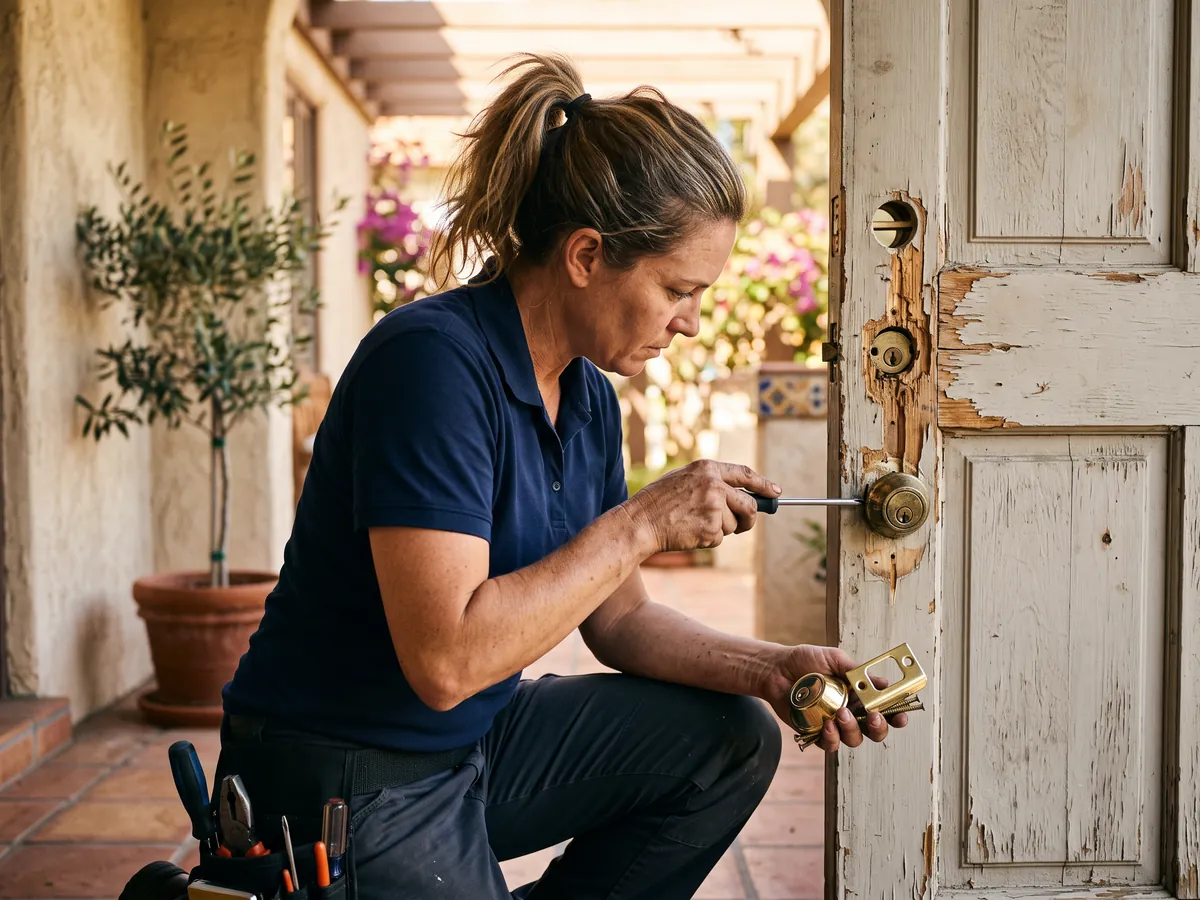
Two deadbolts can look identical on the store shelf and perform very differently on your door. ANSI/BHMA grades rank residential hardware on strength and durability, with Grade 1 at the top and Grade 3 at entry level, and many builder locks sit at the low end. Grade matters, but so does installation: a strong deadbolt held by a strike with short screws can still give way to a kick. When we handle residential lock replacement in Bradbury, we recommend the grade that suits each door, add a reinforced strike with screws into the framing, and explain the tradeoffs in plain language. Call Julian's Locksmith at (951) 903-3193 to talk it through.
Residential Lock Replacement in Bradbury: what to expect
Residential lock replacement doesn't always mean replacing everything on a door. A typical exterior door has three separable parts: the knob or lever set, the deadbolt, and the strikes in the frame. Often only one of them has failed. A deadbolt with a cracked housing can be swapped while the matching knob stays. A worn but otherwise solid deadbolt may only need a new cylinder, including an upgraded or high-security cylinder that fits the existing body. A strike torn from the frame can be replaced with a heavy-duty version without touching the lock at all. Full replacement makes the most sense when several of those parts are worn at once, when the hardware comes from a discontinued line with no parts, when you want a higher security grade throughout, or when consistent style and keying across the house are part of the goal. We'll tell you which approach fits each door, because replacing a whole set to fix one failed component spends money on parts that still had years of life left in them.
What we can do on-site
- Knob and lever entry set replacement. Swapping a knob for a lever, or one brand for another, usually reuses the existing holes when backset and bore match. We confirm the latch length, check the faceplate shape against the old mortise, and replace the strike if the new latch needs a different opening. The finished door should close softly and latch the first time.
- Patio and French door hardware replacement. French doors and fiberglass entry doors often use multipoint locks whose parts are tied to one manufacturer's design. When the whole mechanism fails, we replace it with a compatible unit that matches the existing edge cutout and trim holes. Getting the match right matters, because a mismatched multipoint lock may force the door edge to be recut.
- Interior hardware replacement. Interior doors in older homes sometimes have mortise locks or nonstandard holes. We fit modern passage and privacy sets where the prep allows, and use conversion plates or restored hardware where it doesn't. We'll also point out any interior door that may deserve a keyed lock, such as a home office or an equipment closet.
- Keying the new locks. Replacement is the best time to get every exterior door on one key. We choose hardware that shares a keyway, such as Kwikset KW1 or Schlage SC1, and key each new lock to the same combination before installation. If you prefer to keep your current key, we can usually pin the new cylinders to match it.
- Replacement after forced entry. After a break-in, we start by making the house lockable that day, then complete the full replacement. That may mean a new deadbolt and entry set, a heavy-duty strike, a reinforcement wrap around the door edge and longer hinge screws. We also check every other exterior door, since a second weak point is often nearby.
How Bradbury shapes the job
Rural properties often have several structures under one owner: the house, a guest unit, a barn, a workshop and gates. When replacing locks, decide which buildings share a key and which don't. We replace exterior house locks with weather-resistant hardware, fit deadbolts on outbuildings with solid doors, and key the property in groups, so a ranch hand's key opens the barn but not the house.
HOAs sometimes regulate exterior appearance, including the finish or style of hardware visible from the street. Before replacing a front handleset or entry lock, check your community's architectural guidelines, since some require approval, and we can provide product details for the application. Locks on shared gates and amenity doors belong to the association, so replacing those goes through the HOA or its management company.
For older residents and in 55-plus communities, replacement hardware should be easy to grip, easy to see and easy to operate. Levers instead of knobs, larger thumb-turns, keypads with lighted buttons and smooth-throwing deadbolts all help. We also consider caregiver access, such as a keypad code for a family member or aide, and check with the HOA where community rules govern exterior hardware.
Example situations
- Picture a front door after an attempted break-in: the deadbolt cylinder was wrenched until the housing cracked, though the door held. The owners want stronger hardware. We remove the damaged deadbolt, install a Grade 1 model with a reinforced strike and long screws, add an edge wrap around the lock area, and rekey the other exterior locks so the whole house shares one new key.
- In a 1930s Spanish-style house, for example, the front door's original mortise lock has a cracked case that can't be rebuilt, and no current mortise body matches the pocket. We fit a conversion plate that covers the old pocket, install a bored entry set and deadbolt in an oil-rubbed bronze finish that suits the house, and hand the original parts back to the owners.
- Picture an older homeowner whose arthritis makes round knobs and a stiff deadbolt a daily struggle. We replace the entry knob with a lever, swap the deadbolt for one with a larger thumb-turn, and suggest a keypad deadbolt on the garage entry so a code replaces fumbling with keys. Every keyed cylinder stays on one key, and the doors close with light pressure.
- A typical remodel call: owners repainting their front door want to replace a tarnished polished-brass handleset with a matte black one. The new set they like uses different grip-hole spacing, which would leave a bare hole near the top. We find a matte black set from a brand that matches the old spacing, install it with a matching deadbolt and key both to the existing house key.
From your call to the finished job
- Inventory and goals. Some calls are simple: one broken deadbolt, replace it today. Others are whole-house projects with finish choices and smart locks. Either way, the first conversation sets expectations about which locks we carry, which need ordering, and whether you'd rather buy hardware yourself and have us install it.
- Measure the door prep. At the house, we measure each door before recommending hardware: backset, cross-bore and edge-bore size, door thickness, faceplate shape, the spacing between knob and deadbolt holes, and handleset mounting holes. Those numbers decide which replacement locks fit cleanly and which would need new drilling.
- Choose the hardware. Keyway selection is part of choosing. If every lock will share one key, the hardware needs compatible cylinders. We confirm that before ordering, and if your preferred decorative brand uses a different keyway, we look for a cylinder option that lets it match the rest of the house.
- Quote, approval and verification. Before replacing any lock, we verify ownership or authority: photo ID matching the address, a deed or tax bill, a lease with landlord approval, or a property manager's work order. That protects you from someone else changing your locks. With approval and verification done, we confirm the schedule and parts.
- Remove and install. Doors that need new holes get them drilled with proper jigs so the lock sits square. Old holes the new hardware doesn't cover are filled and can be finished. For smart locks, we also mount the interior unit, install batteries and pair the lock with your app before moving to the next door.
- Key, test and hand over. We key every new cylinder to your chosen key, test each key in each lock, and cycle every lock with the door open and closed. You get the agreed number of keys plus a note listing the brand, keyway and finish, so future copies or additions match. We can take the old hardware away with us.
How we quote the job
- Number of locks and keying. Whole-house replacements involve the most hardware but the lowest cost per door. If the budget is tight, we can replace the exterior locks now, keyed alike, and handle interior hardware later in the same finish, so the house still matches once everything is done.
- Who supplies the hardware. Some hardware isn't sold in stores, such as higher-grade residential deadbolts, high-security cylinders or particular finishes. If you want those, we order them. If you prefer what's available locally, we'll tell you which shelf options are solid and which to skip.
- Reinforcement, travel and timing. Reinforced strikes, long screws and edge wraps add modestly to a replacement and make a large difference in kick resistance. Damaged jambs after a break-in add more. We list reinforcement options as separate line items, so you can see exactly what each one adds before deciding.
Every job gets a clear quote before any work starts. Call (951) 903-3193 with the details and we'll tell you what to expect for your situation in Bradbury.
Practical tips before you call
- In sun-exposed or sprinkler-sprayed spots, choose hardware with a durable PVD-type finish rather than a basic lacquered or painted coating. Those finishes resist fading and tarnish much better. Matte black and oil-rubbed bronze vary widely between brands, so compare samples in daylight before committing.
- Hold on to the old lock's key until the new installation is finished and tested. If you're keying the new locks to your existing key, we need a good copy to work from, ideally the least worn one you have, so dig the original out of the drawer.
- Ask for the old strike to be replaced along with the lock. A new deadbolt sliding into an old, thin strike plate held by short screws gives up much of its strength. A heavy-duty strike with screws reaching the framing makes the frame, not just the lock, part of the defense.
- Pick one keyway for the whole house before buying anything. If the front door is Schlage and the back door Kwikset, they can't share a key without changing one of them. Deciding up front lets every replacement lock run on the same key from day one.
Common errors that cost time and money
- Choosing hardware on looks alone. Some attractive lever and handleset lines use soft die-cast parts and weak springs that sag within a few years. Check the ANSI/BHMA grade on the package and the finish rating before committing, especially for exterior doors that get daily use.
- Over-tightening the through-bolts on new hardware. Cranking the screws distorts the chassis, binds the latch and can crack a die-cast housing before the lock is a week old. Trim screws should be snug, with the knob or lever still returning freely afterward.
- Reusing the old strike plate and short screws with a new deadbolt. The lock may be Grade 1, but if the strike is held by screws that only reach the soft jamb, a kick tears it out. Replace the strike and use screws that bite into the framing.
Reaching Bradbury
Bradbury is about 44 miles from our San Bernardino base, roughly 48 minutes in light traffic via I-215 South to SR-210 West. When you call, you get an arrival estimate based on where the technician is and the traffic at that moment.
Homes and businesses just off Mount Olive Drive are routine stops for us. Give the suite or unit number and any gate instructions, and say whether the van can park out front or should pull into a side lot.
About Bradbury: In September 2020, the Bobcat Fire in the Angeles National Forest led to evacuation warnings for Bradbury and other San Gabriel Valley foothill cities.
| Neighborhoods | Lemon Avenue, Royal Oaks Drive North, Long Canyon Road, Deodar Lane, Bliss Canyon Road, Mount Olive Drive |
|---|---|
| ZIP codes | 91008, 91010 |
| Main routes | I-210, I-605, Huntington Drive, Royal Oaks Drive |
| From our San Bernardino base | about 44 miles via I-215 South to SR-210 West (Foothill Freeway), continuing onto I-210 West through Glendora, Azusa and Irwindale; exit Mount Olive Drive in Duarte and follow it north into Bradbury |
Home lock work in Bradbury?
Call (951) 903-3193 with the address and a quick description of the doors and locks involved. We'll quote the job before any work starts.
Frequently asked questions
Can I replace my locks without drilling new holes?
Usually, yes. Most residential doors use a 2-1/8-inch bore with a 2-3/8- or 2-3/4-inch backset, and current locks are made to fit that pattern. Trouble comes with handlesets, whose mounting holes vary by brand, with older doors that have nonstandard prep, and with mortise locks. We measure before recommending hardware so new locks cover the existing holes whenever possible.
How much does residential lock replacement cost?
The total depends on hardware grade and brand, the number of doors, whether the new locks fit the existing holes, the lock types involved and whether you supply the hardware. Keying alike and strike reinforcement add smaller amounts. We measure, recommend options and give you an itemized quote before any work starts, so you can adjust the plan to your budget.
How long does it take to replace the locks on a house?
A single door with a deadbolt and entry set is a short visit when the new hardware fits the existing holes. A whole house of exterior and interior locks, keyed alike, can take several hours, and doors needing new holes, mortise conversions or frame repair add time. We give you a realistic schedule after measuring, and the house stays lockable the entire time.
When should I replace a home lock instead of repairing it?
Replace it when the housing or bolt is cracked, parts for that brand are no longer made, the lock was damaged in a forced entry, or the hardware is a low grade you want to upgrade. Replacement also makes sense when you want one key or one finish across the house. If the lock is sound and the issue is alignment or wear, repair usually costs less.
What lock rules apply when replacing locks on a California rental?
Civil Code §1941.3 requires landlords to provide operable deadbolts on main swinging entry doors and working window locks, and it defines a deadbolt by a minimum throw of 13/16 inch. Under Civil Code §1941.5 and §1941.6, a landlord must change the locks within 24 hours of a tenant's written request in certain protective-order situations. Rekeying or replacing locks between tenants is also widely recommended.
Can all my new locks work with one key?
Yes, as long as they share a keyway. Schlage and Kwikset, for example, use different keyways, so we choose hardware with compatible cylinders and key every new lock to the same combination during installation. Some decorative brands offer cylinders in common keyways, which lets premium hardware share a key with everything else. One key for the front, back, side and garage entry is the usual goal.
How far is Bradbury from your base?
Bradbury is about 44 miles from our San Bernardino base, roughly 48 minutes in light traffic. Arrival time depends on traffic and on the job the technician is finishing, so we give you an estimate on the phone before you commit.
Related services in Bradbury
- Lock Replacement in Bradbury
- Residential Lock Repair in Bradbury
- Residential Lock Installation in Bradbury
- House Lock Replacement in Bradbury
- Front Door Lock Replacement in Bradbury
- Deadbolt Replacement in Bradbury
- Rekey or Replace Locks in Bradbury
- Same Key for All House Locks in Bradbury
- Security Lock Upgrade in Bradbury
- Smart Lock Replacement in Bradbury
Residential Lock Replacement in nearby cities
- Residential Lock Replacement in DuarteLos Angeles County
- Residential Lock Replacement in MonroviaLos Angeles County
- Residential Lock Replacement in IrwindaleLos Angeles County
- Residential Lock Replacement in ArcadiaLos Angeles County
- Residential Lock Replacement in AzusaLos Angeles County
- Residential Lock Replacement in North El MonteLos Angeles County
- Residential Lock Replacement in Sierra MadreLos Angeles County
- Residential Lock Replacement in Baldwin ParkLos Angeles County