
Bloomington, San Bernardino County
Aluminum Storefront Door Repair for Bloomington Businesses
Short answer: If someone pried or rammed your aluminum storefront door, secure the opening first and document it second. Photograph the damage before anything is moved, ask the police for a report number, then call Julian's Locksmith at (951) 903-3193. After we verify you're authorized, we can often get the door closing and locking again while a glazier deals with broken glass.
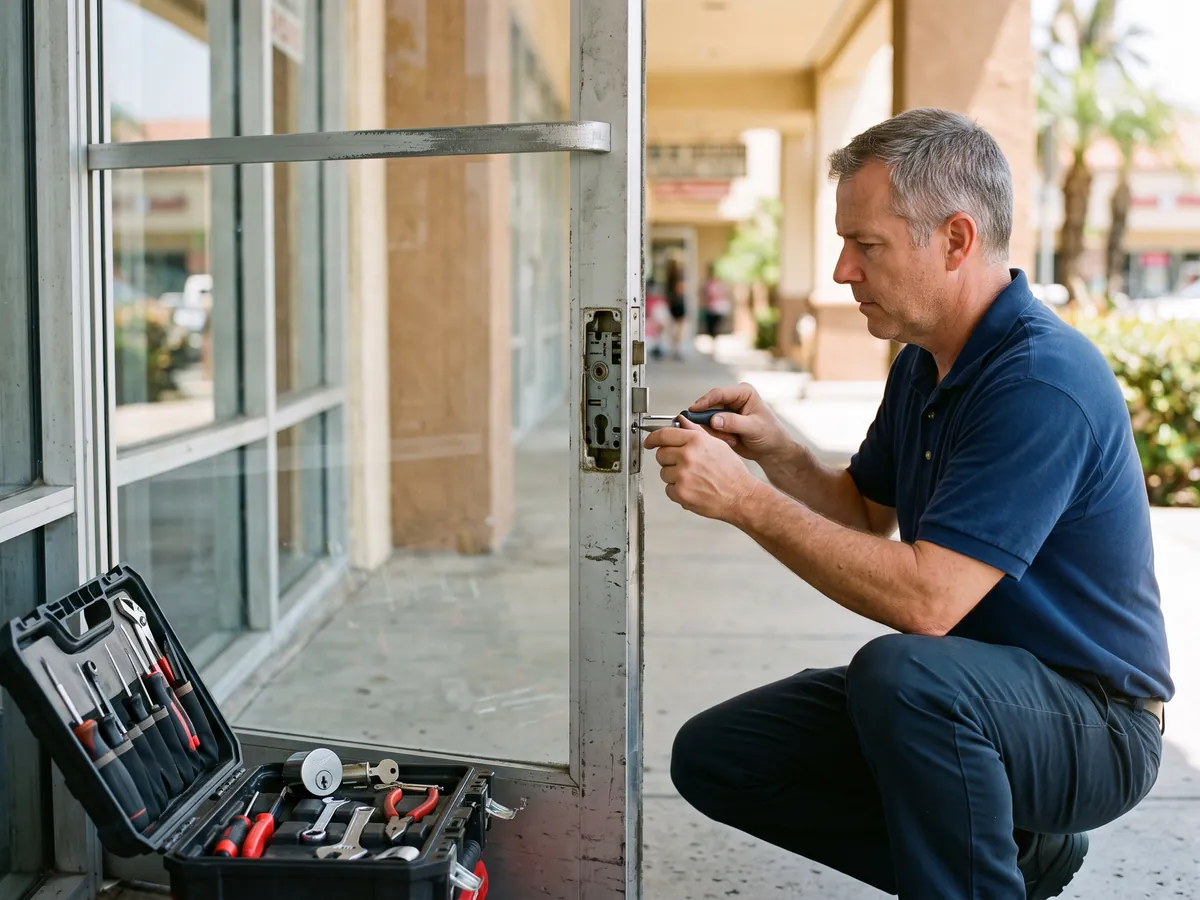
In a leased space, the first question about a damaged storefront door is often not how to fix it but whose job it is. Many leases leave the frame and glass with the landlord while the tenant handles locks, keys and everyday wear, and that line can run straight through a worn pivot. For aluminum storefront door repair in Bloomington, Julian's Locksmith tells you plainly what we found, takes photos you can forward to your property manager, and quotes the hardware work separately from anything that belongs to a glazier or the building owner. That keeps the paperwork moving and the door usable in the meantime.
Aluminum Storefront Door Repair in Bloomington: what to expect
An aluminum storefront door is lighter and simpler than it looks, and knowing its parts makes the repair conversation easier. The leaf is a rectangle of extruded aluminum: two vertical stiles, a top rail and a bottom rail, joined at the corners with screws, tie rods or welds depending on the manufacturer. Between them sits a lite of tempered or insulated glass, held by snap-in stops and a vinyl gasket. The door swings on pivots at the top and bottom, or on butt hinges or a continuous geared hinge, and a closer pulls it shut. The lock lives in the lock stile and the strike waits in the jamb. In aluminum storefront door repair, almost every complaint traces back to one of three places: the pivot points that carry the weight, the corner joints that keep the leaf square, or the closer that controls the swing. Walls on these extrusions are thin, often around an eighth of an inch, so a screw that strips or a pivot that loosens in its pocket can't always be cured by tightening. We check each load-bearing part before touching the lock, because a lock fitted to a door that isn't true will fail again.
How we can help in Bloomington
- Rubbing, scraping and threshold clearance. A bright scrape on the bottom rail means the door is touching the threshold or sweep. We trace the contact point, adjust the pivot height, fit a lower sweep or resecure a loose threshold, and keep the sill at a height that won't catch toes. The door should pass a sheet of paper but not a draft.
- Racked frames and loose corner joints. If you can twist the door by hand or see a hairline gap opening at a corner, the joint is moving. Re-tightening hardware sometimes helps; it will not fix a bent rail. We tell you which you have, because chasing a lock problem on a leaf that has lost its shape just repeats the repair.
- Closer arm, bracket and speed adjustment. Closers also protect the lock. A latch that reaches its strike too fast can bend, and one that arrives too slowly won't engage. After the door hangs true, we set the closer so the bolt clears the strike cleanly, then show your staff which adjustments are safe so nobody turns screws at random.
- Pairs of doors and inactive leaves. Double aluminum entrances multiply the ways a door can drift, because each leaf has its own pivots and the meeting stiles have to line up. We set both leaves to the same reveal, make sure the active leaf's lock reaches its strike, and test that the inactive leaf stays put when it should.
- After a break-in or impact: securing the opening. Insurance adjusters reviewing aluminum storefront door repair want clear photos, a list of what was damaged and an idea of what it will take to fix. We document what we see, keep any parts that came off, and give you a plain list of the hardware work. We don't guess at glass or frame costs, since those belong to whoever replaces them.
Local factors in Bloomington
Coffee shops, bakeries and service counters that open before the commute need doors that work at sunrise. Our day starts at 6:30 a.m. every day, which suits an owner who wants a drag or latch problem fixed before the morning line forms. If you open earlier than that, call the evening before and we'll plan the work around your closing time rather than your opening rush.
Office entrances at warehouses and light industrial parks take a different beating: pallet jacks, hand trucks, dust from the yard and vibration from trucks. Aluminum doors there often get bumped by carts and caked with grit that chews the bottom pivot and sweep. We repair the door, check the hardware and suggest protective details, such as a kick plate or bumper, that keep the next cart from folding a stile.
Neighborhood centers in Bloomington hold dance studios, pediatric offices and tutoring rooms, so doors are opened by small hands and pulled by large strollers. A closer set too fast can pinch fingers, and one set too slow leaves the door ajar. We tune the closing speed for steady operation, check the hinge-side gap and fix rubbing sweeps. Mention if you need the work finished before the after-school rush.
Common situations
- A dental office in a medical plaza near Mary B. Lewis Elementary School has an insulated-glass door heavy enough that older patients struggle with it. Someone turned the closer all the way up to stop the door hanging open. We would free the pivots first, because a dragging door is half the effort, then set the closer to a gentler speed and test how much force it takes to open.
- A cell phone repair shop opens up to find bright scrapes beside the lock and a door that closes but can't be locked with the key. Someone leaned on it with a pry bar. We would verify the owner, test the hardware under pressure, replace the bent bolt hardware and cylinder, and suggest getting a police report number for the insurer. If the stile is cracked, we would say so right then.
- A boutique in a 1960s downtown block has bronze anodized doors from a manufacturer that stopped making that series long ago. The pivots are worn and no catalog part matches. We would measure the pocket, bring the closest available pivot set, adapt the mounting plate where the metal allows, and explain that an exact match may mean a custom order, or replacing the door in the existing frame.
- A tutoring center on a west-facing wall near Alder Avenue has a door that works until about three o'clock. In the afternoon sun the black anodized aluminum heats and swells, and a worn pivot lets the leaf lean into the strike. Rather than just easing the strike, we would replace the pivot so the door sits true, then leave enough clearance to cope with a hot day.
How the visit works
- Tell us what the door is doing. A good description saves a trip. Does the door drag in one spot? Is it hard to open, hard to close, or both? Does the lock still work? A photo of the door and its bottom corner helps, and we can often tell which parts to bring before we leave.
- Confirm who can authorize the work. Ownership checks apply here, too. If the person on site is an employee, we may call the owner or manager before beginning. In shopping centers we also ask whether the landlord requires specific hardware or finishes, since matching neighboring doors can be a condition of the lease.
- Inspect the whole door, not just the lock. Inspection means looking at the door the way it carries weight. We watch the pivots as it swings, check the corners for hairline gaps, press on the glass, look under the closer cover and find the shiny wear marks that show where metal touches metal.
- Quote the options before we start. You get plain options with the reasons behind them. A pivot set may be the whole answer. Or the leaf is bent, and new hardware on it would be wasted on a door that cannot hold it. Nothing starts until you approve a price.
- Repair, re-hang and adjust. The sequence matters. The door gets square first, the closer is tuned second, and the lock and strike come last, because a lock set to a crooked door only fails again. Where we replace parts, we match finish and size to what is already on the door.
- Test, document and hand off. We run the door through repeated openings and closings, check the latch with the door pulled shut from outside, and make sure the key works from both sides. You get a plain summary of what we changed, what we saw and what to keep an eye on.
Pricing factors
- Condition of the frame and floor. The floor matters more than most owners expect. Cracked concrete around the bottom pivot, a rusted floor box or a settled threshold can undo a new pivot in months. When the repair needs something outside our trade, we say so and still make the door usable.
- Timing and working conditions. Where you are and how easy the door is to reach affect the visit. A door at the end of a long arcade, a loading zone with heavy traffic, or a site that requires parking permits can add time. Mention anything unusual when you call so the quote reflects it.
- Repair versus a new door leaf. A new leaf in the existing frame, with hardware transferred, is the right call when the extrusion is damaged. It has a lead time because doors are made to order, so we often stabilize the old door in the interim. We help you decide, and ordering the door itself goes through a storefront supplier.
Every job gets a clear quote before any work starts. Call (951) 903-3193 with the details and we'll tell you what to expect for your situation in Bloomington.
Mistakes to avoid
- Driving longer or fatter screws into a hollow extrusion. The walls are often only about an eighth of an inch thick, so bigger fasteners strip the hole, can poke into the glass pocket and sometimes crack the profile. A stripped hinge or bracket needs backing or a different fastener, not brute force.
- Lifting a sagging door with a pry bar or jack against the glass or the bottom rail. Glass takes point loads badly, tempered edges chip, and a rail can crimp under a tool. Door work should lift at the stile or pivot with proper support, which is why we bring blocks and protective pads.
- Planing, filing or grinding the bottom of the door to stop the scraping. Aluminum filings are sharp, the anodized finish is destroyed where you cut, and the underlying sag is still there. You end up with a door that is shorter, uglier and still not latching. Find out why it hangs low instead.
What to do before we arrive
- Keep notes on when the door misbehaves. If it only drags after the afternoon sun hits it, heat expansion is part of the story. If it sticks every morning, think of grit or a worn bearing. Written down, those observations let a technician narrow the cause before arriving, which often saves a second visit.
- After locking up, give the handle a firm pull from outside. A door that moves an eighth of an inch is not fully engaged, and a sagging door often fools you by looking shut. If you can't get the bolt to catch cleanly, don't just walk away; call us, since an unsecured door invites trouble.
- Look for a manufacturer name or series number on the closer body, the pivot, the glass stop or the door edge, and photograph it. Replacement parts depend on the door series, and a clear picture saves guessing. Also photograph the finish in daylight; clear, bronze and black anodized can look alike indoors.
- Check closer arm and bracket screws every few months with the correct driver, and tighten gently. Thin aluminum strips easily, so a screw that turns freely without biting needs a different fix, not more force. If a screw head spins, stop and tell us instead of reaching for a longer one.
Getting to Bloomington
Bloomington is about 14 miles from our San Bernardino base, roughly 22 minutes in light traffic via Belmont Avenue and Palm Avenue to I-215 South, SR-210 West to the Riverside Avenue exit. When you call, you get an arrival estimate based on where the technician is and the traffic at that moment.
Homes and businesses just off Santa Ana Avenue are routine stops for us. Give the suite or unit number and any gate instructions, and say whether the van can park out front or should pull into a side lot.
About Bloomington: Bloomington High School on Laurel Avenue opened in 1962, and the community's public schools belong to the Colton Joint Unified School District.
| Neighborhoods | Crestmore, North Bloomington, Locust Avenue and Alder Avenue horse properties, South Bloomington, Slover Avenue industrial strip, Kessler Park area |
|---|---|
| ZIP codes | 92316, 92335 |
| Main routes | I-10, Cedar Avenue, Valley Boulevard, Slover Avenue |
| From our San Bernardino base | about 14 miles via Belmont Avenue and Palm Avenue to I-215 South, SR-210 West to the Riverside Avenue exit, then south on Riverside Avenue and west on Bloomington Avenue; the alternate is I-215 South to I-10 West and the Cedar Avenue exit, about 17 miles |
Lock or door hardware trouble in Bloomington?
Call (951) 903-3193 with the address and what the door or lock is doing. We'll quote the repair before any work starts.
Frequently asked questions
Do I have to be present during aluminum storefront door repair?
We need someone with authority at the start to confirm ownership or tenancy, approve the quote and show us the door. After that, a manager or employee can stay with us while we work. We test the door with you at the end so you see it operate. In multi-tenant buildings we may also contact the property manager before we begin.
My door closes but won't latch. Is it the lock or the door?
Often it's the door. If the latch meets the strike a bit high, low or too far back, it cannot catch even though the lock is fine. Watch whether the bolt lines up with the strike opening as the door closes. If it misses, the hang needs correcting. If it lines up and still won't catch, the lock or the strike needs attention, and we cover both.
Can you repair a storefront door that was pried open during a break-in?
Often, yes. We test the latch, bolt and strike under pressure, replace bent hardware and cylinders, and check whether the frame has spread. If a stile is cracked or the frame has been pulled loose, we tell you honestly that those need replacement by a door or storefront contractor. Take photos first and ask the police for a report number; your insurer will want both.
Who pays for aluminum storefront door repair, my landlord or me?
It depends on your lease. Commonly the landlord owns the frame, glass and structural parts of the storefront, while the tenant is responsible for locks, keys and routine wear such as closers and sweeps. A worn pivot can fall in either camp. We separate hardware from frame in our report and send photos, so you have clear facts when you talk with your property manager.
How can I tell if a pivot is worn?
Hold the door partway open and lift gently on the lock-side edge. If it moves up and down, or you hear grinding or squeaking as it swings, the bearing or bushing is worn. A bright scrape on the bottom corner is another sign. You may also notice the door no longer returns to center on its own. We confirm by watching it under load.
When is a new door better than repair?
Replace the leaf when a stile is bent, a corner joint has opened and won't hold, the extrusion is cracked near a pivot or lock, or repeated repairs keep failing in new places. If the aluminum is straight and tight, repair is sensible. We can estimate both sides and help you decide. The door is ordered through a storefront supplier, and we handle the hardware transfer and adjustments.
How far is Bloomington from your base?
Bloomington is about 14 miles from our San Bernardino base, roughly 22 minutes in light traffic. Arrival time depends on traffic and on the job the technician is finishing, so we give you an estimate on the phone before you commit.
Related services in Bloomington
- Storefront Lock Repair in Bloomington
- Narrow Stile Lock Repair in Bloomington
- Storefront Door Repair in Bloomington
- Storefront Door Lock Replacement in Bloomington
- Glass Door Lock Repair in Bloomington
- Door Closer Repair in Bloomington
- Storefront Door Closer Repair in Bloomington
- Commercial Door Repair in Bloomington
- Commercial Door Won't Latch in Bloomington
- Storefront Lockout in Bloomington
Aluminum Storefront Door Repair in nearby cities
- Aluminum Storefront Door Repair in RialtoSan Bernardino County
- Aluminum Storefront Door Repair in FontanaSan Bernardino County
- Aluminum Storefront Door Repair in ColtonSan Bernardino County
- Aluminum Storefront Door Repair in RubidouxRiverside County
- Aluminum Storefront Door Repair in Grand TerraceSan Bernardino County
- Aluminum Storefront Door Repair in North FontanaSan Bernardino County
- Aluminum Storefront Door Repair in Jurupa ValleyRiverside County
- Aluminum Storefront Door Repair in San BernardinoSan Bernardino County
