
Arcadia, Los Angeles County
Car key replacement in Arcadia, CA, by make and model
Short answer: Julian's Locksmith cuts and programs car keys on site in Arcadia for 40 makes and hundreds of models from 2000 to 2026: transponder keys, remote head and flip keys, and push-to-start smart keys. Choose your make below for model-by-year key details, or call (951) 903-3193 with your VIN.
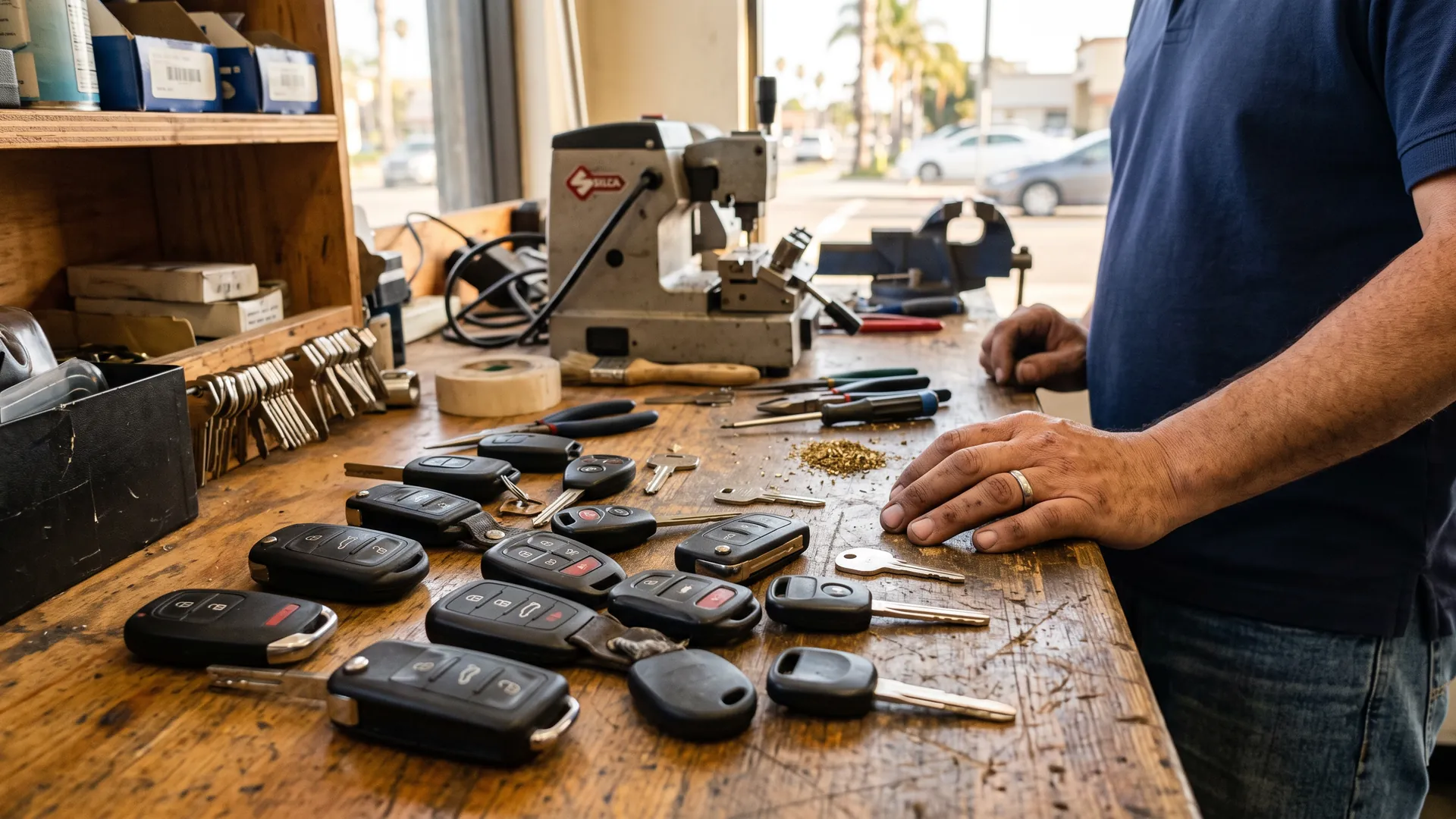
Choose your make
- Acura keys14 models
- Alfa Romeo keys5 models
- Audi keys37 models
- BMW keys31 models
- Buick keys17 models
- Cadillac keys26 models
- Chevrolet keys42 models
- Chrysler keys15 models
- Dodge keys24 models
- Fiat keys6 models
- Ford keys37 models
- Genesis keys9 models
- GMC keys21 models
- Honda keys17 models
- Hummer keys5 models
- Hyundai keys27 models
- Infiniti keys31 models
- Jaguar keys10 models
- Jeep keys14 models
- Kia keys26 models
- Land Rover keys11 models
- Lexus keys19 models
- Lincoln keys15 models
- Mazda keys24 models
- Mercedes-Benz keys28 models
- Mercury keys11 models
- MINI keys9 models
- Mitsubishi keys16 models
- Nissan keys28 models
- Pontiac keys16 models
- Porsche keys11 models
- Ram keys11 models
- Saturn keys9 models
- Scion keys8 models
- Subaru keys14 models
- Suzuki keys12 models
- Tesla keys6 models
- Toyota keys35 models
- Volkswagen keys28 models
- Volvo keys23 models
The key types we replace
- Basic mechanical key. Before treating a vehicle key as purely mechanical, we confirm it. Some keys look like plain metal with a rubber or plastic head yet hide a transponder inside, and immobilizers arrived on different trims and model years at different times. If yours truly has no chip, the new key is cut and then tested in the doors, ignition, glove box and trunk where those locks exist. Mechanical blades also show up on newer vehicles as valet keys and as the emergency insert tucked inside a smart fob. Those blades still matter: they're how you get in when a fob battery dies, so they deserve the same careful cutting.
- Transponder (chip) key. There are two ways to give a new transponder key the right identity. Cloning reads the chip in a working key and writes that same ID onto a special cloneable chip, so the car can't tell the two apart. Programming adds a brand-new key ID to the immobilizer's memory through the OBD-II port, sometimes after entering a security PIN tied to the VIN. Cloning is handy when you have a working key and the chip family supports it. Programming is the better choice when keys are lost, because it also lets us remove keys you no longer control from the car's memory. For your vehicle, we'll explain which method fits and why.
- Remote head key. Remote-head keys take a beating. The rubber button pad wears through, the plastic housing splits at the seam, and the blade can snap right at the head after years of being used as a pry tool or hanging from a heavy key ring. When the electronics inside are still healthy, we can often move the circuit board and chip into a new shell and cut a fresh blade to your code, which keeps the existing programming intact. If the board is cracked or water-damaged, a new key is the honest answer. Either way, for your vehicle, we open the old key and show you what's broken before recommending anything.
- Key with separate remote fob. Pairing a separate remote to a vehicle is a different job from programming the ignition key. Some vehicles accept new remotes through an on-board sequence of key turns and button presses; others need a scan tool connected to the OBD-II port. On many of them, entering remote programming mode clears every remote the car already knows, so any remote you want to keep has to be present and re-paired during the same session. Before we start, gather every remote that belongs to the vehicle. Leaving one in a kitchen drawer is a classic way to end up with a remote that quits the day after a new one is added.
- Flip (switchblade) key. The hinge is the weak point on most flip keys. The pivot pin loosens, the spring loses tension, the release button sticks, and eventually the blade either won't lock open or flops out on its own. Carrying the key half-open in a pocket speeds that wear along. If the electronics are healthy, a replacement shell with a new hinge and pin often brings a vehicle flip key back to crisp action: we transfer the board and chip, move or recut the blade, and test every function. If the board has broken solder joints or water corrosion, we'll show you the damage and quote a new key instead.
- Smart proximity key (push-to-start). Proximity keys bring a security trade-off worth understanding. Because the fob is always listening, thieves with relay equipment can stretch its signal from inside your house to the car in the driveway. Keeping the fob away from exterior walls, or in a signal-blocking pouch, closes that gap, and some fobs offer a sleep mode described in the owner's manual. If a smart key for your vehicle is lost or stolen, programming a replacement is the moment to delete the missing fob from the car's memory. And be wary of used fobs from online sellers: a lot of them are locked to the vehicle they came from and can't be reprogrammed to yours.
- Key card. Adding a key card to a vehicle is usually done inside the vehicle's own menus, and the car typically asks for an already-authorized key, card or phone to approve the new one. That's a deliberate security choice by the manufacturer, and it shapes what any locksmith can do. If you still have a working key, we can walk you through pairing a new card and help if you end up locked out. If every authorized key is gone, the manufacturer's service center generally has to restore access, and we'll tell you so plainly rather than charge for a visit that can't solve the problem. That honesty saves you a wasted afternoon.
- Phone as key. A phone key turns your smartphone into the vehicle's key through the manufacturer's app or a digital wallet. On a vehicle that supports it, the car may use Bluetooth Low Energy to sense the phone as you walk up, NFC for a deliberate tap at the door or console, and, on newer systems, ultra-wideband radio to pinpoint exactly where the phone is. Setting one up runs through the owner's account and usually requires a key the car already trusts. That account link is what makes phone keys convenient, and it's also why no locksmith can create one from the diagnostic port the way we program a fob.
How the job works
- Identify the exact key your vehicle uses. Every job starts with the VIN, the trim and a look at any key you still have. From those we confirm the keyway, the transponder or smart-key chip, the remote frequency, the FCC ID and the button layout. Two vehicle keys that look identical can carry different electronics, so this step keeps the wrong part from ever reaching the car.
- Verify ownership before any work. Before cutting or programming, we compare your government photo ID with the vehicle registration or title and check that the VIN on the paperwork matches the VIN on the dash. If the registration is locked inside, we open the car first, confirm the documents, and only then make the key.
- Get the key code or decode the lock. A key is cut from a code, not a guess. When the factory code can be retrieved through manufacturer channels after ownership is verified, we use it. When it can't, we decode a door lock with a pick-decoder tool that reads the wafer positions without damaging anything, then work out any missing cuts.
- Cut the blade on-site. Cutting happens right beside your car. For a smart key, that means the emergency blade hidden inside the fob; for a transponder or remote-head key, it's the main blade you'll use every day. We deburr the cuts and check the fit in each lock so nothing binds or sticks later on.
- Program the chip, remote or smart key. With the blade done, we connect to the OBD-II port and register the new key with the immobilizer. Depending on the system, this may involve a security PIN, a timed waiting period, or on-board button sequences for the remote. On some vehicles we clone a working key's chip instead, when that's the more reliable path.
- Test everything and clear out old keys. Before we leave, every function gets checked: doors, trunk or liftgate, panic button, remote range, engine start, and the emergency blade in the driver's door. If keys are missing, we delete them from the car's memory where the system allows, so a lost key can no longer start the engine.
Dealer or mobile locksmith?
Price and parts are the other half of the comparison. Dealers typically sell factory keys only and charge their posted service rates for programming. We offer factory keys where it matters and quality aftermarket alternatives where they perform well, and the quote covers cutting, programming and the trip, with nothing tacked on at the end. Timing differs too. Dealer service departments generally keep business hours, while we take automotive calls every day from 6:30 a.m. to 11:30 p.m., which covers early commutes and late evenings. We're closed overnight, and we'll be upfront if your timing means the dealer or a next-day visit is the better plan. Neither option is wrong; the right one depends on your vehicle and your schedule.
Proof of ownership
Not every situation fits the simple case, so here's how we handle the common exceptions. For a leased or financed vehicle, a registration that lists you as the registered owner or lessee works with your ID. If you just bought the car, bring the signed title or bill of sale along with your ID. For a company or fleet vehicle, we need written authorization from the business plus the driver's ID. If the car belongs to a family member, the registered owner should be present or provide signed permission and a copy of their ID. Rental vehicles go through the rental company.
Frequently asked questions
Do you come to Arcadia to make car keys, or do I bring the car to you?
We come to you. Julian's Locksmith is a mobile-only service, so the van drives to wherever the car is parked in Arcadia: your driveway, an apartment lot, a workplace or a shopping center. That matters most when every key is lost, because it saves you a tow. Just make sure we'll have room to work beside the driver's door and that the vehicle is accessible when we arrive.
When can you come out to Arcadia for a car key?
We work every day from 6:30 a.m. to 11:30 p.m., weekends included. Weekends are included. Call (951) 903-3193 and we'll give you an honest ETA to Arcadia based on where we are at the time. If you're stuck outside our hours, it's usually smarter to leave the car parked and locked, get home safely, and call when we open than to pay for an overnight tow.